

On this page
In the complex number system, a general number is written as z = a + ib. The real part is a, and the imaginary part is b. When a problem asks you to force a complex number to lie entirely on the real axis or entirely on the imaginary axis, you are being asked to set one of these two parts to zero.
According to the NCERT Class 11 Mathematics curriculum, a complex number z = a + ib is purely real if b = 0, and purely imaginary if a = 0. But in competitive exams like JEE Main, you are rarely handed the number in a neat a + ib form. Instead, you get a messy fraction like (1 + i cos θ) / (1 − 2i cos θ), and you need the fastest way to extract the condition.
What does it mean for a complex number to be purely real?
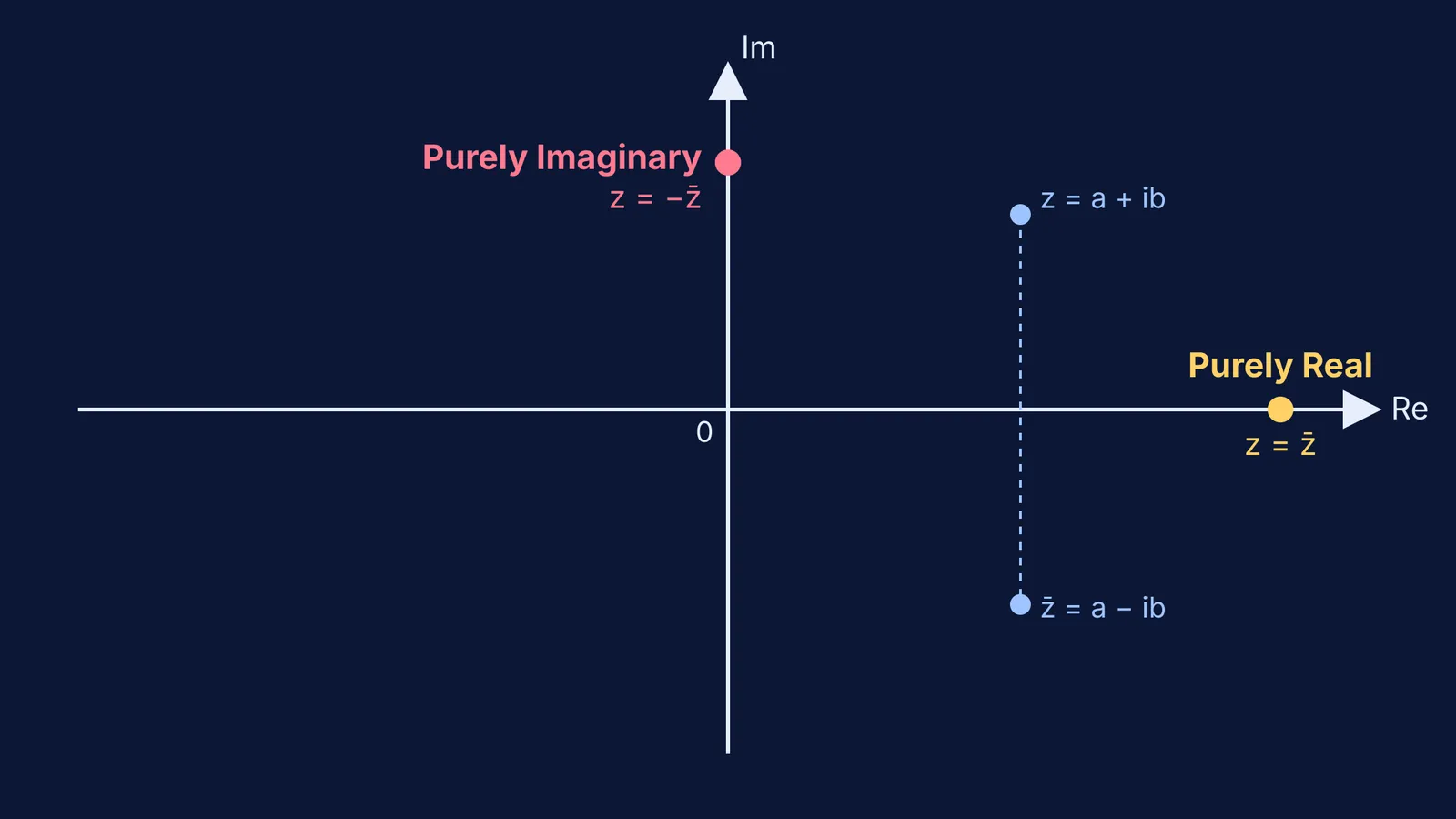
For a complex number z = a + ib, it is purely real when its imaginary part vanishes.
The condition: Im(z) = 0 (which means b = 0).
The conjugate test: z = z̄.
On a graph: The point lies entirely on the horizontal axis (the real axis) of the Argand plane.
When simplifying a fraction like z = (x + iy) / (c + id), the standard method is to multiply the numerator and denominator by the conjugate of the denominator, c − id. Once you separate the result into real and imaginary parts, you set the imaginary part equal to zero to find your condition. (See Solving equations in complex numbers by putting z = x + iy for more on algebraic separation).
What is the condition for a complex number to be purely imaginary?
A complex number is purely imaginary when it has no real component.
The condition: Re(z) = 0 (which means a = 0).
The conjugate test: z = −z̄ (or z + z̄ = 0).
On a graph: The point lies entirely on the vertical axis (the imaginary axis).
If a question asks for the condition that z is purely imaginary, you can either rationalise the expression and set the real part to zero, or plug the whole expression directly into z + z̄ = 0. Using the conjugate test is often faster because you can apply properties like Using z z̄ = |z|² to simplify complex number problems without expanding every single term.
Is 0 a purely real or purely imaginary number?
The number 0 can be written as 0 + 0i. Because its imaginary part is 0, it is purely real. Because its real part is 0, it is purely imaginary. Therefore, 0 is the only complex number that is both purely real and purely imaginary.
How do you find unknown parameters in exam problems?
Exam questions rarely ask you to define these terms. Instead, they ask you to find an angle θ or a parameter x that forces an expression to be purely real or purely imaginary.
Here is a step-by-step framework to attack these problems:
Rationalise the denominator: If z is a fraction, multiply the top and bottom by the complex conjugate of the denominator.
Group the terms: Gather all terms without an i into one bracket (the real part), and all terms with an i into another bracket (the imaginary part).
Apply the condition:
If the question says "purely real", set the bracket with the i to zero.
If the question says "purely imaginary", set the bracket without the i to zero.
Solve for the parameter: Solve the resulting equation using standard trigonometry or algebra. (For finding the correct quadrant for your answer, see Finding arg z in each quadrant: the principal value rules).
A worked example
Problem: Find the real values of θ for which z = (1 + i cos θ) / (1 − 2i cos θ) is a purely real number.
Step 1: Multiply by the conjugate of the denominator, 1 + 2i cos θ. z = (1 + i cos θ)(1 + 2i cos θ) / [ (1 − 2i cos θ)(1 + 2i cos θ) ]
Step 2: Expand and group the real and imaginary parts. Multiply out the denominator first: (1 − 2i cos θ)(1 + 2i cos θ) is a difference of two squares, which becomes 1² − (2i cos θ)². Since i² = −1, this is 1 + 4 cos² θ. Notice how this denominator is now completely real.
Now, multiply out the numerator: 1(1) + 1(2i cos θ) + (i cos θ)(1) + (i cos θ)(2i cos θ). This gives 1 + 2i cos θ + i cos θ + 2i² cos² θ. Again using i² = −1, the numerator simplifies to (1 − 2 cos² θ) + i(3 cos θ).
Finally, divide both the real and imaginary parts of the numerator by the real denominator to get the standard a + ib form: z = (1 − 2 cos² θ) / (1 + 4 cos² θ) + i (3 cos θ) / (1 + 4 cos² θ).
Step 3: The number is purely real, so we set the imaginary part to zero. (3 cos θ) / (1 + 4 cos² θ) = 0
Step 4: The denominator is strictly positive, so the numerator must be zero. 3 cos θ = 0 means cos θ = 0. The general solution is θ = (2n + 1)(π / 2), where n is any integer.
If you are stuck on how to apply these rules to messy algebra, the Fermi Concept Library holds a lesson for every idea in the mathematics syllabus, each with its own place in the map. And when you are grinding through practice papers, the Fermi Problem Library provides worked problems with a step-by-step solver that explains the reasoning rather than just printing an answer.


