

On this page
A question gives you a quadratic and asks for α⁵ + β⁵. Solving for the roots means surds or complex numbers raised to the fifth power: slow and error-prone. You don't need the roots. The quadratic already contains a rule that builds each power sum from the two before it. Write S(n) = αⁿ + βⁿ; the goal is S(5).
Where does S(n) = (α+β)S(n−1) − αβS(n−2) come from?
Start with the two facts every Class 10 student meets. If α and β are the zeroes of ax² + bx + c, then α + β = −b/a and αβ = c/a, as derived in NCERT's Class 10 Mathematics chapter on polynomials. Divide through by a and the equation reads x² − (α + β)x + αβ = 0.
Now use the fact that α is a root: α² = (α + β)α − αβ. Multiply both sides by αⁿ⁻² to get αⁿ = (α + β)αⁿ⁻¹ − αβ·αⁿ⁻². The same line works for β. Add the two and you get:
S(n) = (α + β)·S(n−1) − αβ·S(n−2)
In words: sum of roots times the last value, minus product of roots times the one before. For two roots this is the simplest case of Newton's identities, which reduce to pₖ = e₁pₖ₋₁ − e₂pₖ₋₂ when there are only two variables; the Wikipedia article on Newton's identities says Isaac Newton found them around 1666, apparently unaware of earlier work (1629) by Albert Girard. Number theorists call the same sequence a Lucas sequence Vₙ, defined by Vₙ = P·Vₙ₋₁ − Q·Vₙ₋₂ with V₀ = 2 and V₁ = P, where x² − Px + Q = 0 (Wikipedia: Lucas sequence).
New to recurrences? Read how to find the nth term of a first-order recurrence.
How do you find α⁵ + β⁵ step by step?
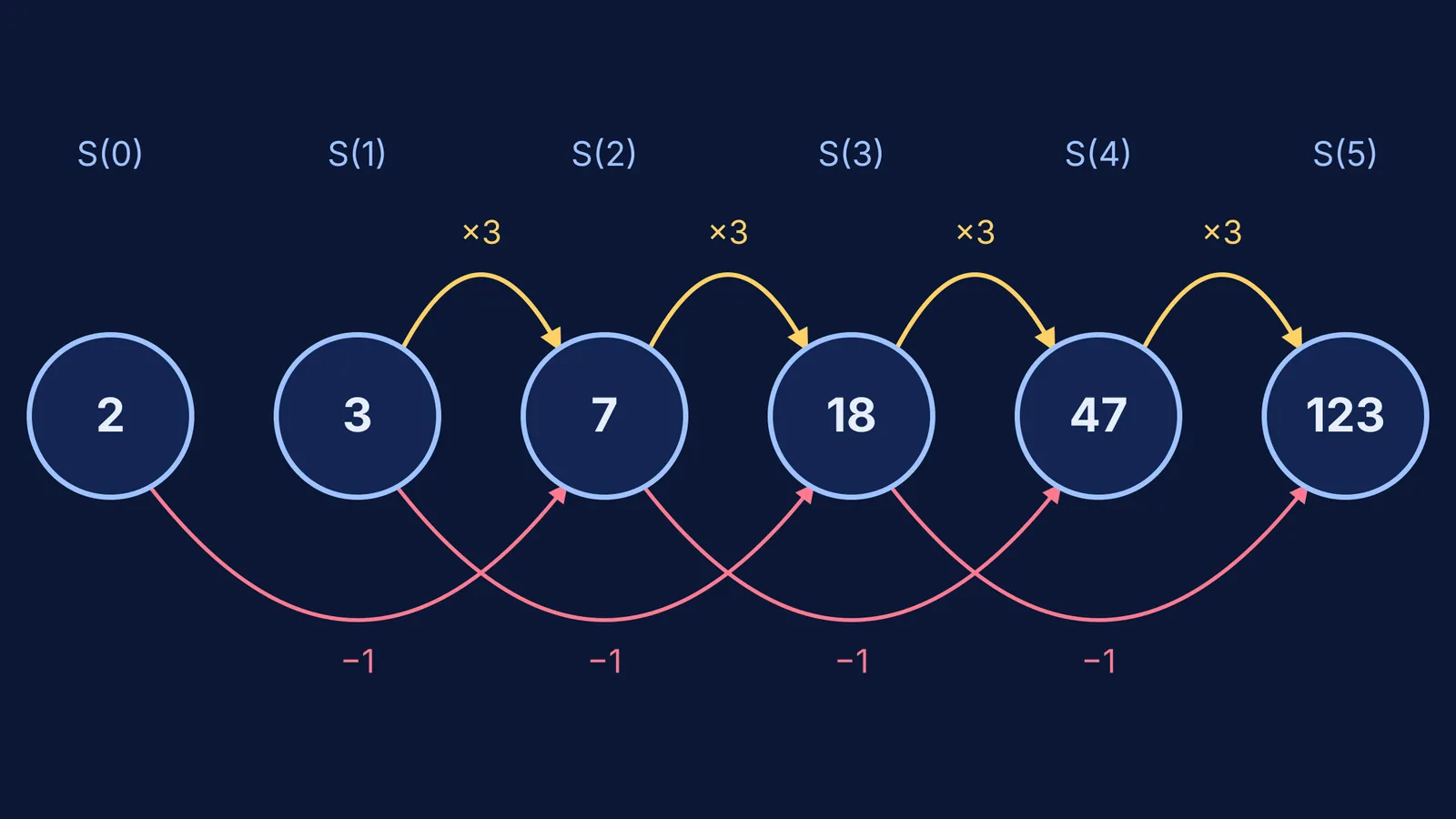
Take x² − 3x + 1 = 0. Here α + β = 3 and αβ = 1, so the rule is S(n) = 3S(n−1) − S(n−2).
S(0) = α⁰ + β⁰ = 1 + 1 = 2.
S(1) = α + β = 3.
S(2) = 3(3) − 1(2) = 7.
S(3) = 3(7) − 1(3) = 18.
S(4) = 3(18) − 1(7) = 47.
S(5) = 3(47) − 1(18) = 123.
So α⁵ + β⁵ = 123, and you never touched the roots (3 ± √5)/2. Each line is one multiplication and one subtraction, far quicker than expanding (α + β)⁵ and peeling off cross terms.
The method also works when the roots are complex. For x² + x + 1 = 0 the roots are ω and ω², with α + β = −1 and αβ = 1. The rule S(n) = −S(n−1) − S(n−2) gives 2, −1, −1, 2, −1, −1, ..., a cycle of length three. That matches what you know about powers of the cube roots of unity.
What if the leading coefficient is not 1?
Either divide by a first, or keep integers with the equivalent form a·S(n) + b·S(n−1) + c·S(n−2) = 0, which comes from multiplying aα² + bα + c = 0 by αⁿ⁻² and adding the β version.
Example: 2x² − 4x + 1 = 0. Then S(0) = 2 and S(1) = 2. From 2S(n) = 4S(n−1) − S(n−2): S(2) = (8 − 2)/2 = 3, S(3) = (12 − 2)/2 = 5, S(4) = (20 − 3)/2 = 8.5, S(5) = (34 − 5)/2 = 14.5. Fractions are expected here, because αβ = 1/2.
For the reverse task, see forming a quadratic from the sum and product of its zeroes.
Which mistakes cost marks on α⁵ + β⁵ questions?
Run through this checklist before writing the final answer:
Sign of the sum: for x² − 3x + 1, α + β is +3, not −3. Read it as −b/a.
The rule subtracts αβ·S(n−2). If αβ = −2, the term becomes +2·S(n−2).
S(0) = 2, every time.
Leading coefficient: divide by a, or use the integer form. Don't mix the two.
Write n and S(n) in a column so the two previous values stay in view.
How can you check your answer?
First, S(2) from the ladder should equal (α + β)² − 2αβ; here 9 − 2 = 7. Second, if a = 1 and the other coefficients are integers, every S(n) is an integer. A fraction means an arithmetic slip.
To practise, try S(6) for x² − 3x + 1 = 0 (it should come out to 322), then repeat with x² − 2x − 1 = 0, where αβ is negative. If a ladder goes wrong and you can't see where, the Fermi Problem Library has worked problems with a step-by-step solver that explains the reasoning rather than printing an answer. If the gap is further back, in sum and product of roots, the Fermi Concept Library gives each concept in mathematics its own lesson.


