

On this page
In complex-number problems, a handful of properties of roots of unity do most of the work. Learn where each comes from and you won't need a list of tricks.
What are the nth roots of unity?
An nth root of unity is a complex number z with zⁿ = 1, and there are exactly n of them: cos(2πk/n) + i sin(2πk/n) for k = 0, 1, …, n − 1 (Wikipedia: Root of unity).
Write ω = cos(2π/n) + i sin(2π/n). The roots are then 1, ω, ω², …, ωⁿ⁻¹. Each has modulus 1, and each is the previous one turned by 2π/n. For a refresher, see why multiplying complex numbers multiplies lengths and adds angles.
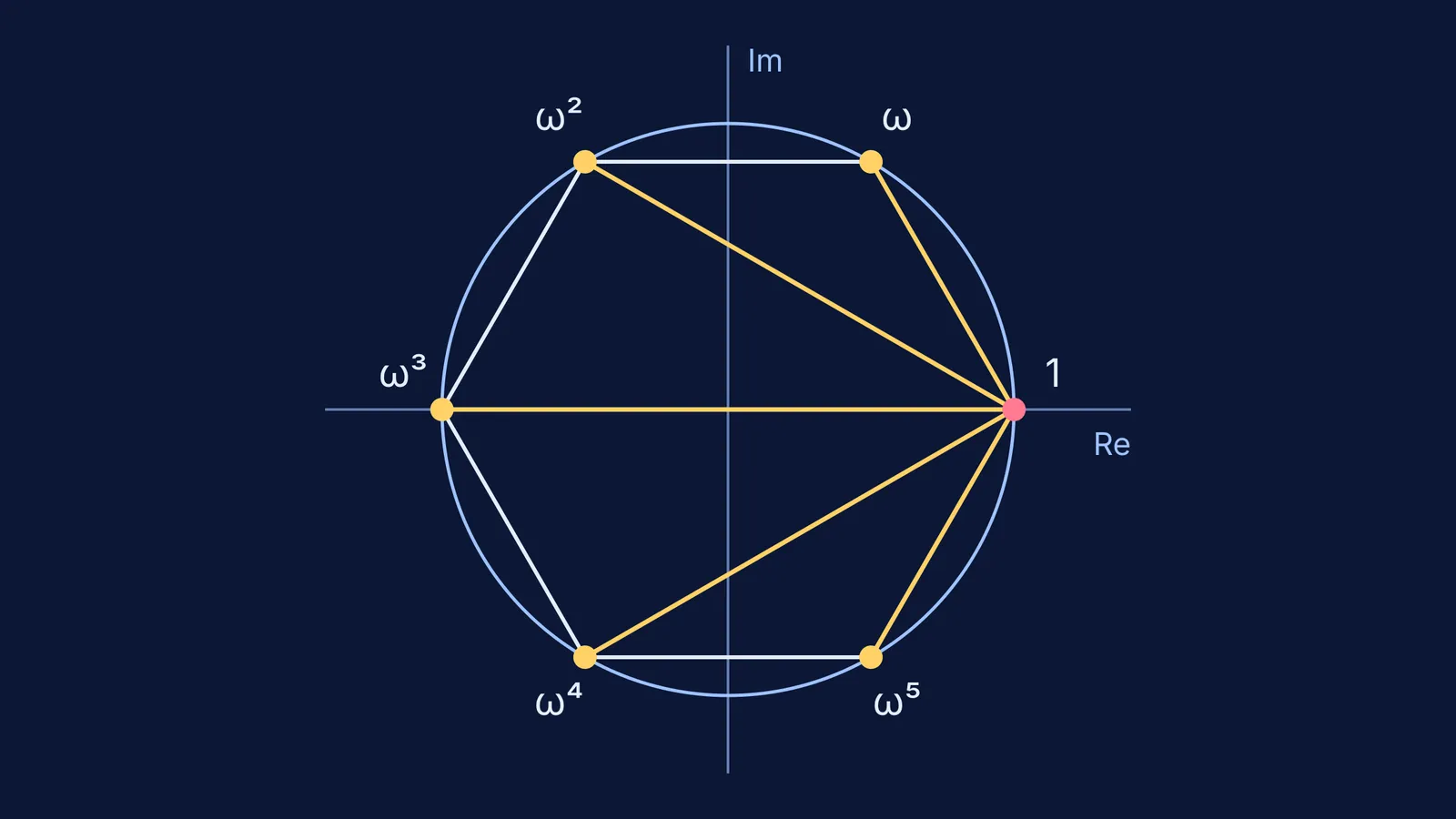
For n ≥ 3, the roots form a regular polygon with n sides, with every vertex on the unit circle (Wolfram MathWorld).
Why is the sum of the nth roots of unity zero?
The roots are the zeros of zⁿ − 1, so by Vieta's formulas their sum is minus the coefficient of zⁿ⁻¹, which is 0 whenever n > 1 (Wikipedia: Root of unity).
Or as a geometric series: 1 + ω + … + ωⁿ⁻¹ = (ωⁿ − 1)/(ω − 1) = 0, because ωⁿ = 1 and ω ≠ 1.
The product comes from the same polynomial: its constant term is −1, so the product of the roots is (−1)ⁿ × (−1) = (−1)ⁿ⁺¹. Check: for n = 2, 1 × (−1) = −1; for n = 3, 1 × ω × ω² = ω³ = 1.
How do you factorise using roots of unity?
The zeros of zⁿ − 1 are exactly the n roots of unity, each with multiplicity 1 (Wikipedia: Root of unity), so zⁿ − 1 = (z − 1)(z − ω)(z − ω²)…(z − ωⁿ⁻¹). Divide both sides by z − 1:
1 + z + z² + … + zⁿ⁻¹ = (z − ω)(z − ω²)…(z − ωⁿ⁻¹).
For cube roots, this gives z² + z + 1 = (z − ω)(z − ω²), and a³ + b³ = (a + b)(a + ωb)(a + ω²b). It's the same move as factorising a² + b² using complex numbers.
Worked example. Show that x³ᵐ + x³ᵖ⁺¹ + x³ʳ⁺² is divisible by x² + x + 1 for any whole numbers m, p and r.
The zeros of x² + x + 1 are ω and ω². Put x = ω: the terms become 1, ω and ω², which add to 0. The same works for x = ω². Both zeros of the divisor are zeros of the expression, so x² + x + 1 divides it by the factor theorem.
How do you evaluate sums of powers of roots of unity?
The rule: 1 + ωᵏ + ω²ᵏ + … + ω⁽ⁿ⁻¹⁾ᵏ equals n if n divides k, and 0 otherwise. If n divides k, every term is 1; if not, ωᵏ ≠ 1 and the geometric series gives 0. Wikipedia's orthogonality relation is a general form of this rule.
Three examples with cube roots:
1 + ω²⁰²⁶ + ω⁴⁰⁵²: 2026 leaves remainder 1 when divided by 3, so the sum is 0.
(1 − ω + ω²)(1 + ω − ω²): use 1 + ω + ω² = 0 to rewrite the brackets as −2ω and −2ω², so the product is 4ω³ = 4.
⁶C₀ + ⁶C₃ + ⁶C₆: add (1 + 1)⁶, (1 + ω)⁶ and (1 + ω²)⁶. By the rule, only terms with powers divisible by 3 survive, each counted three times. Since 1 + ω = −ω² and 1 + ω² = −ω, the answer is (64 + 1 + 1)/3 = 22. Check directly: 1 + 20 + 1 = 22.
How are roots of unity linked to regular polygons?
Put z = 1 into the divided factorisation above. The left side becomes n. The right side, in modulus, is the product of the distances from the vertex 1 to the other n − 1 vertices. So in a regular n-gon inscribed in a circle of radius 1, the distances from one vertex to all the others multiply to n.
Test it on the hexagon in the diagram. From the vertex at 1, the distances are 1, √3, 2, √3 and 1, and their product is 6. Each distance is |1 − ωᵏ| = 2 sin(πk/n). This gives an identity: the product of sin(πk/n) for k = 1 to n − 1 equals n/2ⁿ⁻¹.
A checklist for roots-of-unity problems
Reduce every exponent modulo n.
Look for a hidden 1 + ω + … + ωⁿ⁻¹ = 0.
For divisibility questions, substitute the zeros of the divisor.
For polygon lengths or products of sines, put z = 1 into the divided factorisation.
Stuck at step 2 or 3? The Fermi Problem Library has worked problems with a step-by-step solver that explains the reasoning rather than printing an answer. If polar form itself is the weak spot, the Fermi Concept Library gives each concept in mathematics its own lesson and shows where it sits in the map.


