

On this page
Start by looking at the familiar difference of two squares. You already know that an expression like a² − b² factors cleanly into the product of two binomials, giving (a + b)(a − b). This is one of the most widely used algebraic tools in mathematics. But what about the sum of two squares, a² + b²?
Why does a² + b² not factor over the reals?
Over the real numbers, the sum of two squares is irreducible. There is absolutely no way to write it as the product of two real linear factors like (a + something)(a + something else).
You can see why by trying to solve the simple equation x² + 9 = 0. If you try to isolate the variable, you get x² = −9. In the set of real numbers, any number multiplied by itself is either zero or positive. A positive number added to another positive number can never equal zero. Because the equation has no real solutions, the expression x² + 9 cannot be broken down into real linear factors. It represents a parabola that sits entirely above the x-axis, never crossing it.
How to factorise a squared plus b squared using complex numbers?
To break this expression down into linear factors, you must introduce the imaginary unit i, which is formally defined by the property i² = −1.
By rewriting the addition as a subtraction, you can cleverly force the expression into the familiar difference-of-squares pattern. The sum of squares a² + b² can be factored over the complex numbers as (a + ib)(a − ib) (Khan Academy).
Here is the step-by-step derivation of how this works:
Start with the original sum: a² + b²
Rewrite the plus sign as a double negative, which changes nothing mathematically: a² − (−b²)
Replace the negative sign with the imaginary unit squared, i²: a² − (i²b²)
Group the second term into a single square: a² − (ib)²
Apply the standard difference of squares rule: (a + ib)(a − ib)
You can easily verify this by expanding the brackets backwards. When you multiply (a + ib)(a − ib), you get a² − iab + iab − i²b². The middle terms cancel out perfectly, and substituting i² = −1 leaves you with a² − (−1)b², which simplifies right back to the original a² + b².
What is the geometric meaning in the complex plane?
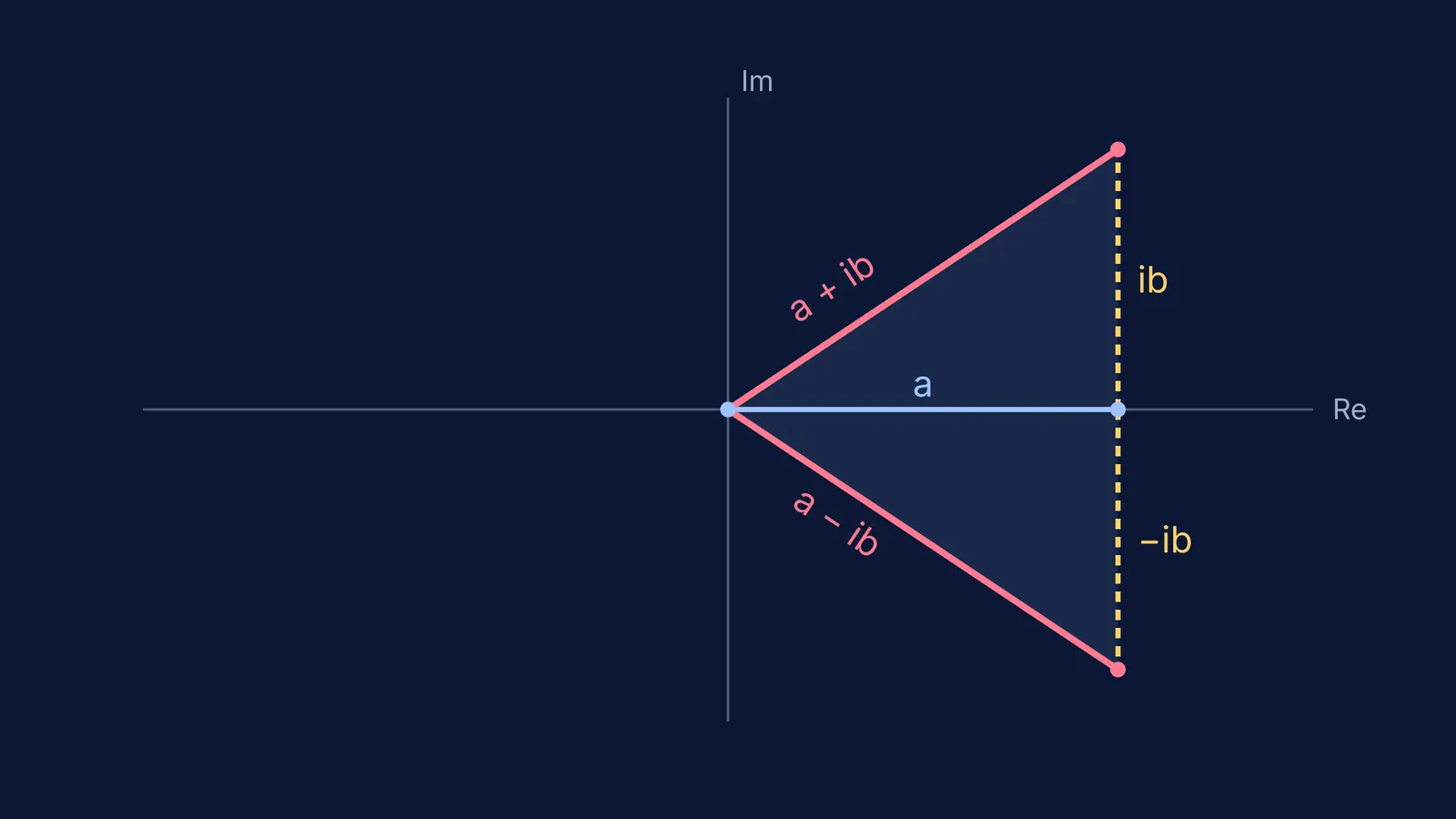
This is not just a neat algebraic trick; it has profound geometric meaning. In the complex plane (often called the Argand plane), a complex number z = a + ib represents a point with horizontal coordinate a and vertical coordinate b.
Multiplying this number by its complex conjugate z̄ = a − ib gives the square of its distance from the origin. By Pythagoras' theorem, this distance squared is exactly |z|² = a² + b².
Using z z̄ = |z|² to simplify complex number problems is a standard technique for finding lengths, dividing complex expressions, and clearing imaginary numbers out of denominators. When you rationalise a denominator by multiplying by the conjugate, you are directly applying the a² + b² factorisation in reverse.
How do you factorise x⁴ + 4y⁴ without complex numbers?
While a² + b² strictly forces you into the world of complex numbers, higher even powers sometimes hide a surprising real factorisation. A common trap in competitive mathematics and entrance exams is an expression like x⁴ + 4y⁴.
Although it looks exactly like an irreducible sum of squares that would require complex numbers, you can actually factorise it purely over the real numbers. Sophie Germain's identity states that x⁴ + 4y⁴ = (x² + 2xy + 2y²)(x² − 2xy + 2y²) (Wikipedia).
Instead of using the imaginary unit i, you use a clever "complete the square" trick by adding and subtracting the same term:
Start with the sum: x⁴ + 4y⁴
Add a middle term to create a perfect square trinomial: x⁴ + 4x²y² + 4y⁴
Because you added it, subtract it immediately to keep the overall value the same: (x² + 2y²)² − 4x²y²
Now you have constructed a true difference of two squares, which expands to: (x² + 2y² + 2xy)(x² + 2y² − 2xy)
This identity is famous for turning apparently prime numbers into composite numbers, and it serves as a reminder that not every sum of even powers demands complex roots.
Where do these algebraic patterns appear in exams?
In rigorous exams like JEE Main and Advanced, you often need to rewrite polynomial expressions quickly to cancel terms, rationalise denominators, or find the roots of a high-degree equation. Solving equations in complex numbers by putting z = x + iy frequently relies on spotting a sum of squares hidden in a larger fraction and converting it to (x + iy)(x − iy) so one bracket can cleanly divide out of the numerator.
If you struggle to spot these mathematical patterns during tests, the Fermi Concept Library covers every concept in physics, chemistry, biology, mathematics and computing, each with its own lesson and its place in the map. For more direct practice, the Fermi Problem Library has worked problems with a step-by-step solver that explains the reasoning rather than printing an answer.


