

On this page
Most students learn complex multiplication as algebra: expand, replace i² with −1, collect terms. On the Argand plane, every multiplication is a stretch plus a turn, and once you see that, questions about squares, rotations and ω become geometry you can predict.
What does multiplying complex numbers do on the Argand diagram?
The Argand plane is the plane in which each point (x, y) stands for the complex number x + iy, with the x-axis as the real axis and the y-axis as the imaginary axis, as NCERT's Class 11 chapter on complex numbers defines it. The same chapter describes the modulus |z| = √(x² + y²) as the distance of the point from the origin, and states that |z₁z₂| = |z₁||z₂|.
That is the length half. For the angle half, write z in polar form, r(cos θ + i sin θ), where r is the length and θ the angle anticlockwise from the positive real axis. OpenStax Precalculus 2e gives the product as z₁z₂ = r₁r₂[cos(θ₁ + θ₂) + i sin(θ₁ + θ₂)] and notes that it "calls for multiplying the moduli and adding the angles."
So multiplying by w scales every point's distance from the origin by |w| and turns it anticlockwise by the angle of w.
A worked example: predict first, then expand
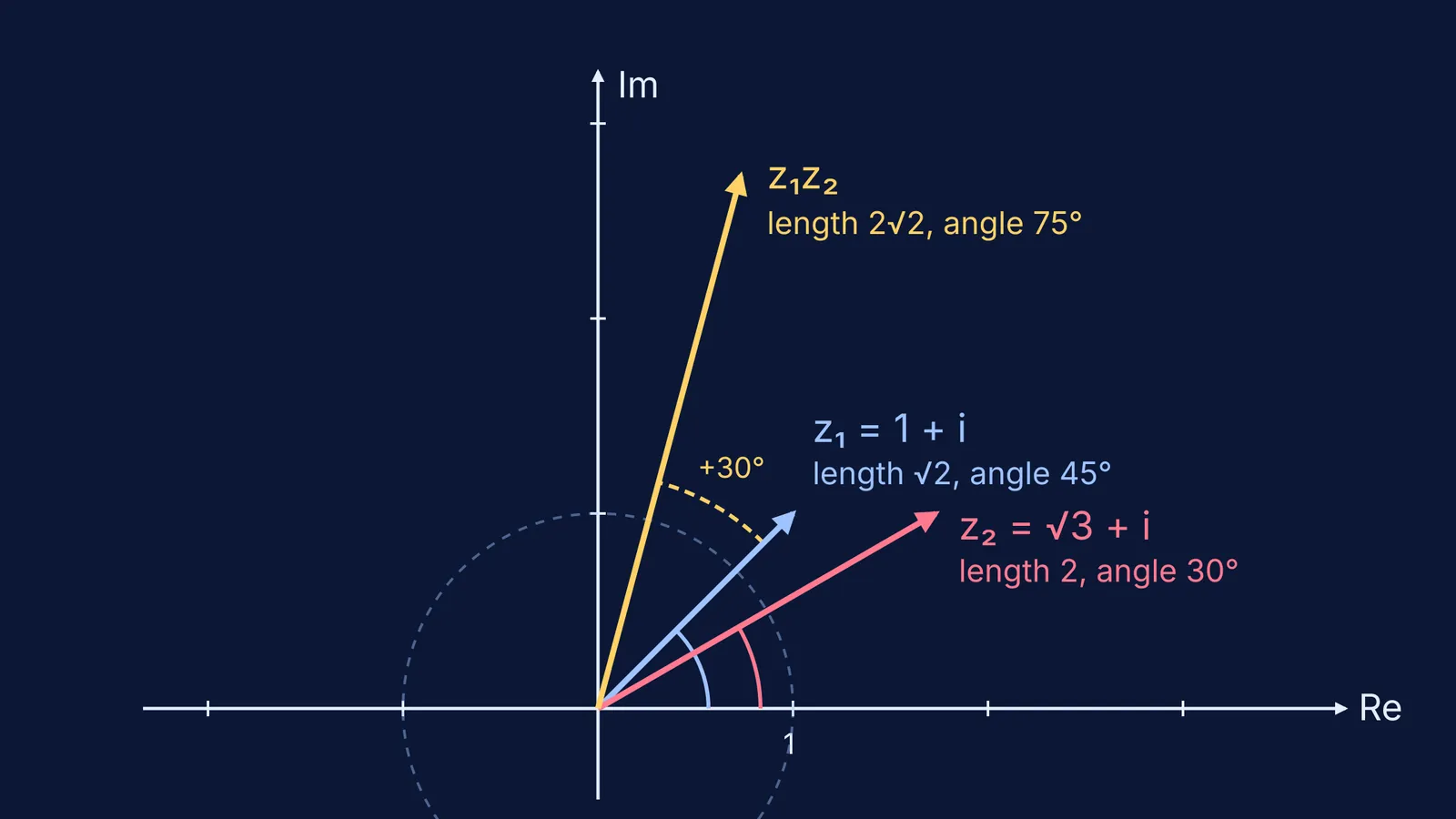
Take z₁ = 1 + i and z₂ = √3 + i.
Length of z₁: √(1 + 1) = √2. Angle: 45°, because (1, 1) sits on the diagonal.
Length of z₂: √(3 + 1) = 2. Angle: 30°, because tan θ = 1/√3.
Prediction for the product: length √2 × 2 = 2√2, angle 45° + 30° = 75°.
Now expand: (1 + i)(√3 + i) = √3 + i + i√3 + i² = (√3 − 1) + i(√3 + 1).
Check the length: (√3 − 1)² + (√3 + 1)² = (4 − 2√3) + (4 + 2√3) = 8, so the length is √8 = 2√2. Check the angle: tan θ = (√3 + 1)/(√3 − 1) = 2 + √3, which is tan 75°. Both predictions hold.
Why does multiplying by i rotate a point by 90 degrees?
The number i sits at (0, 1): length 1, angle 90°. By the rule above, multiplying by i keeps every length and adds 90° to every angle. The algebra agrees: i(a + ib) = ia + i²b = −b + ia, so the point (a, b) moves to (−b, a).
So 3 + 2i becomes −2 + 3i: perpendicular arrows (dot product −6 + 6 = 0), both of length √13.
Repeat and you walk round a square: i² = −1 is a half-turn, i³ = −i three quarter-turns, i⁴ = 1 home again, which is the cycle of powers of i in NCERT's chapter.
Use it in square questions. If two corners of a square are 0 and P = 3 + 2i, the corner next to 0 on the other side is iP = −2 + 3i, and the fourth is P + iP = 1 + 5i. No slopes, no distance formula.
Where do the cube roots of unity sit on the Argand plane?
The cube roots of unity solve z³ = 1. Skip the cubic and use lengths and angles. If z³ = 1, then |z|³ = 1, so |z| = 1. Three times the angle must be a whole number of turns (0°, 360° or 720°), so the angle is 0°, 120° or 240°.
The nth root theorem in OpenStax Precalculus 2e says the same in general: the nth roots have angles θ/n + 2kπ/n for k = 0, 1, ..., n − 1, so the roots are equally spaced around a circle. For n = 3:
1, at angle 0°
ω = −1/2 + (√3/2)i, at angle 120°
ω² = −1/2 − (√3/2)i, at angle 240°
They form an equilateral triangle on the unit circle. Multiplying by ω turns a point by 120°, so three turns make ω³ = 1. Three equal arrows 120° apart cancel, which is the picture behind 1 + ω + ω² = 0. And ω² is the mirror image of ω in the real axis, its conjugate.
How to practise on an interactive Argand plane
A static diagram shows one product; dragging points tests the rule on many. Use any interactive complex plane or the Fermi Simulation Lab, which has interactive simulations for ideas that are easier to see than to read. Say each prediction out loud before you look:
Put z₂ on the unit circle and drag z₁. The product is z₁ turned by z₂'s angle, same length.
Set z₂ = i and multiply four times. You trace a square.
Set z₂ = ω and multiply three times. You trace an equilateral triangle.
Set z₂ to the conjugate of z₁. The angles cancel, so the product lands on the positive real axis at |z₁|².
Next, see how the plane turns into a geometry tool in complex numbers for JEE using the Argand plane, how repeated turns give Abraham de Moivre's shortcut for powers of complex numbers, and how halving the angle gives the square root of a complex number.


