

On this page
When a problem gives you the sum and product of the zeros of a quadratic polynomial, you do not need to work backwards through long algebra to find the equation. You can build it directly using a single formula.
What is the formula for a quadratic from its sum and product?
If the sum of the zeros is S and the product of the zeros is P, the quadratic polynomial is given by:
p(x) = k(x² − Sx + P)
Here, k is any non-zero real number. This rule comes from Vieta's formulas, which show that for a general quadratic ax² + bx + c = 0, the sum of the roots is −b/a and the product is c/a (Wikipedia). If you divide the entire polynomial by a, you get x² + (b/a)x + (c/a). Substituting our sum and product terms into this expression yields x² − Sx + P. Because setting this to zero gives the same roots, multiplying the whole expression by any non-zero k still preserves those roots.
How to find a quadratic polynomial with given sum and product of zeros?
To write down your polynomial, follow these three steps:
Identify the sum (S) and the product (P). Be careful: read the question twice to ensure it gave you the sum and product, not the two zeros individually.
Put those values into the skeleton equation x² − Sx + P.
Choose a value for k to tidy up the polynomial. If S and P are integers, let k = 1. If S or P are fractions, choose a k that clears the denominators.
For example, if a question states that the sum of the zeros is 1/4 and the product is −1:
S = 1/4
P = −1
The polynomial is k(x² − (1/4)x − 1)
To remove the fraction, pick k = 4. Multiplying through gives 4x² − x − 4. This is your final polynomial.
If you are stuck on a problem like this, the Fermi Problem Library has worked problems with a step-by-step solver that explains the reasoning rather than printing an answer.
Why does any non-zero k work?
The zeros of a polynomial are the specific x-values where the graph crosses the horizontal x-axis (where y = 0).
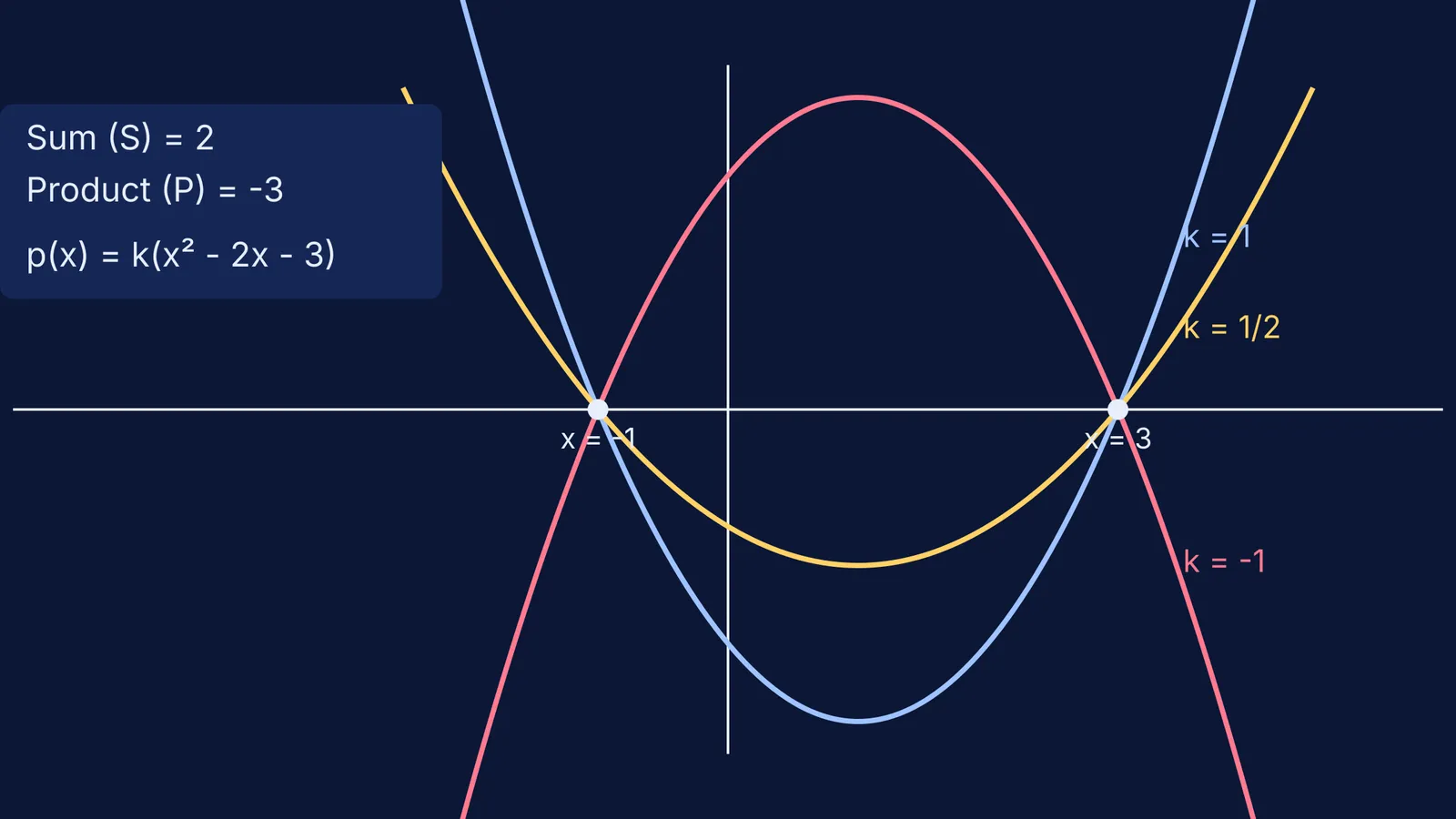
Multiplying a polynomial by a constant k stretches the graph vertically or flips it upside down, but it does not move the points where it crosses the axis. For instance, x² − 2x − 3, −x² + 2x + 3 and 2x² − 4x − 6 all cross the x-axis at exactly x = −1 and x = 3. Their zeros are identical, which means their sum and product are also identical.
To see how these constants affect the shape of the graph, explore the Fermi Concept Library, which maps every concept in mathematics.
How can you check if your polynomial is correct?
Once you have found your polynomial, it is good practice to test it. You can work forwards to see if the zeros match the S and P you were given.
Take the polynomial you built and find its zeros by factorising or using the quadratic formula. For example, if you found x² − 2x − 3, set it equal to zero and factorise it into (x − 3)(x + 1) = 0. This tells you the zeros are exactly 3 and −1.
Now, test them:
Sum: 3 + (−1) = 2
Product: 3 × (−1) = −3
If these match the numbers in the original question, your polynomial is correct. This checking habit is especially useful in exams, where a simple sign error early on can cascade through a multi-part question and cost you valuable marks. Taking an extra minute to verify your work can save you from losing points on a concept you already understand.
If your problem involves more complex equations, you might need to know When two quadratics share a root or how to handle Quadratic word problems in Class 10. You can also use the discriminant test to see When is ax² + bx + c positive for all x?.


