

On this page
Put x² + x + 1 = 0 into the quadratic formula and you meet √(−3) on the second line. It is tempting to stop and write "no solution". That is only true for real numbers. In Class 11 and JEE maths, this equation has two clean complex answers that you can find and check in a few lines.
What does a negative discriminant tell you?
For ax² + bx + c = 0 with real a, b, c and a ≠ 0, the quadratic formula is x = (−b ± √(b² − 4ac)) / 2a, and b² − 4ac is the discriminant (OpenStax College Algebra 2e, section 2.5). The same section states that when b² − 4ac < 0, the equation has two complex solutions.
The tool that handles the negative number is the imaginary unit: i is defined as the square root of −1, so i² = −1 (OpenStax College Algebra 2e, section 2.4). Any negative number under a root splits the same way: OpenStax works √(−49) = 7i, and here √(−3) = √3 · √(−1) = i√3.
How do you solve x² + x + 1 = 0 step by step?
Read off the coefficients: a = 1, b = 1, c = 1.
Find the discriminant: b² − 4ac = 1 − 4 = −3.
Rewrite the root: √(−3) = i√3.
Substitute: x = (−1 ± i√3) / 2.
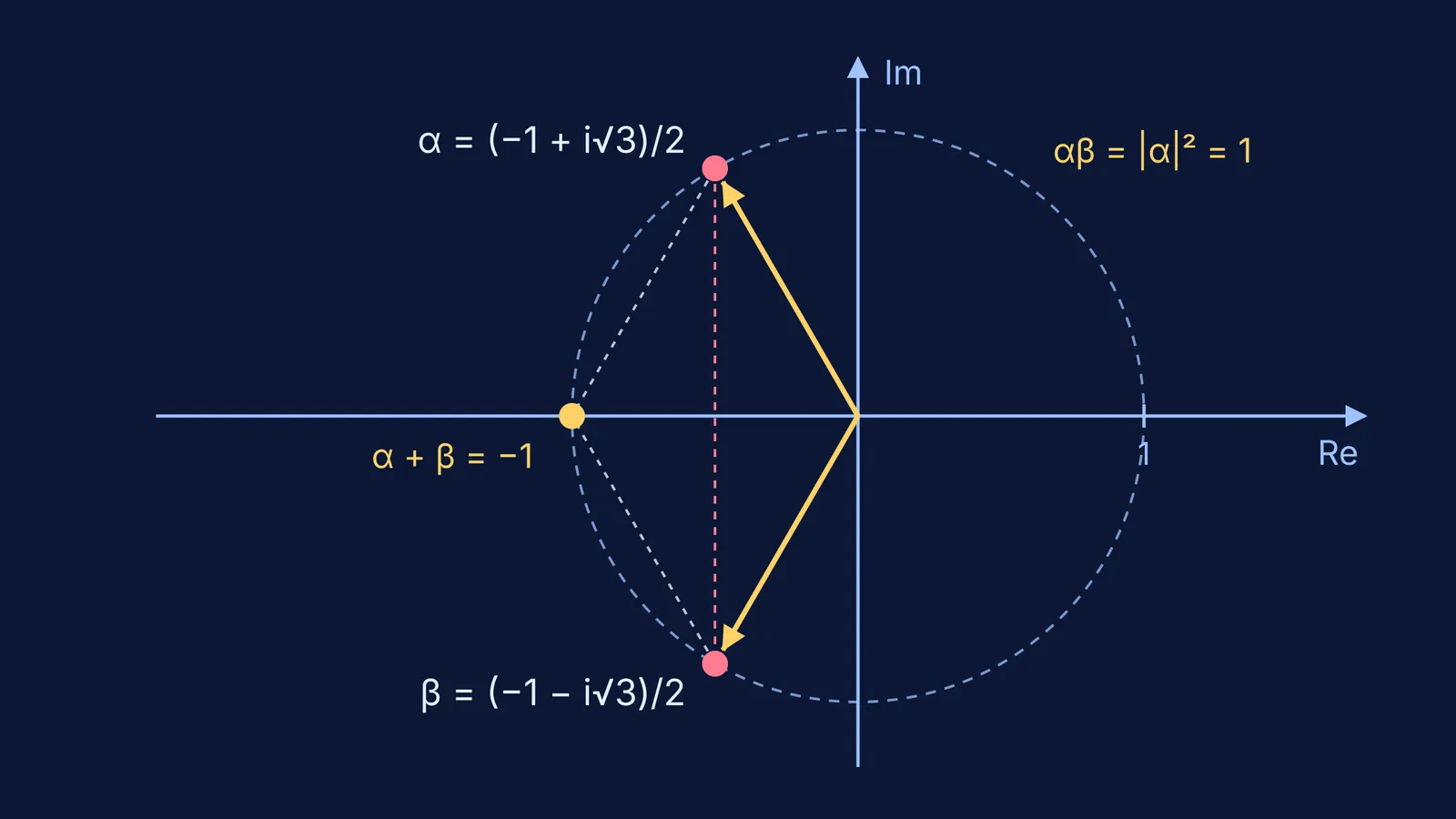
Split into two roots in a + bi form: α = −1/2 + (√3/2)i and β = −1/2 − (√3/2)i.
Why do the complex roots come in a conjugate pair?
The complex conjugate of a + bi is a − bi: the same real part with the sign of the imaginary part changed (OpenStax, section 2.4). The Complex Conjugate Theorem says that if a polynomial has real coefficients and a complex zero a + bi, then a − bi is also a zero (OpenStax College Algebra 2e, section 5.5).
You can see this in the formula: both roots share the real part −b/2a, and the ± sits in front of i√3. They are mirror images across the real axis.
The condition "real coefficients" matters. The roots of x² + ix + 2 = 0 are i and −2i, not conjugates, because the coefficient of x is not real.
With real coefficients, the theorem is a shortcut. If one root is 3 + 2i, the other is 3 − 2i; their sum is 6, their product 9 + 4 = 13, and the equation is x² − 6x + 13 = 0.
How do you check complex roots with sum and product?
For ax² + bx + c = 0 with roots α and β, the sum is α + β = −b/a and the product is αβ = c/a (Vieta's formulas). For x² + x + 1 = 0 the targets are −1 and 1.
Sum: (−1 + i√3)/2 + (−1 − i√3)/2 = −2/2 = −1. The imaginary parts cancel.
Product: a number times its conjugate is (a + bi)(a − bi) = a² + b² (OpenStax, section 2.4), so αβ = 1/4 + 3/4 = 1.
Both match, so the roots are right. The check also catches a common slip, treating (i√3)² as +3: then the product comes out as 1/4 − 3/4 = −1/2, not 1.
Practice: solve 2x² − 4x + 5 = 0. You should get x = 1 ± (√6/2)i, with sum 2 (= 4/2) and product 1 + 6/4 = 5/2 (= c/a).
What mistakes cost marks here?
Check your working for these:
Writing "no real roots" when the question asks for complex roots, or the reverse.
Dropping the ±, which leaves one root instead of a pair.
Dividing only −b by 2a and leaving the i√3 term undivided.
Writing √(−3) · √(−3) = √9 = 3. It is (i√3)(i√3) = 3i² = −3.
Expecting conjugate roots when a coefficient is complex.
If your discriminant is right but the roots still come out wrong, the Fermi Problem Library has worked problems with a step-by-step solver that explains the reasoning rather than printing an answer, so you can find the line where yours went off. If i itself feels shaky, the Fermi Concept Library gives each mathematics concept its own lesson.
Next, use sum and product to find α⁵ + β⁵ without solving the quadratic, see these roots on a circle with polar and Euler form, or try the condition for a complex number to be purely real or imaginary.


