

On this page
Polar form describes a point on the Argand plane by how far it is from the origin and in which direction. Euler form writes the same idea as one exponential. Once you can switch between forms, multiplying, dividing and taking powers becomes arithmetic on lengths and angles.
The current NCERT Class 11 chapter Complex Numbers and Quadratic Equations (reprint 2026-27) defines the modulus and draws the Argand plane but does not develop polar form, so this guide picks up there.
What are the modulus and argument of a complex number?
The modulus of z = x + iy is r = |z| = √(x² + y²), the distance of the point from the origin on the Argand plane (NCERT Class 11, Chapter 4).
The argument θ is the angle that the line from the origin to z makes with the positive real axis, so that cos θ = x/r and sin θ = y/r (OpenStax Precalculus 2e).
The argument is not unique: adding any whole multiple of 2π lands on the same point, and the number 0 has no argument at all (MIT OpenCourseWare 18.03SC). To pick one value, books fix a range called the principal value: MIT's notes use 0 ≤ θ < 2π, and you will also see −π < θ ≤ π. Use whichever range your textbook or exam paper states.
How do you convert a + ib to polar and Euler form?
Sketch the point (a, b) and note its quadrant.
Find r = √(a² + b²).
Find the reference angle α = tan⁻¹|b/a|, which lies between 0 and π/2. If a = 0, the point is on the imaginary axis and θ = π/2 or −π/2.
Place it by quadrant (here using −π < θ ≤ π): first quadrant θ = α; second θ = π − α; third θ = −(π − α); fourth θ = −α.
Write z = r(cos θ + i sin θ), then shorten it to z = re^(iθ).
Step 5 uses Euler's formula, e^(iθ) = cos θ + i sin θ. MIT's notes say this formula "should be regarded as the definition of the exponential of an imaginary power" (MIT OpenCourseWare).
To go back to a + ib, use a = r cos θ and b = r sin θ. For example, 2e^(i2π/3) = 2(−1/2) + 2(√3/2)i = −1 + i√3.
How does polar form make multiplying and dividing easier?
In polar form the rules are short: to multiply, multiply the moduli and add the arguments; to divide, divide the moduli and subtract the arguments (OpenStax Precalculus 2e). In Euler form, r₁e^(iθ₁) · r₂e^(iθ₂) = r₁r₂e^(i(θ₁ + θ₂)). See why multiplying complex numbers means lengths multiply and angles add for the rotation picture, and the argument of a product and quotient of complex numbers for edge cases.
Worked example with z₁ = 1 + i√3 and z₂ = 1 − i:
z₁: r = √(1 + 3) = 2, first quadrant, θ = π/3, so z₁ = 2e^(iπ/3).
z₂: r = √(1 + 1) = √2, fourth quadrant, θ = −π/4, so z₂ = √2e^(−iπ/4).
Product: z₁z₂ = 2√2e^(i(π/3 − π/4)) = 2√2e^(iπ/12).
Quotient: z₁/z₂ = (2/√2)e^(i(π/3 + π/4)) = √2e^(i7π/12).
Check the product the long way: (1 + i√3)(1 − i) = (1 + √3) + i(√3 − 1), whose modulus is √8 = 2√2. It matches.
After adding arguments, bring the answer back into your principal range: a sum of 5π/4 becomes −3π/4 if your range is −π < θ ≤ π.
If you set up the method correctly but still land in the wrong quadrant, the Fermi Problem Library has worked problems with a step-by-step solver that explains the reasoning rather than printing an answer.
How do you raise a complex number to a power?
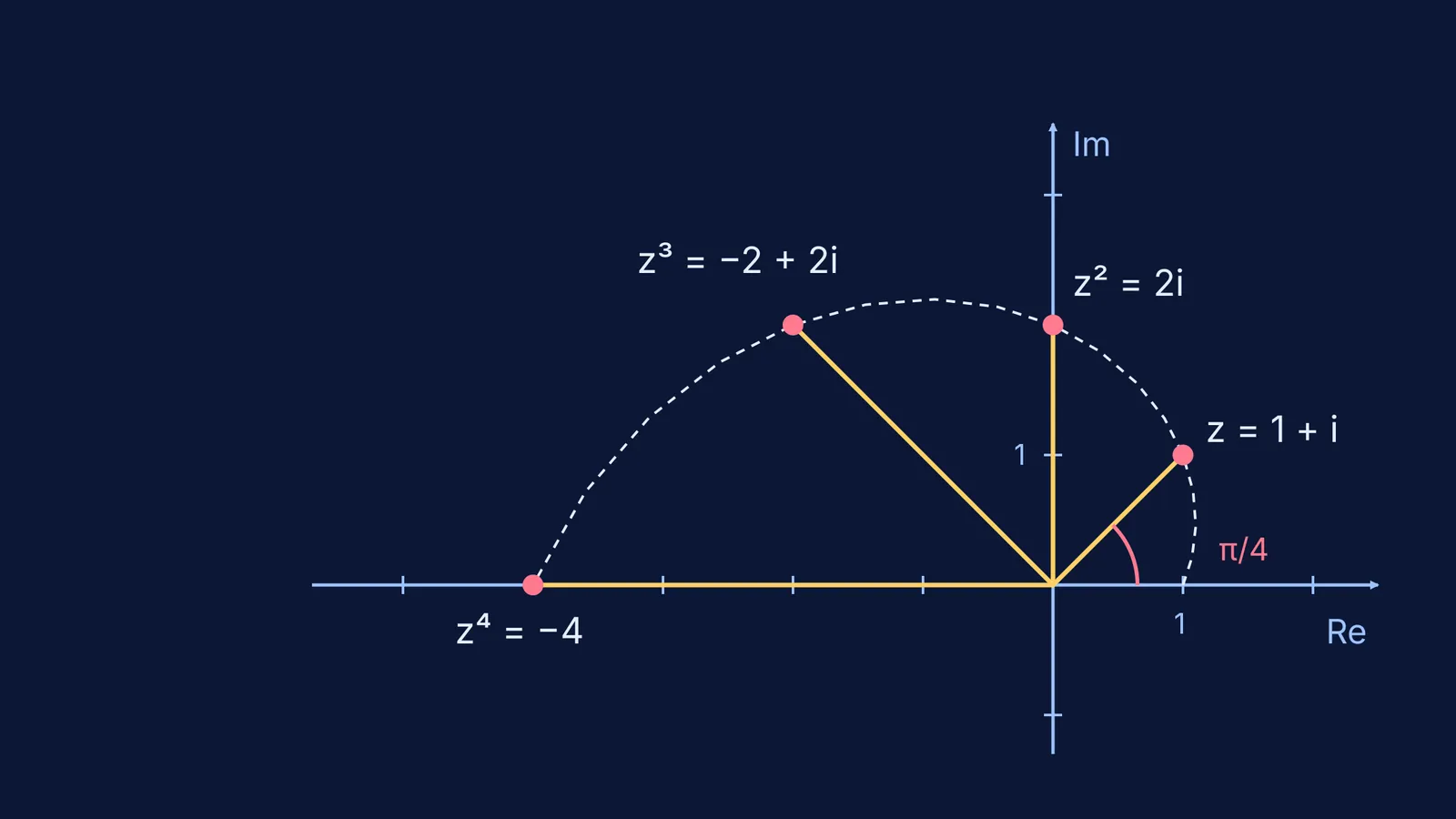
Powers repeat the multiplication rule: (re^(iθ))ⁿ = rⁿe^(inθ), and when r = 1 this becomes De Moivre's formula, (cos θ + i sin θ)ⁿ = cos nθ + i sin nθ (MIT OpenCourseWare).
The diagram at the top shows this for z = 1 + i = √2e^(iπ/4). Each power stretches the length by √2 and turns the point a further π/4: z² = 2i, z³ = −2 + 2i and z⁴ = 4e^(iπ) = −4.
Back to the worked example: z₁⁶ = 2⁶e^(i6π/3) = 64e^(i2π) = 64, in one line instead of five multiplications.
If the Argand plane itself still feels shaky, the Fermi Concept Library gives every concept in mathematics its own lesson and its place in the map. When you are ready for the next step, try finding the locus of z on the complex plane, where conditions on modulus and argument turn into lines, circles and arcs.


