

On this page
A locus question asks for every point z in the Argand plane that obeys one condition. Read the condition as geometry first (a distance, a ratio of distances or an angle), and the algebra with z = x + iy only confirms the shape.
What does |z − a| mean on the Argand plane?
It is a distance. The absolute value of a complex number is its distance from the origin, and the absolute value of the difference of two complex numbers is the distance between them (Wikipedia: Absolute value).
So |z + 1| is |z − (−1)|, the distance from z to −1. A sign read the wrong way here is a common slip. For |2z − 4|, take the coefficient out first: |2z − 4| = 2|z − 2|.
How do you find the locus of z when |z − a| = |z − b|?
Here z is equally far from a and b, so it lies on the perpendicular bisector of the segment ab: a straight line.
Worked example: |z − 1| = |z + 1|. The bisector of the segment from −1 to 1 is the imaginary axis. Check with z = x + iy: (x − 1)² + y² = (x + 1)² + y² gives −2x = 2x, so x = 0.
What is the locus of |z − a| = k|z − b|?
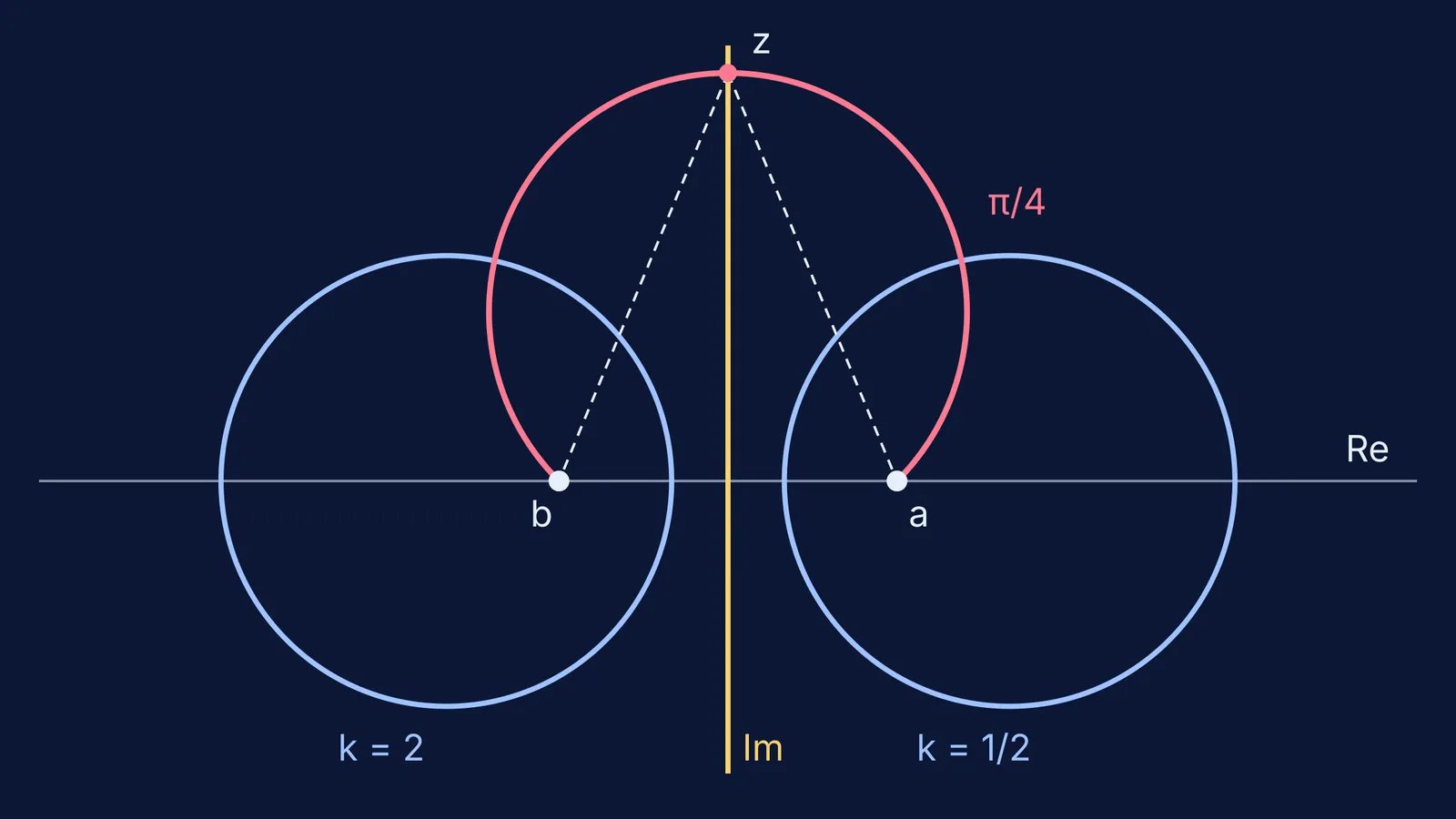
Points whose distances to two fixed points have a constant ratio k form a circle, called a circle of Apollonius (Wikipedia: Circles of Apollonius). When k = 1 it becomes the bisector line above.
Worked example: |z − 1| = 2|z + 1|.
Square both sides: (x − 1)² + y² = 4[(x + 1)² + y²].
Expand: x² − 2x + 1 + y² = 4x² + 8x + 4 + 4y².
Collect: 3x² + 3y² + 10x + 3 = 0, so x² + y² + (10/3)x + 1 = 0.
Read off the circle: centre −5/3, radius √(25/9 − 1) = 4/3.
Check: z = −1/3 is 4/3 from 1 and 2/3 from −1; z = −3 is 4 and 2 away. Both ratios are 2. Since z stays nearer b, the circle encloses b = −1.
What does an argument condition like arg((z − a)/(z − b)) = θ give?
arg(z − a) = θ fixes the direction from a to z, so the locus is a ray from a at angle θ to the positive real axis, with a itself excluded.
arg((z − a)/(z − b)) = θ means arg(z − a) − arg(z − b) = θ, up to a multiple of 2π: the angle you turn through from z − b to z − a.
The points M from which a fixed segment AB is seen under a fixed angle lie on an arc of a circle (Wikipedia: Inscribed angle). That is why argument conditions give arcs, not full circles.
Worked example: arg((z − 1)/(z + 1)) = π/4. Multiplying top and bottom by the conjugate of z + 1 gives real part x² + y² − 1 and imaginary part 2y, both over |z + 1|². An argument of π/4 needs these equal and positive: x² + y² − 1 = 2y with y > 0. That is x² + (y − 1)² = 2, the circle with centre i and radius √2, but only its arc above the real axis. Check at the top point z = (1 + √2)i: arg(z − 1) is 112.5° and arg(z + 1) is 67.5°, a difference of 45°.
The lower arc of the same circle is the locus of arg((z − 1)/(z + 1)) = −3π/4. With θ = π/2 you get the upper half of x² + y² = 1.
How do you solve any locus of z question step by step?
Rewrite every modulus as |z − p|: fix the signs and take out coefficients.
Name the shape: equal distances give a line, a ratio k ≠ 1 a circle, arg(z − a) a ray, and the angle between z − a and z − b an arc.
Confirm with z = x + iy, as in our post on solving complex equations by putting z = x + iy.
Test one point, then state what is excluded and which side of the chord the arc lies on.
For the largest or smallest |z| on a locus, see our guide to the triangle inequality for |z| and the Argand plane as a geometry tool.
If your picture and your algebra disagree, the Fermi Problem Library has worked problems with a step-by-step solver that explains the reasoning rather than printing an answer. If modulus and argument still feel shaky, each has its own lesson in the Fermi Concept Library.
Try it: sketch |z − 2i| = 3|z + 2i| first, then check your circle with the four steps.


