

On this page
Added two arguments, got 5π/4, and found −3π/4 in the answer key? Both angles point the same way. Only one is the principal value.
What is the argument of a complex number?
The argument of a non-zero complex number z is the angle its arrow on the Argand plane makes with the positive real axis. Angles that differ by a multiple of 2π give the same arrow, so arg z has infinitely many values.
The principal value, written Arg z, is usually the one value in the interval (−π, π], as Wikipedia's article on the argument) explains. NIST's Digital Library of Mathematical Functions notes that the principal value is discontinuous on the negative real axis, which is exactly where sign slips happen.
What is the argument of a product of complex numbers?
Write z₁ = r₁(cos θ₁ + i sin θ₁) and z₂ = r₂(cos θ₂ + i sin θ₂). Multiply them and use the addition formulas for sine and cosine: z₁z₂ = r₁r₂(cos(θ₁ + θ₂) + i sin(θ₁ + θ₂)). Moduli multiply and angles add, so arg(z₁z₂) = arg z₁ + arg z₂.
The catch is stated in the same DLMF section: the product and quotient rules hold for general values of the argument, but not necessarily for principal values.
Each principal value lies in (−π, π], so their sum lies in (−2π, 2π] and needs at most one correction:
If Arg z₁ + Arg z₂ > π, subtract 2π.
If Arg z₁ + Arg z₂ ≤ −π, add 2π.
Otherwise the sum is already the principal value.
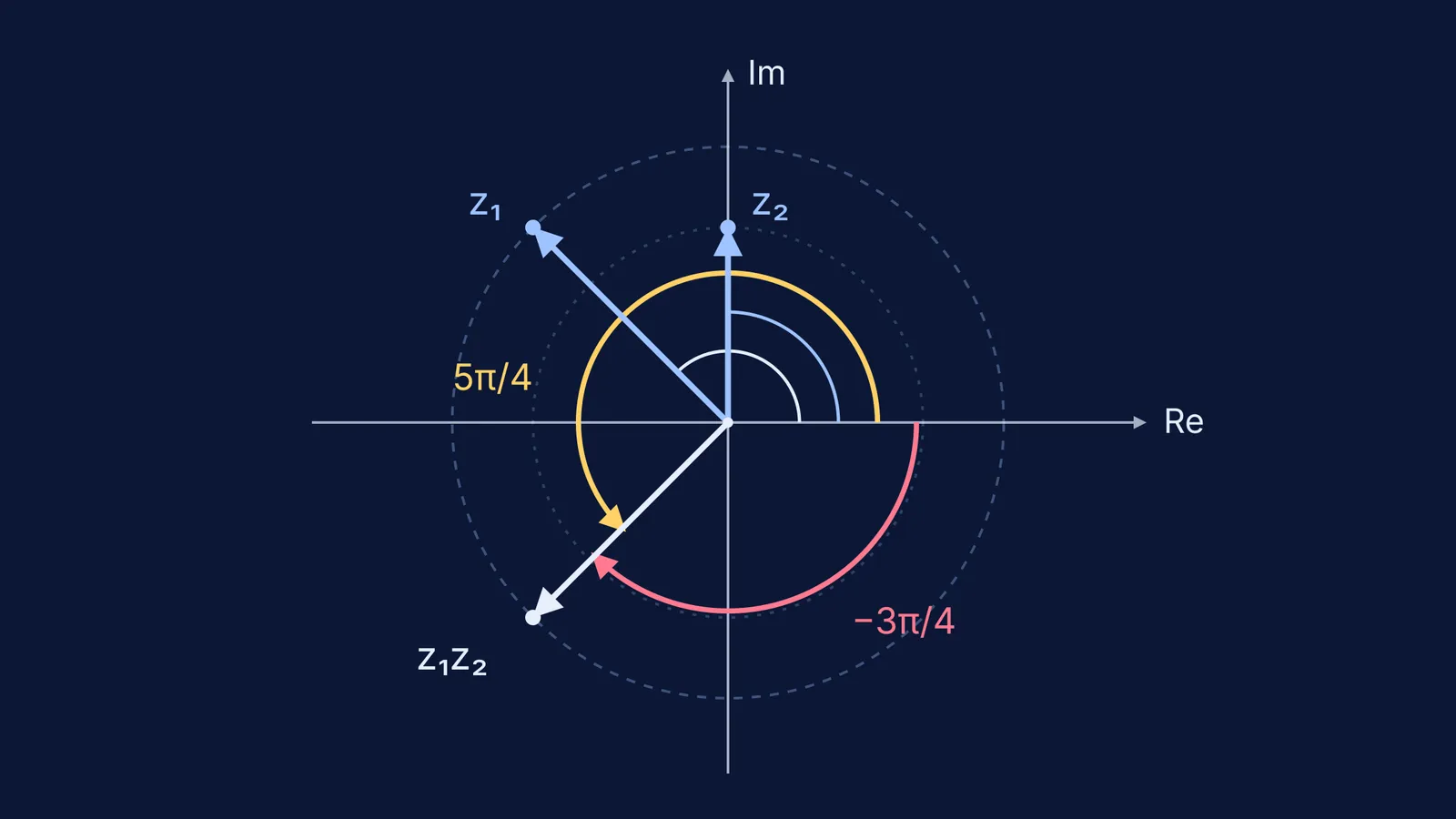
Worked example: take z₁ = −1 + i and z₂ = i. Then Arg z₁ = 3π/4 (second quadrant) and Arg z₂ = π/2.
Add: 3π/4 + π/2 = 5π/4.
5π/4 is more than π, so subtract 2π: Arg(z₁z₂) = −3π/4.
Check directly: (−1 + i)i = −i + i² = −1 − i, which sits in the third quadrant at −3π/4.
In the diagram at the top, the yellow arc (5π/4) and the pink arc (−3π/4) end on the same ray.
How do you find the argument of a quotient?
Division undoes multiplication, so arguments subtract: arg(z₁/z₂) = arg z₁ − arg z₂, again true for general values (DLMF 1.9). The difference of two principal values also lies between −2π and 2π, so the same one-step correction works.
Wikipedia's argument article) gives this example. For (−1 − i)/i, Arg(−1 − i) − Arg i = −3π/4 − π/2 = −5π/4. That is below −π, so add 2π to get 3π/4. Check: (−1 − i)/i = (−1 − i)(−i) = i + i² = −1 + i, which is in the second quadrant at 3π/4.
What about powers and conjugates?
Powers. Applying the product rule n times gives arg(zⁿ) = n arg z. For any integer n, Arg(zⁿ) equals n Arg z up to a multiple of 2π, as the Wikipedia article) states. Here one shift may not be enough: n Arg z can be several turns away, so keep adding or subtracting 2π until you land in (−π, π].
Example: z = −1 + i and n = 3. Then 3 × 3π/4 = 9π/4, and subtracting 2π gives π/4. Check: (−1 + i)² = −2i, and −2i(−1 + i) = 2 + 2i, first quadrant, angle π/4, modulus (√2)³ = 2√2. This is de Moivre's idea; see de Moivre and the shortcut for powers of complex numbers.
Conjugates. Reflecting z in the real axis flips the sign of the angle: arg z̄ = −arg z (DLMF 1.9). With principal values this holds everywhere except the negative real axis. For z = −5, z̄ = −5 and Arg is π, not −π, because −π is outside (−π, π].
One consequence: z/z̄ = z²/|z|², so arg(z/z̄) = 2 arg z, adjusted into the principal range. If z z̄ = |z|² is new to you, read using z z̄ = |z|² to simplify complex number problems.
How do you avoid losing marks on principal arguments?
Find each principal argument from the quadrant, not from tan⁻¹(y/x) alone. tan⁻¹(1/(−1)) gives −π/4, but −1 + i is in the second quadrant, so its argument is 3π/4.
Add, subtract or multiply the arguments as the rule says.
Bring the result into (−π, π] by adding or subtracting 2π.
Check the quadrant of the final number with a quick sketch or one multiplication.
Read the wording: "principal argument" or Arg means the one value in (−π, π]; arg is only fixed up to 2π.
For the bigger geometric picture, see complex numbers for JEE: using the Argand plane as a geometry tool.
If your sums keep landing in the wrong quadrant, the Fermi Problem Library has worked problems with a step-by-step solver that explains the reasoning rather than printing an answer, so you can see where the 2π shift belongs. If the idea of argument itself feels shaky, the Fermi Concept Library gives each concept in mathematics its own lesson.
Try the five-step check on your next three complex-number problems before you look at the key.


