On this page
Many students meet the rod-on-rails problem with a resistor first. Pull the rod, a current flows, a magnetic force drags it back, and the rod creeps up to a terminal speed. Swap the resistor for a capacitor, and the answer becomes a constant acceleration. Here is why.
What changes when a capacitor replaces the resistor?
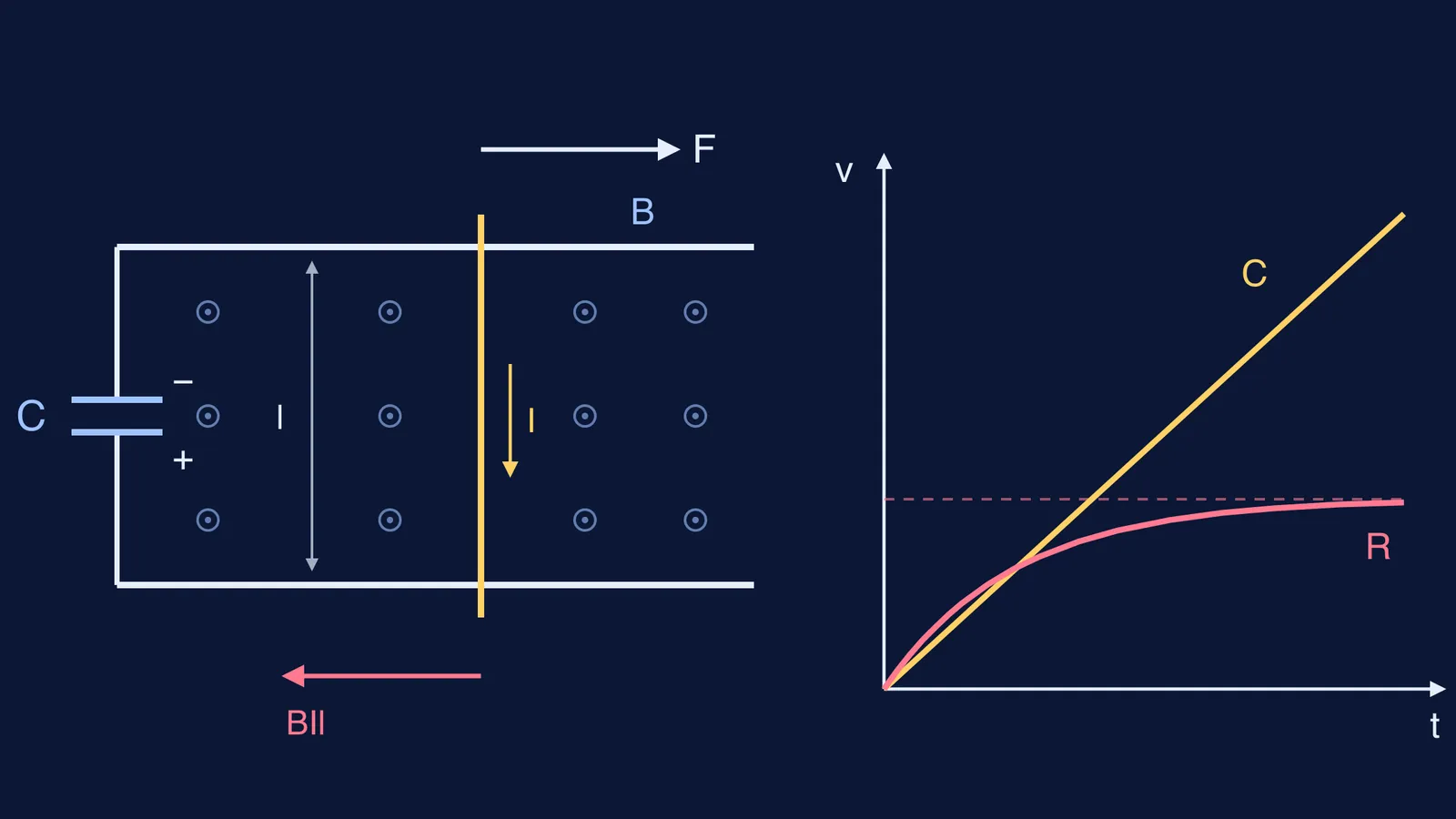
The setup: two smooth parallel rails a distance l apart, joined at one end by a capacitor C, in a uniform magnetic field B perpendicular to their plane. A rod of mass m lies across the rails, and a constant force F pulls it along. If the rails are vertical, gravity supplies F = mg.
With a resistor, the current depends on the rod's speed. OpenStax University Physics, Section 13.3 gives the induced current as I = Blv/R and the magnetic force on the rod as IlB. That drag grows with v, so the net force shrinks, and the rod settles at the speed where the drag equals F.
A capacitor does not respond to speed. It takes current only while its voltage is changing. That one difference is the whole problem.
How do you derive the acceleration step by step?
Emf: a rod of length l moving at speed v through a field B has motional emf ε = Blv, Eq. 6.5 in NCERT Class 12 Physics, Chapter 6.
Charge: in the ideal problem the rails and rod have no resistance, so the capacitor's voltage equals the emf at every instant. Capacitance is defined as C = Q/V (OpenStax, Section 8.1), so the charge is q = CBlv.
Current: current is the rate of change of charge, so I = dq/dt = CBl(dv/dt) = CBla.
Force: the magnetic force on the rod is IlB (OpenStax, Section 13.3), which here is B²l²Ca. By Lenz's law it opposes the motion.
Newton's second law: F − B²l²Ca = ma, so a = F/(m + B²l²C).
Nothing on the right-hand side depends on v or t. So the acceleration is constant, the speed grows in a straight line, and the capacitor charges with a steady current I = CBla.
If you follow each line but lose the thread when a question adds a twist, the Fermi Problem Library has worked problems with a step-by-step solver that explains the reasoning rather than printing an answer.
Why doesn't the rod reach a terminal speed?
Terminal speed needs a drag that grows with speed. Here, suppose the rod did move at a steady speed. The capacitor's voltage Blv would then be steady, the current would be zero, the drag would vanish, and F would speed the rod up again. The rod can never settle.
The energy books balance too. For constant acceleration, the distance covered is x = v²/2a, so the work done by F is Fx = ½(m + B²l²C)v². Of that, ½mv² is the rod's kinetic energy. The rest, ½B²l²Cv², is exactly ½CV² with V = Blv, the energy stored in a capacitor according to OpenStax, Section 8.3.
One caveat: real rods and rails have some resistance, so the constant-acceleration answer belongs to the idealised model that exam problems describe.
Worked example: a rod falling on vertical rails
A JEE-style problem posted on Careers360 has a rod of mass 100 g and length 1 m falling on vertical rails through a 2 T field, with a 0.015 F capacitor joining the rails. Take g = 10 m/s².
Extra mass: B²l²C = 4 × 1 × 0.015 = 0.06 kg.
Acceleration: a = mg/(m + B²l²C) = 1/0.16 = 6.25 m/s², the answer given on that page.
After 0.4 s: v = 2.5 m/s, so the capacitor's voltage is Blv = 5 V and its charge is 0.075 C.
Current throughout: I = CBla = 0.015 × 2 × 1 × 6.25 = 0.1875 A.
Now put a 4 Ω resistor in place of the capacitor. Setting the drag B²l²v/R equal to mg gives a terminal speed of v = mgR/B²l² = 1 m/s. The same rod, the same field, a completely different motion: the speed-time graph at the top of this post shows both.
How do you spot which case a question is?
Use this checklist before writing a single equation:
Look at what joins the rails. A resistor means speed-dependent drag and a terminal speed. A capacitor means acceleration-dependent drag and a constant acceleration.
Write ε = Blv first, then the element's own law: I = ε/R for a resistor, q = Cε for a capacitor.
Fix the direction of the current and the force with Lenz's law: the force always opposes the motion.
Check the limits. Put B = 0 or C = 0 and your answer should fall back to a = F/m.
Note the assumptions the question makes: frictionless rails, no resistance, a uniform field.
If motional emf or capacitance still feels shaky on its own, each has its own lesson in the Fermi Concept Library. Then try the worked example again tomorrow without looking.