On this page
Take the quadratic 2x² − 8x + 6. The NCERT Class 10 mathematics textbook, Chapter 2 factorises it by splitting the middle term into 2(x − 1)(x − 3). Add the coefficients: 2 − 8 + 6 = 0. That alone tells you x = 1 is a root, and one division, 6 ÷ 2 = 3, gives you the other.
Why does a + b + c = 0 mean one root is 1?
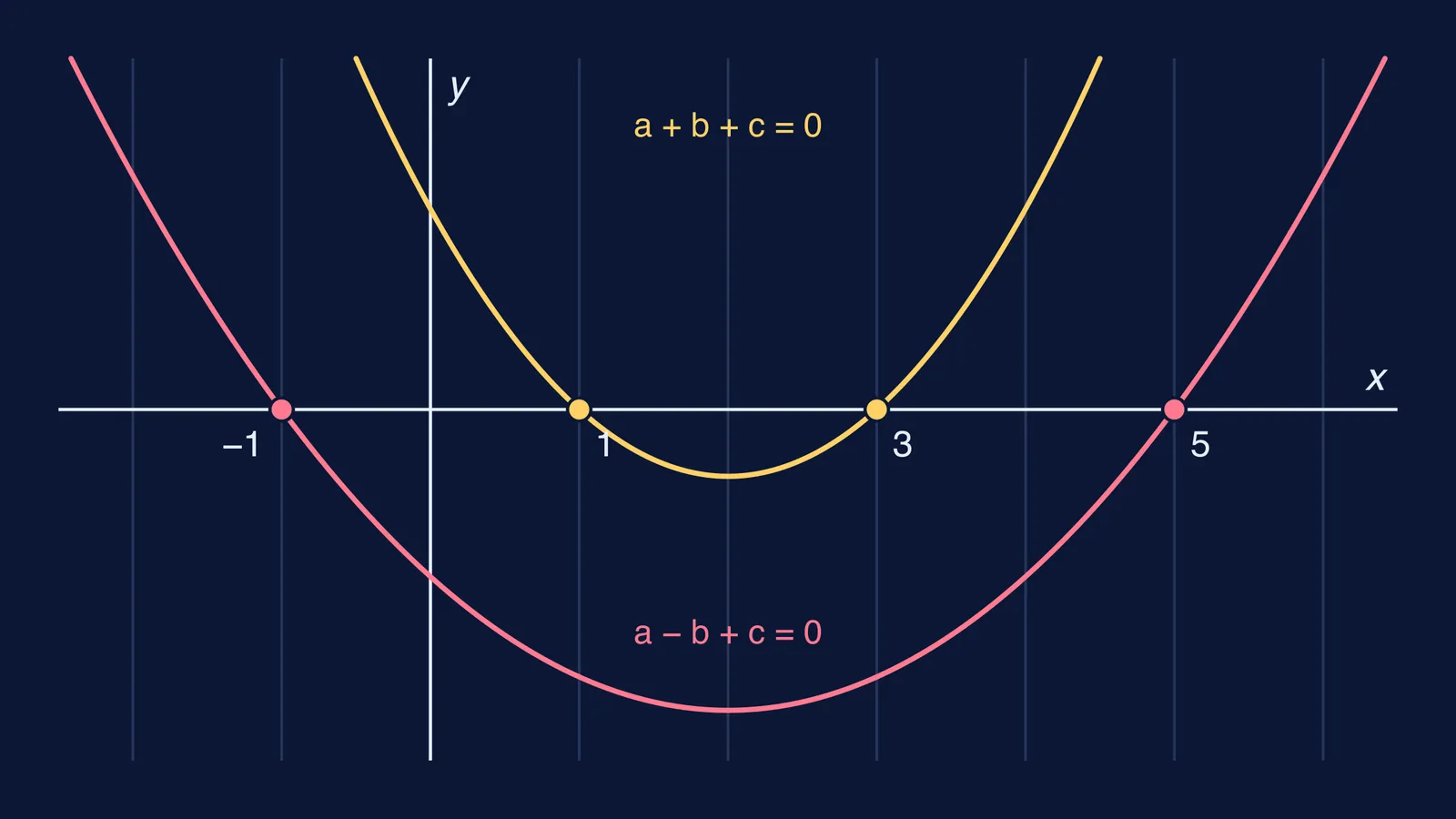
Put x = 1 into ax² + bx + c. Every power of 1 is 1, so the value is simply a + b + c.
A real number k is a zero of a polynomial p(x) if p(k) = 0, as defined in the NCERT Class 10 chapter on polynomials. So if a + b + c = 0, then p(1) = 0 and x = 1 is a root. No factorising needed.
For the second root, use the product. If α and β are the zeroes of ax² + bx + c, then αβ = c/a, as derived in Section 2.3 of the same NCERT chapter. With α = 1, the other root is c/a.
The same section gives the sum, α + β = −b/a; together the two results are called Vieta's formulas, after the 16th-century French mathematician François Viète. They agree here: 1 + c/a = −b/a becomes a + c = −b after multiplying by a, which is just a + b + c = 0 again.
When is x = −1 a root of a quadratic?
Put x = −1 instead. Now x² = 1, so the value is a − b + c. If a − b + c = 0, then x = −1 is a root.
The product rule gives the partner: (−1) × β = c/a, so β = −c/a. Watch that minus sign; it is the step people drop.
Example: x² − 4x − 5. Here a = 1, b = −4 and c = −5, so a − b + c = 1 + 4 − 5 = 0. One root is −1, and the other is −(−5)/1 = 5. Check: (x + 1)(x − 5) = x² − 4x − 5.
How do you use the shortcut in an exam?
Run this check before you reach for the quadratic formula:
Rewrite the equation as ax² + bx + c = 0, with every term on one side.
Add a + b + c. If it is 0, the roots are 1 and c/a.
If not, work out a − b + c. If it is 0, the roots are −1 and −c/a.
If neither is 0, factorise or use the quadratic formula as usual.
Check your pair: the roots should add to −b/a and multiply to c/a.
Step 1 matters. In x² = 5x − 4, the numbers you see add to 2. Move everything across first: x² − 5x + 4 = 0, so 1 − 5 + 4 = 0, and the roots are 1 and 4.
Three more worked examples:
3x² − 5x + 2 = 0: 3 − 5 + 2 = 0, so the roots are 1 and 2/3.
7x² + 3x − 4 = 0: a + b + c = 6, but a − b + c = 7 − 3 − 4 = 0, so the roots are −1 and 4/7.
2x² + 3x + 5 = 0: a + b + c = 10 and a − b + c = 4. Neither works, so go to the discriminant: 9 − 40 is negative, so there are no real roots.
Does the trick work for cubics too?
The first half does. Putting x = 1 into any polynomial gives the sum of its coefficients, so if they add to zero, x − 1 is a factor. In x³ − 6x² + 11x − 6, the coefficients add to 0; dividing by x − 1 leaves x² − 5x + 6, with roots 2 and 3. Similarly, x = −1 is a root when the even-power coefficients and the odd-power coefficients have equal totals.
The product step changes, because a cubic has three roots. Divide by x − 1, or use the cubic relations in Section 2.3 of the NCERT chapter: with one root equal to 1, the other two zeroes of ax³ + bx² + cx + d add to −b/a − 1 and multiply to −d/a.
How do you make the check automatic?
Try it on every quadratic you meet for a week, whether or not it works. You will start to notice which questions were built for it.
If the product rule itself feels shaky, the Fermi Concept Library covers every concept in mathematics, each with its own lesson. For practice, the Fermi Problem Library has worked problems with a step-by-step solver that explains the reasoning rather than printing an answer, so you can see exactly where a sign slipped.
Next time you see a quadratic, add the coefficients first.