On this page
If a question gives you a cell's EMF at two temperatures, it is really giving you three thermodynamic quantities. The voltage gives you ΔG. The way the voltage changes with temperature gives you ΔS. Put the two together and you get ΔH. Below are the three formulas, a worked example and a quick self-check.
What is the temperature coefficient of EMF?
The temperature coefficient of EMF is (∂E/∂T) at constant pressure: how many volts the cell's EMF changes for each kelvin of temperature change. It comes from the link between Gibbs energy and cell voltage, ΔG = −nFE, where n is the number of moles of electrons transferred in the balanced reaction and F is the Faraday constant (electrochemistry lecture notes, MMC College).
The Faraday constant is exact in the SI. The CODATA 2022 values published by NIST give it as 96,485.332 12... C mol⁻¹. For exam work, 96,485 C mol⁻¹ is fine.
At constant pressure, (∂ΔG/∂T) = −ΔS. Differentiate ΔG = −nFE with respect to temperature and you get nF(∂E/∂T) = ΔS, as derived on Chemistry LibreTexts.
How do you get ΔS from nF(dE/dT)?
These are the three formulas you need. All of them appear in the MMC College notes:
ΔG = −nFE
ΔS = nF(dE/dT)
ΔH = ΔG + TΔS = −nFE + nFT(dE/dT) = −nF[E − T(dE/dT)]
The sign of the temperature coefficient is the sign of ΔS. If the EMF falls as the cell warms, ΔS is negative. If it rises, ΔS is positive. LibreTexts notes that when a reaction produces gas and its entropy rises sharply, the standard cell potential decreases as the temperature falls.
How do you find ΔH from EMF at two temperatures?
Here is an exam-style problem. We chose the numbers to make the arithmetic easy to follow. A cell reaction with n = 2 has an EMF of 1.050 V at 298 K and 1.045 V at 308 K. Find ΔG, ΔS and ΔH at 298 K, using F = 96,485 C mol⁻¹ (NIST).
Slope: dE/dT ≈ (1.045 − 1.050) V ÷ (308 − 298) K = −5.0 × 10⁻⁴ V K⁻¹.
Entropy: ΔS = 2 × 96,485 × (−5.0 × 10⁻⁴) = −96.5 J mol⁻¹ K⁻¹.
Gibbs energy at 298 K: ΔG = −2 × 96,485 × 1.050 = −202,619 J mol⁻¹, about −202.6 kJ mol⁻¹.
TΔS at 298 K: 298 × (−96.485) = −28,753 J mol⁻¹, about −28.8 kJ mol⁻¹.
Enthalpy: ΔH = ΔG + TΔS = −202.6 − 28.8 ≈ −231.4 kJ mol⁻¹.
Now check your answer. Repeat steps 3 to 5 at 308 K. ΔG = −2 × 96,485 × 1.045 = −201,654 J mol⁻¹, and TΔS = 308 × (−96.485) = −29,717 J mol⁻¹. ΔH comes out at −231,371 J mol⁻¹ again, about −231.4 kJ mol⁻¹. The two-point method assumes ΔH and ΔS stay constant over those 10 K. That means the EMF is a straight line in T, so both temperatures must give the same ΔH. If your two values disagree, you have made an arithmetic slip somewhere.
What do the numbers mean? The reaction releases 231.4 kJ per mole of reaction as enthalpy. Run reversibly, the cell turns 202.6 kJ of that into electrical work. The remaining 28.8 kJ, the TΔS term, leaves as heat.
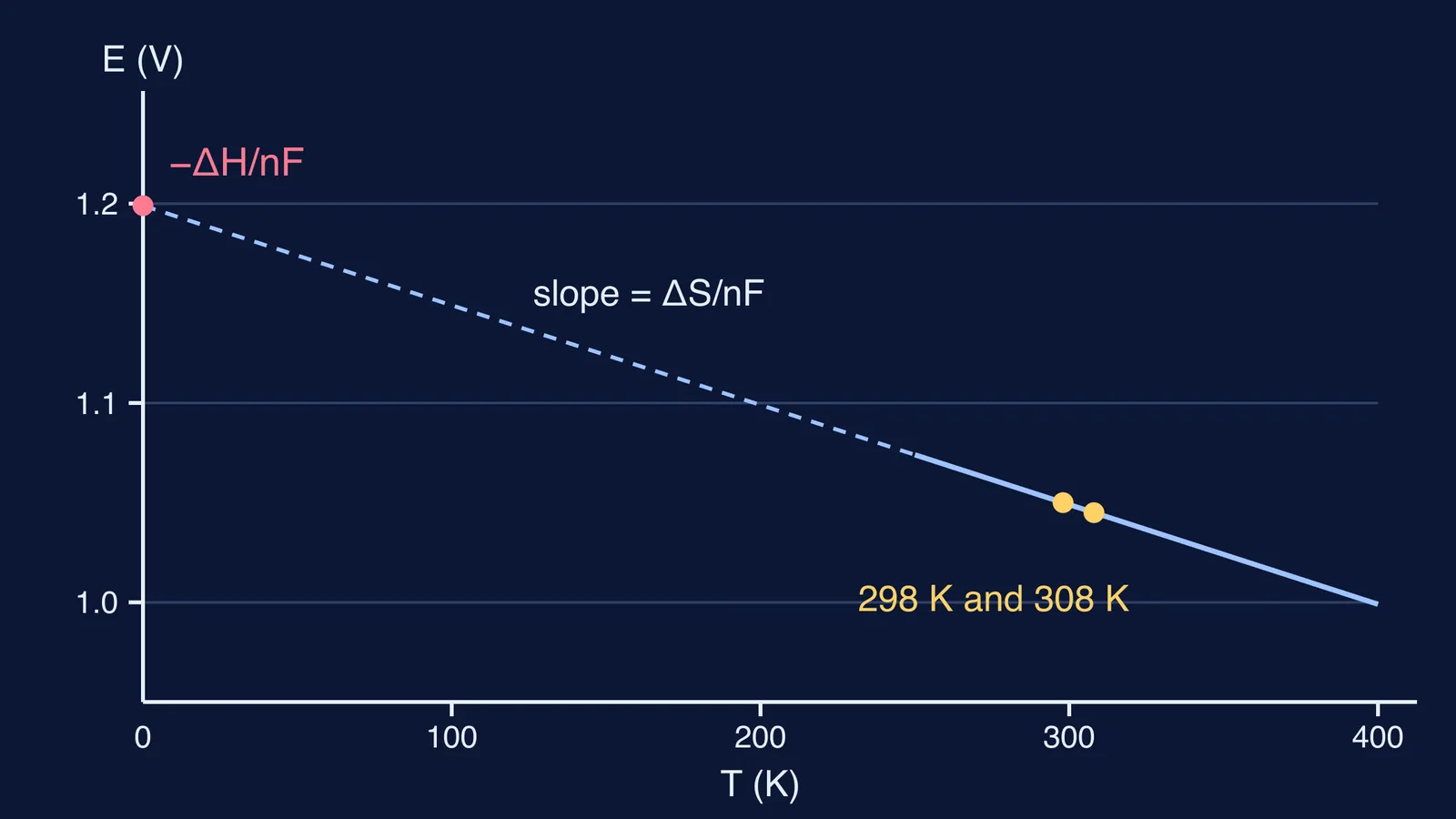
It also helps to picture this as a graph. Because E = −ΔH/nF + (ΔS/nF)T, a plot of E against T has a slope of ΔS/nF. If you extend the line to T = 0, it meets the axis at −ΔH/nF, which is 1.199 V in this example. That extension is algebra, not a measurement at absolute zero.
What mistakes cost marks on temperature coefficient problems?
Using °C in TΔS. A 10 °C gap is the same as a 10 K gap for the slope, but T itself must be in kelvin.
Taking n from the wrong equation. Count the electrons in the balanced cell reaction the question actually gives you.
Flipping the slope. Write (E₂ − E₁) ÷ (T₂ − T₁) with both values in the same order, then keep the sign.
Mixing J and kJ when you add ΔG and TΔS.
Pairing E at one temperature with T at the other in ΔH = −nFE + TΔS.
Forgetting that doubling the equation doubles n, ΔG, ΔS and ΔH, while E and dE/dT stay the same.
If your slope or sign keeps coming out wrong, the Fermi Problem Library has worked problems with a step-by-step solver that explains the reasoning rather than just printing an answer. If the gap is further back, in Gibbs energy or entropy itself, each idea has its own lesson in the Fermi Concept Library.
Try this next: take any two EMF readings from your textbook's exercises, work out ΔH at both temperatures, and see whether the two values match.