On this page
Gilli danda needs two pieces of wood, yet every strike packs in torque, angular momentum, impulse and projectile motion. Here is what happens in each hit, with numbers you can check.
How does gilli danda work, step by step?
The game uses a long stick, the danda, and a small oval-shaped piece of wood, the gilli. Wikipedia's entry on gillidanda gives typical sizes of about 1.5 ft (0.46 m) for the danda and about 6 in (150 mm) for the gilli. The game goes by many names across India, including kitti-pul in Tamil and chinni-kolu in Kannada.
The striker balances the gilli on a stone at a slant, like a see-saw, with one end touching the ground and the other raised. Then come two hits:
A sharp tap on the raised end flips the gilli into the air.
While it is in the air, a full swing of the danda strikes it as far as possible.
Why does the first hit make the gilli spin?
The first idea is torque. The size of a torque is τ = r⊥F, where the lever arm r⊥ is the perpendicular distance from the pivot to the line of the force (OpenStax University Physics, section 10.6). The greater the lever arm, the greater the torque.
The second: the rate of change of angular momentum equals the net external torque, dL/dt = Στ (OpenStax, section 11.2).
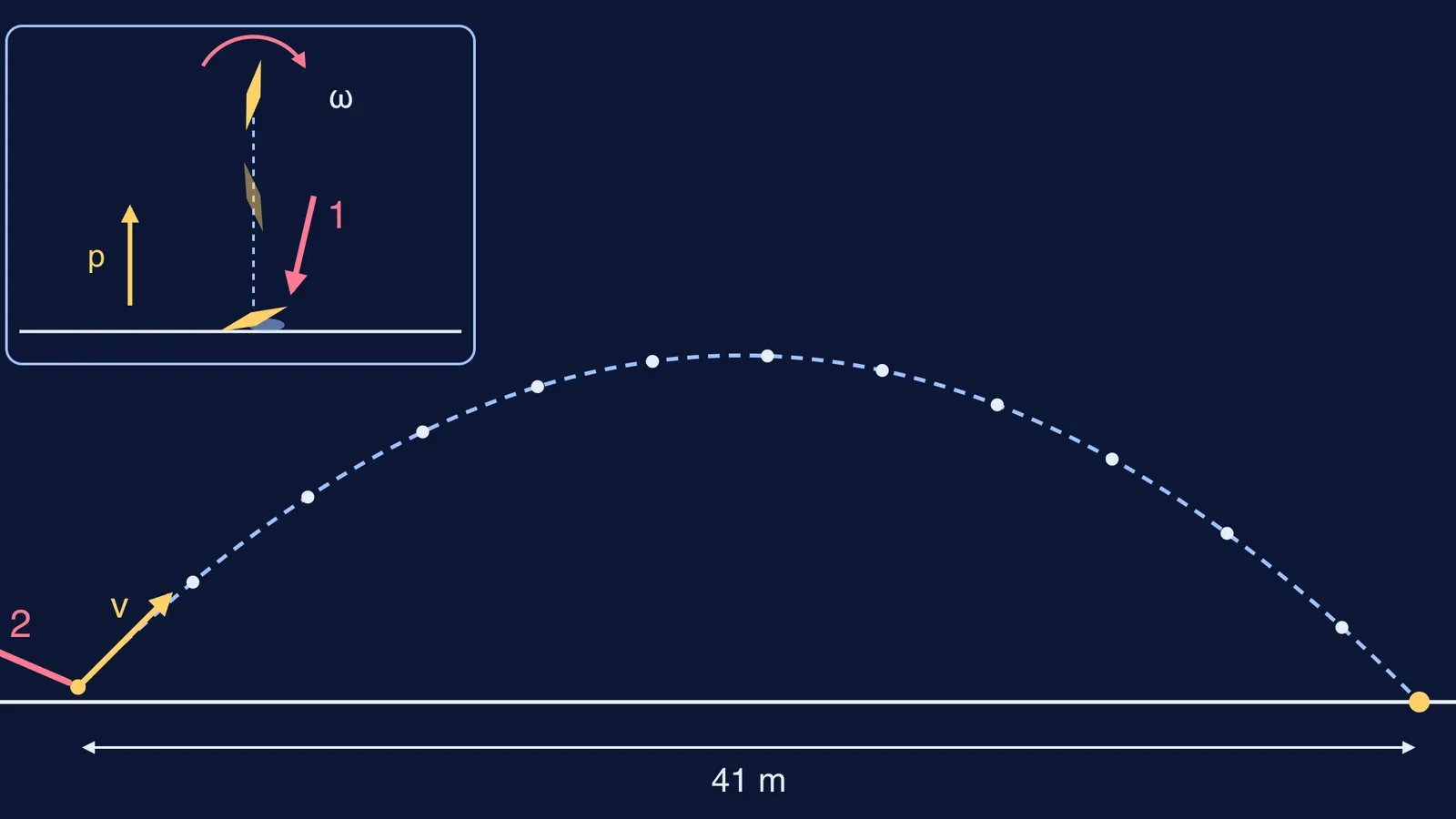
When you tap the raised end, the gilli tips about the stone like a see-saw and the end on the ground kicks up. Neither the tap nor the stone's push back acts through the gilli's centre. So one short blow gives the centre upward momentum and, because the forces have lever arms, gives the gilli angular momentum. It jumps and spins.
The danda is a lever too. A point on the turning stick moves at v = rω, where r is its distance from the axis (OpenStax, section 10.3), so the far end moves fastest for the same turn of the wrist.
What sends the gilli flying on the second hit?
The second hit is a collision. Impulse is force multiplied by the time it acts, and the impulse-momentum theorem says the change in momentum equals the impulse, J = Δp (OpenStax, section 9.2). Contact lasts only milliseconds, so the average force is large: in an OpenStax tennis-serve example, a 0.057 kg ball leaving at 58 m/s after 5.0 ms of contact needs about 660 N.
Once the gilli leaves the danda, it is a projectile. On level ground without air resistance, the range is R = v² sin(2θ)/g, and it is greatest at 45° (OpenStax, section 4.3). The same section notes that with air resistance the best angle is somewhat smaller.
Worked example: the numbers behind one strike
These are illustrative values, not measurements: a gilli 0.15 m long (the size above), an assumed mass of 50 g, treated as a thin rod. A thin rod's moment of inertia about its centre is I = ML²/12 (OpenStax, section 10.5).
Hit 1, the flip. Suppose the tap and the stone together give a net upward impulse of 0.15 N·s whose line of action passes 3 cm from the centre.
Upward speed: v = J/m = 3.0 m/s.
Height: h = v²/2g ≈ 0.46 m, reached in about 0.31 s.
Moment of inertia: I = 0.05 × 0.15²/12 ≈ 9.4 × 10⁻⁵ kg·m².
Angular impulse: r⊥J = 0.0045 kg·m²/s.
Spin: ω = r⊥J/I ≈ 48 rad/s, about 7.6 turns a second, or 2.3 turns on the way up.
Hit 2, the launch. Suppose the danda sends the gilli off at 20 m/s at 45°.
Change in momentum: Δp = 1.0 kg·m/s, since the gilli is almost at rest at the top of its flip.
Over an assumed 2 ms of contact, the average force is 500 N.
Range: R = v²/g ≈ 41 m, before air resistance shortens it.
Look again at step 4 of hit 1: double the lever arm to 6 cm and the same push gives twice the spin.
How can you use gilli danda to revise physics?
Turn the next game into a revision session:
Measure the gilli with a ruler and weigh it on a kitchen scale, so the numbers are yours.
Film the flip in slow motion and count the turns up to the top. Compare with your ω.
Pace out a good hit and work back with v = √(gR). That is the least launch speed that could cover the distance; any other angle, or air resistance, needs more.
Tap nearer the middle, then nearer the tip. Which flip spins more, and why?
Parents, ask these while you watch, not as homework: "Why did that one spin more?" gets a child reasoning about torque.
Torque and projectiles are easier to see than to read, and the Fermi Simulation Lab has interactive simulations for ideas like these. When a rotational-motion numerical goes wrong, the Fermi Problem Library has worked problems with a step-by-step solver that explains the reasoning rather than printing an answer.
Next game, count the spins before you chase the gilli.