On this page
In 1607 a Chinese scholar-official and an Italian Jesuit published a book that gave Chinese mathematics a new way to argue. Xu Guangqi and Matteo Ricci had translated the first six books of Euclid's Elements, and to do it Xu had to make up words that did not yet exist in Chinese. The book was called Jihe yuanben, and the word jihe later became the ordinary Chinese name for geometry.
The story matters for you for a plain reason: the definitions and step-by-step proofs of school geometry go back to Euclid's Elements, and Xu's way of learning it still works.
Who translated Euclid's Elements into Chinese?
Xu Guangqi was born in Shanghai in 1562, obtained the highest level in the imperial civil-service examination and rose to be the leading minister at the Ming court, according to his MacTutor biography. His partner was Matteo Ricci, an Italian Jesuit who had studied in Rome under Christopher Clavius (MacTutor). Clavius taught mathematics at the Jesuits' Roman College and wrote commentaries on Euclid, as the Beyond Ricci project at Boston College describes.
Euclid's Elements was written around 300 BC as a collection of 13 books (Wikipedia). Xu and Ricci did not work from the Greek. They used the Latin commentary that Clavius first published in 1574 (MacTutor; Max Planck Institute for the History of Science).
Ricci explained the original text aloud, and Xu wrote down what he had understood (MacTutor). They stopped after six books. Those six books were published in final form in 1611, and the remaining books were translated only in the 1850s, by Li Shanlan and the British missionary Alexander Wylie, who began in 1852 (Eminent Chinese of the Ch'ing Period).
Which geometry words did Xu Guangqi coin?
Xu had to invent new Chinese terms for point, curve, parallel line, acute angle and obtuse angle. MacTutor explains that these concepts were alien to Chinese mathematics, so there were no Chinese words for them, and that the new terms soon became part of Chinese mathematics (MacTutor).
Book I opens with a list of definitions. A 2017 study in the Journal of Dialectics of Nature compared the 36 definitions of Book I in Latin and Chinese and concluded that the translators reached "the closest natural equivalent" of the original in meaning and style (Ji Zhigang, 2017).
The title itself became a word. Jihe was already a word in traditional Chinese mathematics, and over nearly 300 years it came to name one branch of mathematics, geometry (Song Zhiye and Ji Zhigang, 2017).
If you want the background on what those opening definitions, postulates and common notions are, our explainer on Euclid's axioms vs postulates sets them side by side. The same idea, a short list of starting rules, returns three centuries later in Zermelo's axioms of set theory.
How did Xu Guangqi describe Euclid?
In his foreword to the translation, Xu wrote: "Four things in this book are not necessary; it is not necessary to doubt, to assume new conjectures, to put to the test, to modify" (MacTutor). In other words, every step is meant to follow from what came before.
How can you read a proof the way Xu did?
Xu's method was explain, then write what you understood. Here it is on Book I, Proposition 1, the first construction in the Elements, using the Clark University edition.
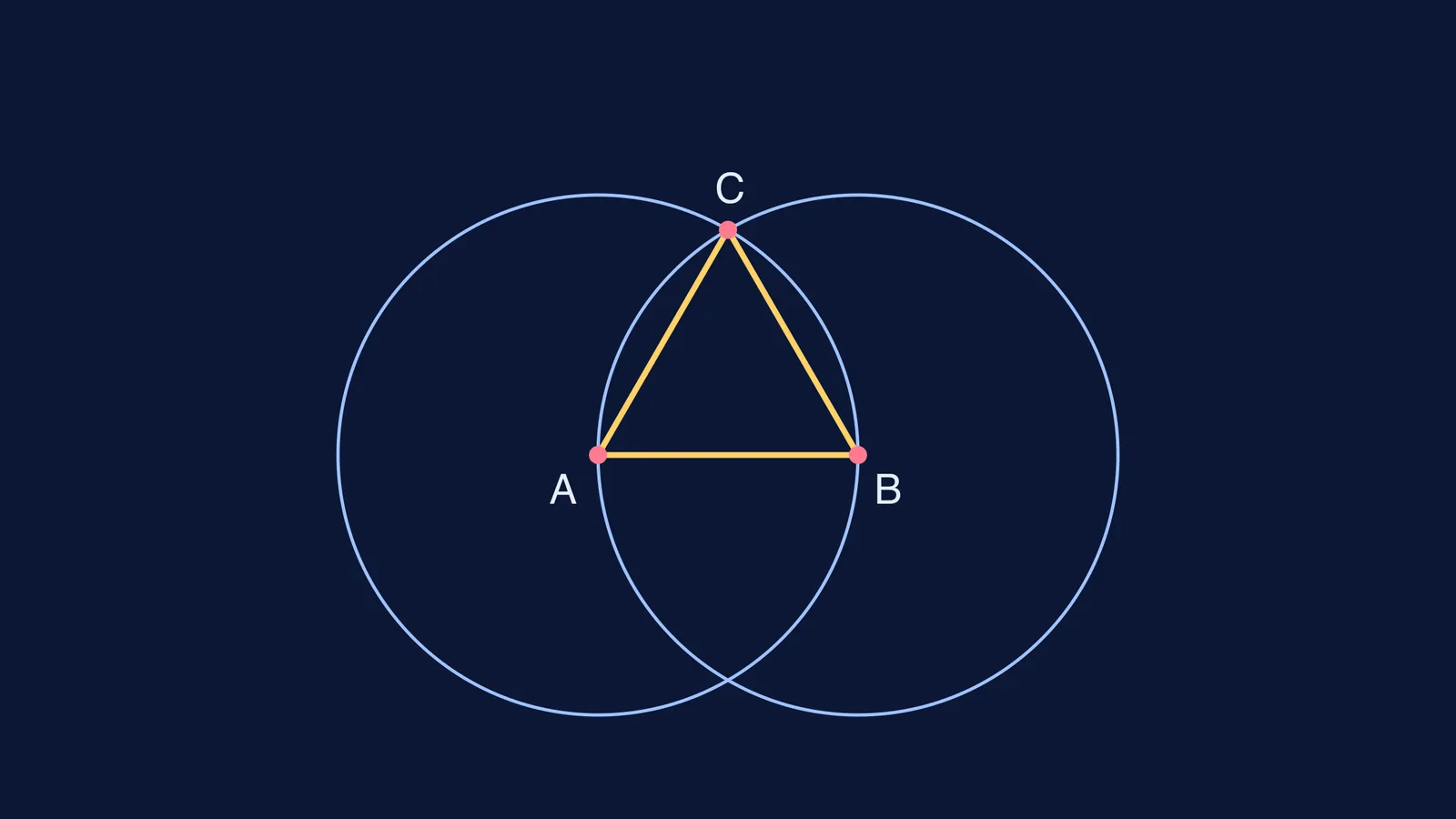
The task: construct an equilateral triangle on a given straight line AB.
Draw a circle with centre A and radius AB.
Draw a circle with centre B and radius BA.
Call C a point where the circles cut each other, and join CA and CB.
A is the centre of the first circle, so AC equals AB.
B is the centre of the second circle, so BC equals BA.
Things which equal the same thing also equal one another (Common Notion 1), so AC equals BC, and all three sides are equal.
Now do what Xu did. Close the book and write the proof in your own words, naming the reason for each line. Then check:
Did every step give a reason (a definition, a postulate, a common notion or an earlier result)?
Could a friend who has never seen the proof follow your version?
Which step did you skip? That is the one you have not yet understood.
If a step in a proof stops you because a definition is missing, the Fermi Concept Library covers every concept in mathematics, so you can look it up. For ideas that are easier to see than to read, the Fermi Simulation Lab has interactive simulations.
Translation can also go wrong: our story of Schiaparelli and the Mars canals shows what one mistranslated word did to astronomy.