On this page
In 1877, an Italian astronomer drew a map of Mars criss-crossed with thin dark lines and gave them an ordinary Italian word. English readers saw a different word, and for decades people argued about whether someone had built the canals of Mars. The real story has two errors in it: one in a dictionary and one in the human eye.
What did Schiaparelli actually see in 1877?
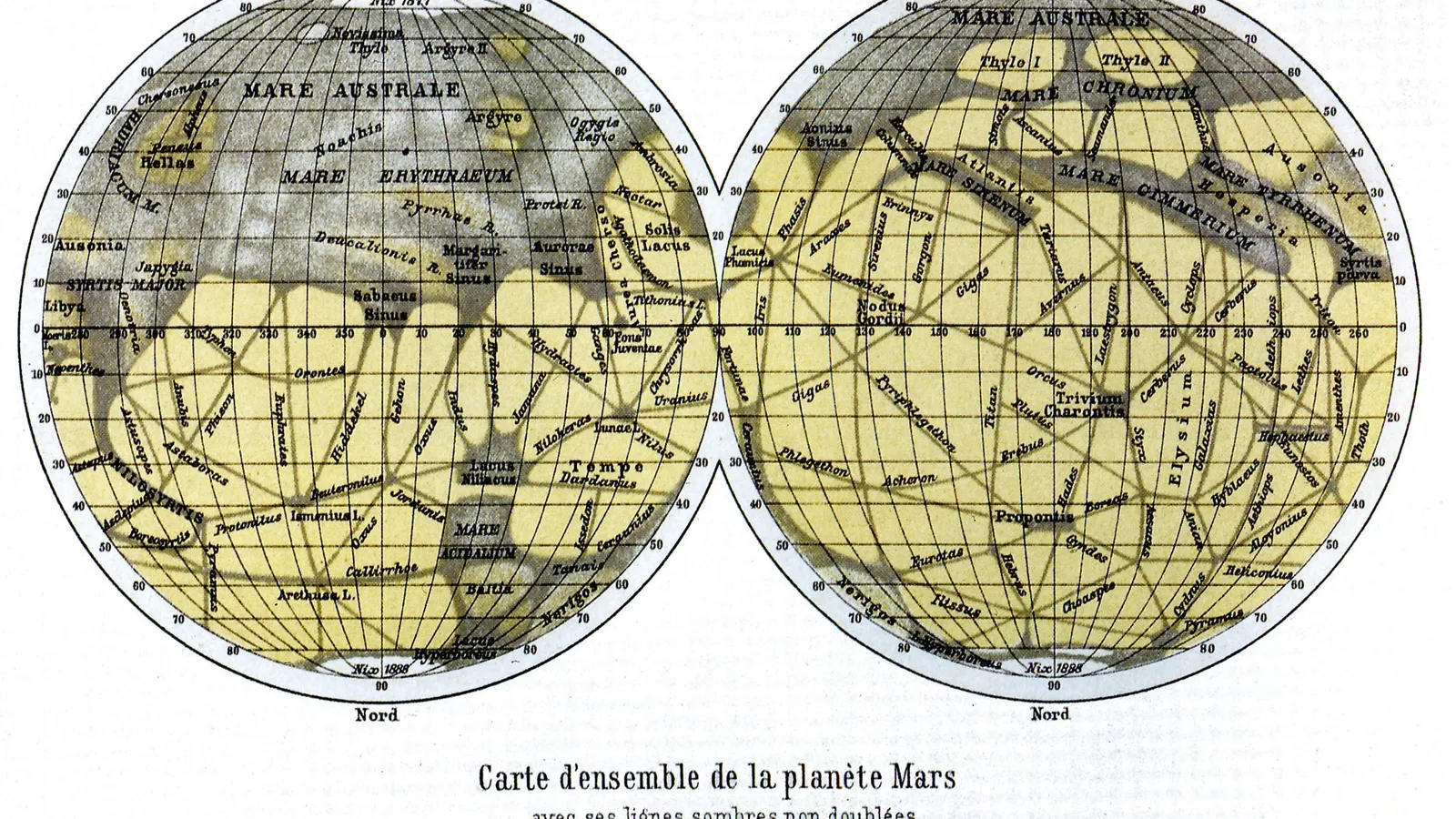
Giovanni Schiaparelli worked at the Brera Observatory in Milan for over forty years, according to his Wikipedia biography. On 5 September 1877, Mars reached a perihelic opposition, an especially close approach to Earth, and he used a 22-centimetre telescope in Milan to help produce the first detailed map of the planet, as the Wikipedia article on Martian canals records.
He also renamed the planet. Schiaparelli named dark features after ancient seas and rivers, and light areas after islands and legendary lands (Wikipedia). Across this map ran a network of straight dark lines. He called them canali.
Was "canals" a translation mistake?
Largely, yes. In Italian, canali means "channels" or "grooves", and it was popularly mistranslated into English as "canals" (Wikipedia). Lowell Observatory's own history page also describes Schiaparelli's lines as canali (channels), and says he thought they had a natural, geological origin.
The difference matters. A channel can be natural, like a river bed. A canal is dug by someone. Schiaparelli did not even coin the term: Angelo Secchi had used "canale" for Martian features in 1858, though for large features rather than straight lines (Wikipedia).
How did one word turn into Martians?
The idea found its loudest champion in the American Percival Lowell. In May 1894 he arrived in Flagstaff, Arizona, and began watching Mars through two borrowed telescopes, an 18-inch and a 12-inch (Lowell Observatory). He argued that the lines were artificial because of their straightness, their even width and the way they radiated from special points, and he set out the case in three books: *Mars* (1895), *Mars and Its Canals* (1906) and *Mars As the Abode of Life* (1908), according to the same page.
Why did astronomers see lines that weren't there?
In 1903, J. E. Evans and E. Walter Maunder tested this in a classroom. Their paper in the *Monthly Notices of the Royal Astronomical Society* (DOI 10.1093/mnras/63.8.488) asked whether a network of fine lines could be produced "upon entirely unbiassed observers without those lines having a real objective existence".
They showed boys from the Royal Hospital School, Greenwich, mostly aged twelve to fourteen, a disc with dark Mars-like patches and six small black dots, but no lines. Classes of about twenty boys sat at measured distances and drew what they saw. In the first experiment, the boys in the two nearest rows and the farthest row drew no canals, but five of the six boys in the third row joined some of the dots with straight fine lines that matched canals on the Martian maps (Evans and Maunder, 1903). At that in-between distance, the eye linked separate marks into lines.
How was the Martian canal myth finally settled?
Bigger telescopes and spacecraft settled it. In 1909, Eugène Antoniadi saw no canals through an 83-centimetre telescope at Meudon Observatory, near Paris (Wikipedia). NASA's Mariner 4 flew past Mars on 14-15 July 1965 and took 21 pictures plus part of a 22nd, showing Moon-like cratered ground (NASA NSSDC). Its arrival ended the idea that any canal features existed (Wikipedia).
To see how Mars moves through the sky around opposition, read our post on why Mars appears to move backwards in the sky. For the colour, read why Mars looks red from Earth, and for how India reached the planet, see how Ritu Karidhal planned Mangalyaan's path to Mars.
How do you avoid your own "canals" in a practical?
You will face the same trap in a school lab: a few scattered readings, and a strong urge to join them into the line you expected. Use this four-question check before you write a conclusion.
Seen or inferred? Write the raw observation first ("six points, rising"), then your reading of it ("roughly linear") on a separate line.
Which word am I using? "Precipitate", "linear" and "proportional" each make a claim. Check that the word means exactly what you observed, the way canali and canals did not.
Would someone else see it? Ask a classmate to plot your data without telling them what you expect, the way Evans and Maunder gave their boys no hints.
What would a better instrument show? Take more readings, or closer ones. If the line disappears when you look harder, it was the eye, not the data.
Worked example: your readings for a spring sit at 2.1, 4.0, 6.3 and 7.9 cm for 1, 2, 3 and 4 masses. "Straight line through the origin" is an inference. "Extension rises by roughly 2 cm per mass" is what the numbers show; add a zero-mass reading before you claim the origin.
The Fermi Simulation Lab has interactive simulations for the ideas that are easier to see than to read, so you can test a pattern instead of guessing it.