

On this page
Earth completes an orbit around the Sun in about 365 days, while Mars takes 687 days (NASA Space Science Data Coordinated Archive). Because Earth is on the "inside track" and moving faster, it eventually catches up to and passes Mars.
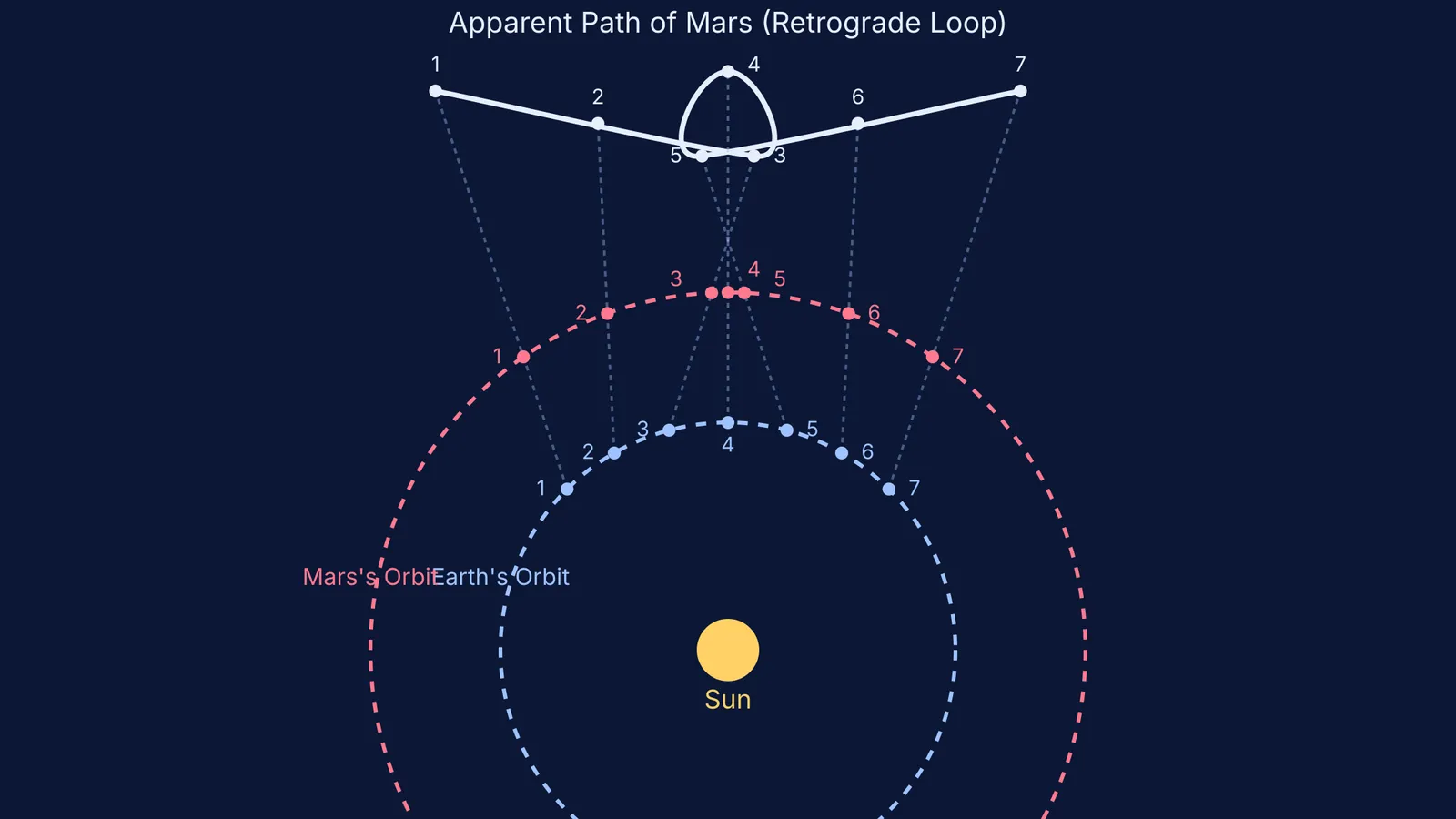
When you pass a slower car on the highway, it looks like it's moving backward relative to the distant scenery. The same optical illusion happens with planets. As Earth laps Mars, the Red Planet appears to stop its normal eastward motion, reverse direction against the background stars, and then resume its forward path once Earth pulls far enough ahead. This apparent reversal is known as retrograde motion.
How long does the retrograde motion last?
Mars goes into retrograde approximately every 26 months, and the "backward" phase itself typically lasts about 72 days (Wikipedia).
During this period, Earth is directly between Mars and the Sun—an event astronomers call opposition. Because the two planets are at their closest point, Mars appears brighter in our night sky than at any other time in its cycle.
How can you simulate the retrograde loop?
Reading about relative velocities and orbits is one thing, but picturing the shifting lines of sight in your head is difficult. This is exactly where an interactive model helps.
Instead of trying to draw multiple overlapping triangles on paper, you can use the Fermi Simulation Lab to watch it happen. When you set the Earth and Mars to orbit at their true speeds, you can draw a line connecting them and project it onto a distant star field. As Earth overtakes Mars in the simulation, you will see the projected point slow down, loop backward, and then continue forward, instantly turning a confusing optical illusion into a clear geometric result.
By observing the simulation from a top-down view, you can see how the line connecting the two planets swings forward, briefly rotates backward as the Earth passes by, and then resumes its forward swing. This change in the angle of the line of sight is exactly what you see when you look up at the night sky.
Why does relative motion matter in physics?
Understanding how motion looks from a moving frame of reference is a core skill in mechanics, especially for competitive exams. The retrograde motion of Mars is just one large-scale example of a concept that appears in many forms.
Changing frames: Problems asking whether two projectiles will collide midair or how rain falls on a moving car become much simpler when you switch to the frame of one of the objects. By subtracting the observer's velocity vector from everything else, you bring the observer to rest and simplify the geometry.
Finding the true velocity: What looks like backward motion is just a negative relative velocity. At the moment of opposition, both Earth and Mars are moving in roughly the same direction, but because Earth is faster, the relative velocity vector of Mars from Earth points in the opposite direction.
Validating intuition: When you calculate that an object should move left, picturing the physical setup (like Earth lapping Mars) acts as a quick sanity check for your math. If you want to test your understanding of circular motion, try deriving the angular speed of clock hands as they lap each other on a clock face. Just like the planets, the faster minute hand overtakes the slower hour hand, creating a constantly shifting relative angle. Alternatively, for 2D relative motion, try finding the closest approach of two moving bodies by subtracting their velocity vectors.
How can you build your intuition for relative motion?
If you are struggling with relative velocity problems in physics, try to connect the mathematical formulas to physical events you can visualise.
Start with 1D motion: Before tackling 2D vectors, master problems where objects move along a straight line, such as two trains passing each other.
Draw the vectors: Always sketch the velocity vectors. Visualising the subtraction of vectors makes it clear why an object appears to move backwards.


