

On this page
When the Indian Space Research Organisation (ISRO) launched the Mars Orbiter Mission on November 5, 2013, they were attempting something no nation had ever achieved: successfully reaching Mars on the very first attempt.
Behind the success of this mission, affectionately known as Mangalyaan, was a massive logistical and physical challenge. The spacecraft had to travel approximately 680 million kilometres over 323 days to intercept a moving planet (NASA). Ritu Karidhal, a scientist who had spent her childhood in Lucknow gazing at the stars and cutting out newspaper clippings about space, was serving as the mission's Deputy Operations Director. She was tasked with solving one of the most dangerous problems on that path: the sheer limitation of the speed of light.
Why did Mangalyaan need an autonomous brain?
Because Mars is, on average, 225 million kilometres away from Earth, communication is not instantaneous. A radio signal travelling at the speed of light took about 20 minutes to reach Mangalyaan in orbit, and it took another 20 minutes for a response to come back to Earth (TEDxGateway).
This 40-minute round trip meant ISRO ground control could not manually pilot or "joystick" the spacecraft. If a sensor failed, a motor misfired, or a navigation camera lost its lock on the stars, the spacecraft would be doomed before engineers on Earth even knew a problem had occurred.
As Deputy Operations Director, Karidhal led the development of Mangalyaan's "autonomous brain." This onboard software system was designed to perform Fault Detection, Isolation, and Recovery (FDIR). It had to execute complex, pre-loaded commands, detect any hardware malfunctions on its own, and instantly switch to redundant backup systems without human intervention.
If you are studying planetary motion and struggling with the maths of orbits, you can explore Kepler's second law from angular momentum or use the Fermi Concept Library to find every concept in physics, each with its own lesson and its place in the map.
The slingshot path to Mars
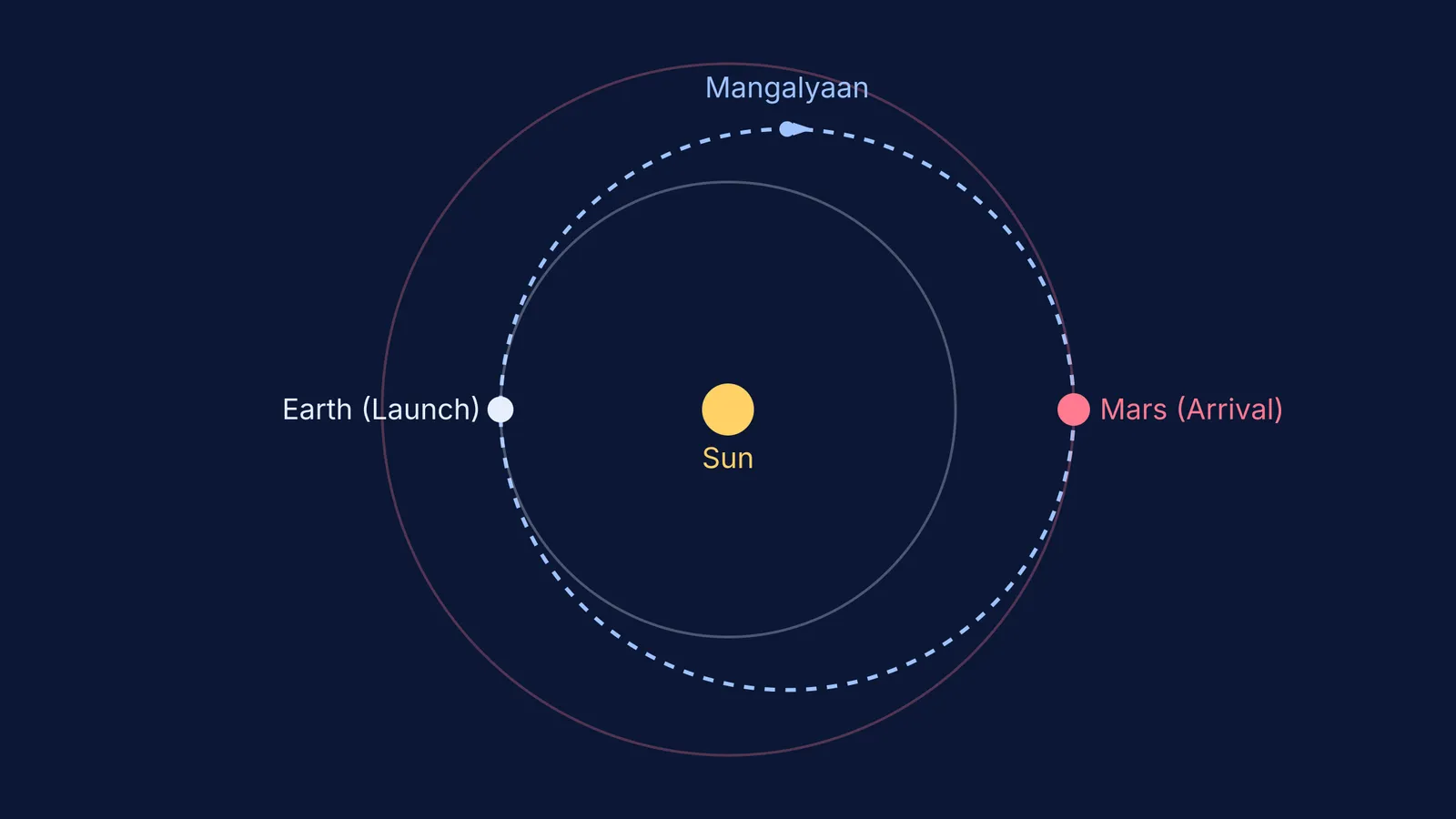
Getting to Mars was not as simple as pointing a rocket and firing. To save fuel, Mangalyaan relied on orbital mechanics. It first entered a highly elliptical orbit around Earth. Over several weeks, the spacecraft fired its engine precisely when it was closest to Earth (at perigee) to incrementally increase its velocity.
Once it had built up enough speed, a final engine burn—the Trans-Mars Injection—flung it out of Earth's gravitational sphere of influence and onto a 300-day heliocentric trajectory toward Mars (NASA).
What happened during the 26-minute blackout?
The ultimate test for Karidhal's autonomous system came on September 24, 2014, during the critical Mars Orbit Insertion (BBC News). The spacecraft had to fire its main engine in reverse to slow down enough to be captured by Martian gravity.
However, the laws of celestial mechanics meant that this critical engine burn had to happen exactly when Mangalyaan passed behind Mars. The bulk of the planet blocked all radio signals, causing a total communication blackout that lasted for a nerve-wracking 26 minutes (TEDxGateway).
During this silence, the autonomous brain took complete control. It oriented the spacecraft correctly, fired the liquid apogee motor for the exact calculated duration, and then reoriented the antenna towards Earth. When Mangalyaan emerged from the shadow of Mars, it broadcast a signal confirming it was safely in orbit.
Learning how objects move through space requires a solid grasp of vector addition and kinematics. You can review motion in a plane from r(t): velocity and acceleration vectors to see how these trajectories are plotted mathematically. If you are stuck on a difficult calculation, the Fermi Problem Library has a step-by-step solver that explains the reasoning rather than just printing an answer.
How to use the "autonomy" framework for exam prep
Karidhal and her team could not control the spacecraft in real-time, so they front-loaded the work. You can apply this same "autonomous brain" strategy to high-stakes exams like JEE or NEET, where you won't have a teacher or textbook to guide you in the hall.
Map the trajectory: Just as Mangalyaan followed a precise path to Mars, build a study schedule that counts backwards from your exam date, pacing your syllabus coverage.
Program your backup systems: Identify your weakest subjects (your "points of failure"). Decide in advance what you will do if you encounter a question you don't know—for example, skipping it immediately and returning later, just as a spacecraft switches to a redundant sensor to save power.
Simulate the blackout: The communication blackout was not a surprise; it was planned for. Take full-length mock tests in complete silence, with no phones, no music, and no checking answers halfway through. Train your brain to execute the plan when cut off from outside help.
By building your own internal autonomy, you ensure that when the pressure is highest, your preparation takes over automatically.