

On this page
If you look up at the night sky, Mars stands out as a distinct reddish-orange dot among the white and blue stars. The ancient Romans named the planet after their god of war because of its blood-like colour, and for centuries, stargazers wondered what gave the Red Planet its unique hue. Today, we know the real reason comes down to basic chemistry.
The Red Planet is essentially a rusting world. When you look at Mars, you are seeing the result of billions of years of oxidation. This is the exact same chemical reaction that rusts a steel bridge or a bicycle left out in the rain, happening on a planetary scale.
What makes iron rust on Mars?
Mars is a terrestrial planet with a radius of 3,390 kilometres, making it about half the size of Earth. Despite being significantly smaller than our home planet, its surface regolith (dirt) and volcanic rocks are incredibly rich in iron.
Over billions of years, this iron reacted with oxygen. In chemistry, this process is called oxidation. When iron atoms are exposed to oxygen, they lose electrons and bond with the oxygen to form a new compound: iron oxide. This is a large-scale example of the everyday oxidation you see in corrosion.
For a long time, scientists thought the primary iron oxide blanketing Mars was hematite, a mineral that typically forms in dry conditions. However, a February 2025 study in *Nature Communications* revealed that the dominant rust on Mars is actually ferrihydrite.
Ferrihydrite is a water-bearing iron oxide that only forms in the presence of cool, liquid water. Because this mineral is so widespread in the Martian dust, this discovery suggests that the planet's rust formed 3 to 3.5 billion years ago. During this ancient period, Mars was a cold but wet world with enough liquid water flowing across its surface to trigger a global rusting event.
Why does Mars look red from Earth?
If you were standing on the surface of Mars, the ground would not just be red; it actually features a complex mix of browns, golds, and tans. So why does the entire planet look uniformly red from millions of kilometres away? This happens because of the Martian weather and the physics of how light travels.
Martian winds are powerful enough to kick the extremely fine, powdery ferrihydrite dust high into the air.
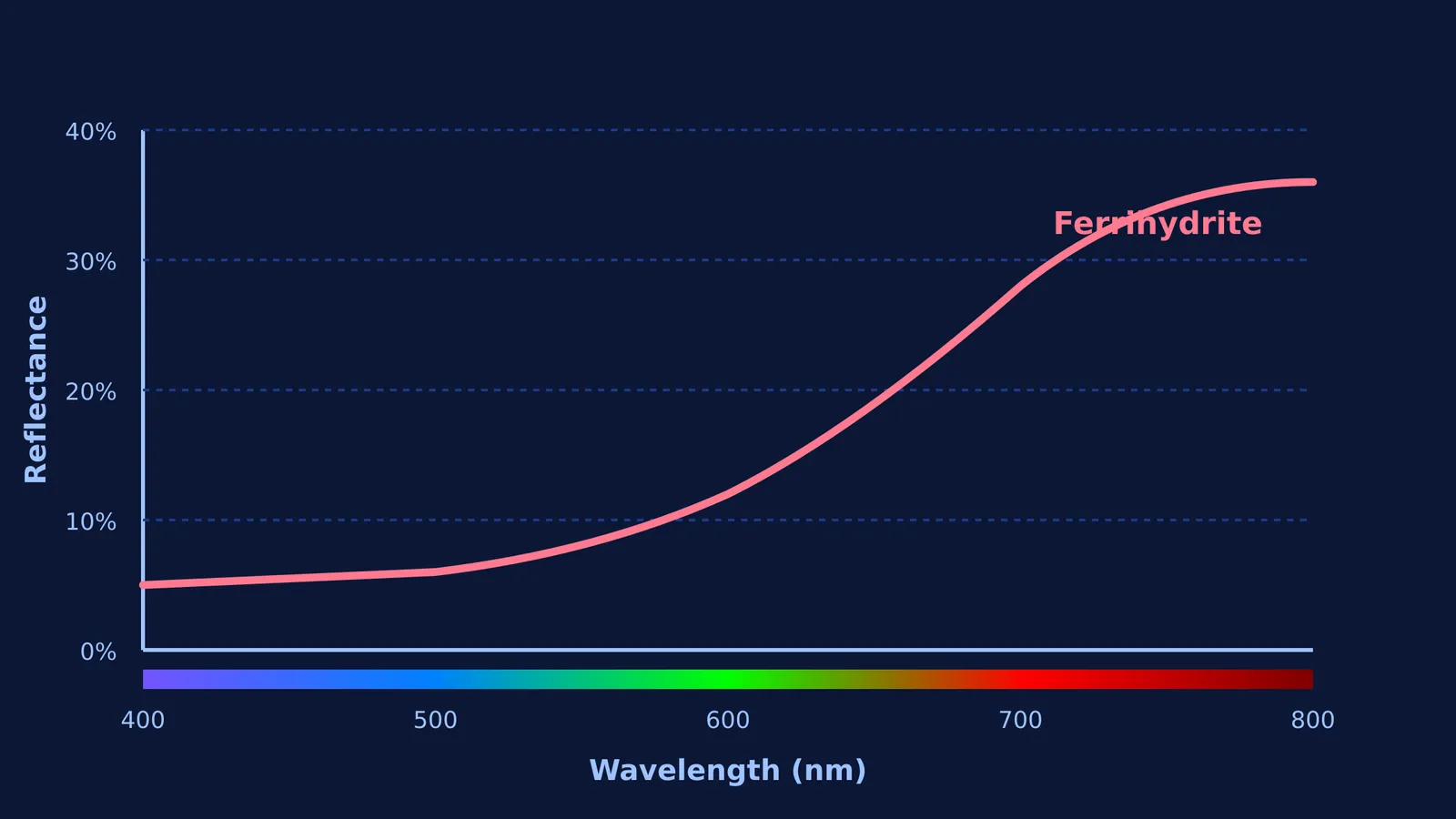
When white sunlight hits this suspended dust, the iron oxide acts like a massive optical filter. As the graph above illustrates, ferrihydrite absorbs shorter wavelengths of light, such as blue and green. This happens because the electrons in the iron atoms absorb that specific energy to jump between atomic states. At the same time, the mineral strongly reflects longer wavelengths, which correspond to red and near-infrared light. The dispersion of white light by the dust layer ensures that only the red photons survive the long journey back through space to reach your eyes on Earth.
How to identify oxidation states of iron?
If you are studying for chemistry exams, understanding how iron rusts and how to track electrons is a core skill. Iron is a d-block transition metal, which means it can lose different numbers of electrons depending on the environment and what it reacts with. You will usually encounter iron in one of two common oxidation states:
Ferrous iron (Fe²⁺): In this state, the iron atom has lost two electrons. Ferrous compounds are often pale green or colourless, and they typically form in environments without much oxygen.
Ferric iron (Fe³⁺): Here, the iron atom has lost three electrons. Ferric compounds, like the ferrihydrite and hematite found on Mars, are typically red, orange, or brown because they are fully oxidised.
Being able to determine the oxidation state of a transition metal is essential for balancing redox equations. You can easily practise calculating these states from chemical formulas, such as finding oxidation numbers from structure.
Visualising these complex chemical reactions and understanding how light scatters off molecular structures can be difficult when you are only reading a textbook. If you want to see these mechanisms in action, the Fermi Simulation Lab offers interactive simulations for the ideas that are easier to see than to read. Working through active simulations makes it much easier to picture exactly why a rusty planet absorbs blue light and reflects a brilliant red.


