On this page
You will meet ∫ dx/(x² + 1)² in Class 12 integration and in JEE practice, and at first it can look stuck. Partial fractions do not help, and the standard arctan result only covers the first power of (1 + x²). The fix is one substitution. Put x = tan θ and the whole fraction collapses into cos²θ, which you already know how to integrate.
Why does x = tan θ work for 1/(1 + x²)²?
For an integrand containing a² + x², the usual substitution is x = a tan θ, together with the identity 1 + tan²θ = sec²θ, as the page on trigonometric substitution sets out. Here a = 1, so 1 + x² becomes sec²θ in one step.
Squaring it puts sec⁴θ in the denominator, and dx brings one sec²θ back on top. What is left is 1/sec²θ, which is cos²θ.
You do not need a square root for this substitution to help. It works whenever the trouble is a power of (1 + x²).
How do you integrate dx/(x² + 1)² step by step?
Substitute. Let x = tan θ, so dx = sec²θ dθ and 1 + x² = sec²θ.
Simplify. ∫ dx/(1 + x²)² = ∫ sec²θ dθ / sec⁴θ = ∫ cos²θ dθ.
Lower the power. Since cos 2θ = 2cos²θ − 1, you get cos²θ = (1 + cos 2θ)/2.
Integrate. ∫ (1 + cos 2θ)/2 dθ = θ/2 + (sin 2θ)/4 + C.
Go back to x. θ = tan⁻¹x, and sin 2θ = 2 tan θ/(1 + tan²θ) = 2x/(1 + x²).
So ∫ dx/(x² + 1)² = ½ tan⁻¹x + x/(2(1 + x²)) + C.
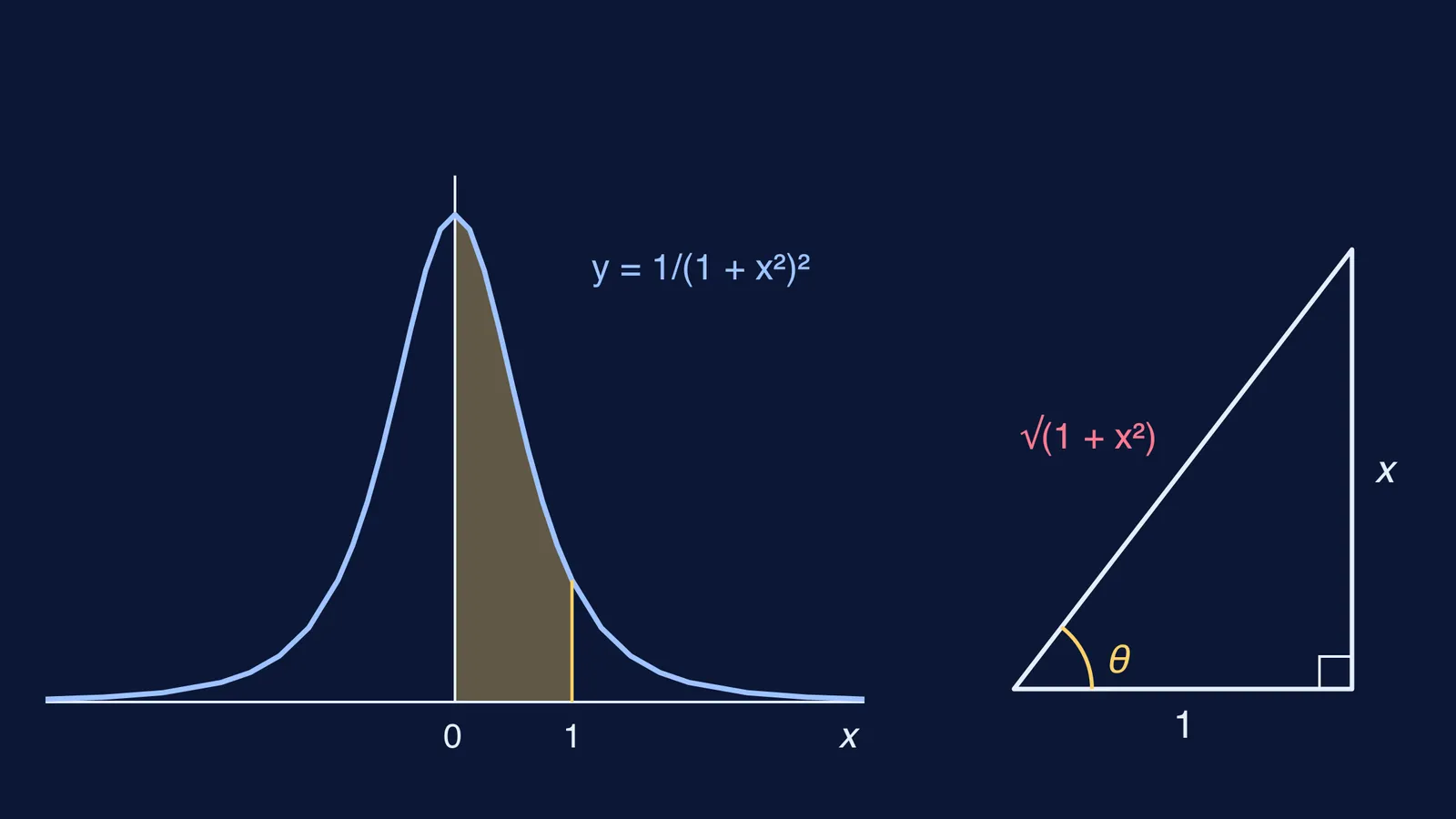
Both double-angle forms used in steps 3 and 5, cos 2θ = 2cos²θ − 1 and sin 2θ = 2 tan θ/(1 + tan²θ), are in the standard list of trigonometric identities. The tan form of sin 2θ saves you drawing a triangle. If you prefer the triangle, draw a right triangle with opposite side x and adjacent side 1, so the hypotenuse is √(1 + x²). Then sin θ cos θ = x/(1 + x²), and you get the same term.
If cos 2θ = 2cos²θ − 1 feels shaky, our post on the three forms of cos 2x and when to use each one explains which form to pick.
How do you check the answer quickly?
Differentiate it. The derivative of ½ tan⁻¹x is 1/(2(1 + x²)); see where the derivative of tan⁻¹x comes from. The quotient rule on x/(2(1 + x²)) gives (1 − x²)/(2(1 + x²)²).
Put both over the common denominator 2(1 + x²)². The numerators add to (1 + x²) + (1 − x²) = 2, which leaves 1/(1 + x²)². That is the integrand, so the answer is right.
What about definite integrals and a general a?
From x = 0 to x = 1, θ runs from 0 to π/4. Then θ/2 + sin 2θ/4 gives π/8 + 1/4, about 0.643. From 0 to infinity, θ runs to π/2 and sin 2θ falls back to 0, so the value is π/4.
For ∫ dx/(a² + x²)², put x = a tan θ. Then dx = a sec²θ dθ and (a² + x²)² = a⁴ sec⁴θ, so the integral is (1/a³) ∫ cos²θ dθ. The same steps give tan⁻¹(x/a)/(2a³) + x/(2a²(a² + x²)) + C. Put a = 1 and you are back to the first answer.
The pattern continues. A denominator of (1 + x²)³ becomes cos⁴θ, which needs the double-angle formula twice. When the numerator has an x term, as in (px + q)/(x² + 1), split it first; splitting a linear numerator into log and arctan parts shows how.
A short practice plan
Write the five steps above from memory, without looking.
Do ∫ dx/(4 + x²)² with x = 2 tan θ. You should get tan⁻¹(x/2)/16 + x/(8(4 + x²)) + C, which matches the general formula with a = 2.
Work out the definite integral from 0 to 1 and confirm π/8 + 1/4.
Differentiate your answer every time until the check is automatic.
Try ∫ dx/(1 + x²)³ and watch cos⁴θ appear.
If you get stuck on a step, the Fermi Problem Library has worked problems with a step-by-step solver that explains the reasoning rather than printing an answer. To revise substitution or the double-angle identities on their own, each concept has its own lesson in the Fermi Concept Library.