

On this page
Most students learn d/dx tan⁻¹x = 1/(1 + x²) as a line in a formula sheet, and then mix it up with the cot⁻¹x formula in the exam. You don't need to memorise two results. Derive the first in four lines, and the second follows with one extra step. Once you see where the minus sign comes from, you won't lose it.
How do you find the derivative of tan⁻¹x?
The derivative of tan⁻¹x is 1/(1 + x²) for every real number x, as listed in OpenStax Calculus Volume 1, section 3.7.
To derive it, turn the inverse function back into an ordinary one and use implicit differentiation:
Let y = tan⁻¹x. Then tan y = x, where y lies between −π/2 and π/2 (the principal values in the table of inverse trigonometric functions).
Differentiate both sides with respect to x: sec²y · dy/dx = 1.
Rearrange: dy/dx = 1/sec²y.
Use sec²y = 1 + tan²y = 1 + x². So dy/dx = 1/(1 + x²).
Step 4 is cleaner than for sin⁻¹x, where you need cos y = √(1 − x²) and must pick the sign of the root. Here sec²y is already a square, so there is no root and no sign to choose.
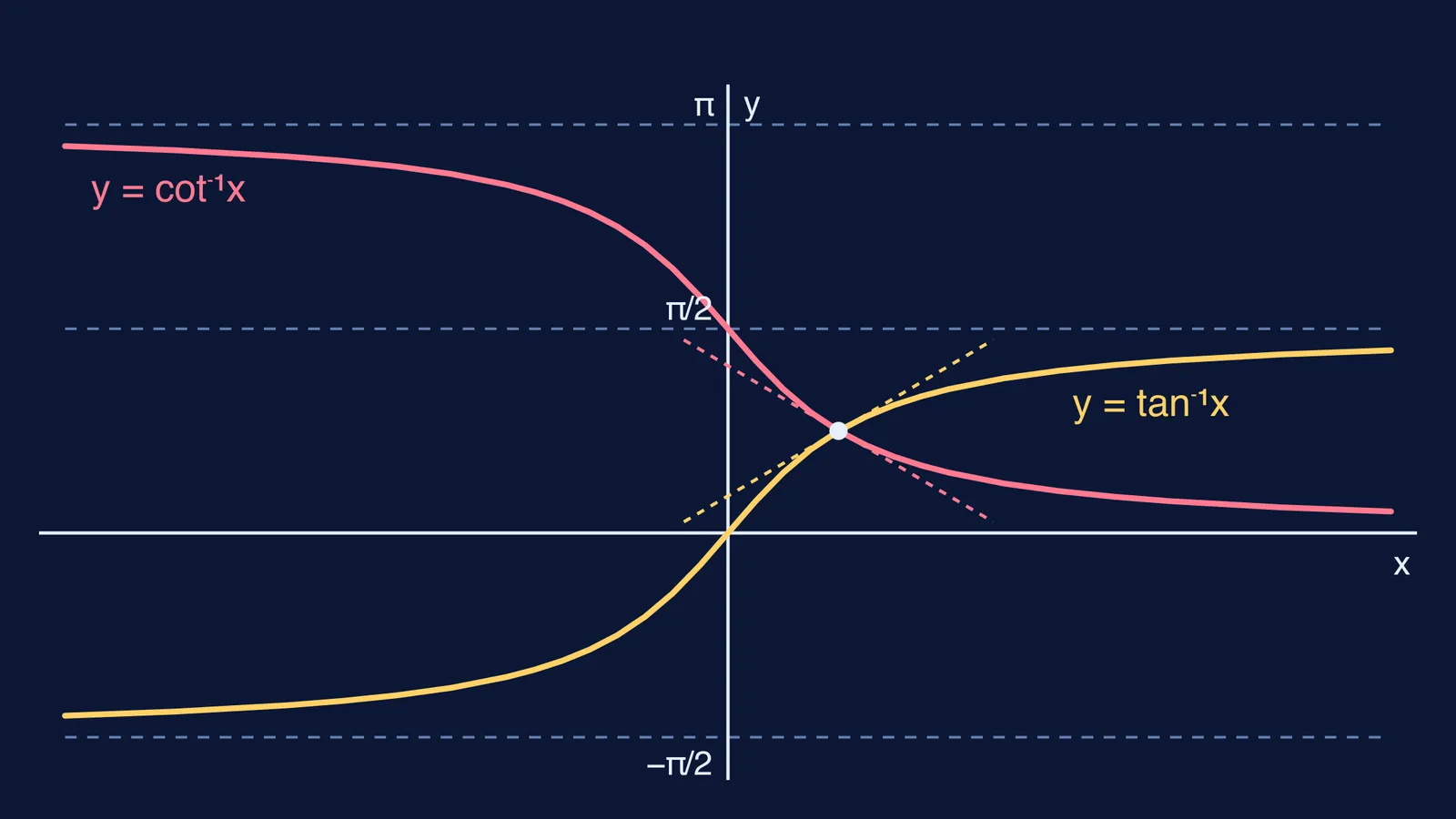
The answer also tells you how the graph behaves. 1/(1 + x²) is positive for every x, so tan⁻¹x always rises. The slope is 1 at x = 0 and gets smaller as x moves away from 0, because the curve flattens towards its asymptotes at ±π/2. For the same idea worked at a single point, see our post on finding the derivative of an inverse function without the inverse.
Why is the derivative of cot⁻¹x negative?
The derivative of cot⁻¹x is −1/(1 + x²), according to both OpenStax Calculus Volume 1 and Wolfram MathWorld. You can reach it in two ways, and doing both is a good check.
Route 1: implicit differentiation. Let y = cot⁻¹x, so cot y = x. Differentiate: −cosec²y · dy/dx = 1. Since cosec²y = 1 + cot²y = 1 + x², you get dy/dx = −1/(1 + x²). The minus sign comes from d/dx cot y = −cosec²y, which you can derive with the quotient rule in our post on the derivatives of sec x, cosec x and cot x.
Route 2: the complementary-angle identity. For every real x, cot⁻¹x = π/2 − tan⁻¹x (Wikipedia, inverse trigonometric functions). The derivative of the constant π/2 is zero, so d/dx cot⁻¹x = −d/dx tan⁻¹x = −1/(1 + x²).
Route 2 also explains the picture. With the usual range from 0 to π, cot⁻¹x falls from π towards 0 as x increases. It is the tan⁻¹x curve reflected in the line y = π/4, so its slope has the same size and the opposite sign.
What are some worked examples with the chain rule?
In exams the inside is rarely just x. Use 1/(1 + inside²) times the derivative of the inside.
y = tan⁻¹(x²): dy/dx = 2x/(1 + x⁴). This is Example 3.65 in OpenStax.
y = cot⁻¹(3x): dy/dx = −3/(1 + 9x²).
y = tan⁻¹x + cot⁻¹x: dy/dx = 1/(1 + x²) − 1/(1 + x²) = 0. That's right, because the sum is the constant π/2.
Now a harder one: y = tan⁻¹(1/x), for x ≠ 0. By the chain rule, dy/dx = 1/(1 + 1/x²) · (−1/x²). Multiply the top and bottom by x² and you get −1/(x² + 1), which is exactly the derivative of cot⁻¹x. Wikipedia's list of identities gives tan⁻¹(1/x) = cot⁻¹x for x > 0 and cot⁻¹x − π for x < 0. On each side of zero the two functions differ only by a constant, so their derivatives match.
How can you check your answer in the exam?
Before you move on, run these five checks:
Direction. Is the function rising or falling? tan⁻¹ of an increasing inside gives a positive derivative. cot⁻¹ of an increasing inside gives a negative one.
Denominator. It should be 1 + (inside)², with no square root. If you wrote a root, you have mixed it up with sin⁻¹ or cos⁻¹.
Chain factor. Did you multiply by the derivative of the inside?
Domain. Both functions are defined for every real x, so unlike sin⁻¹x, you have no endpoints to exclude.
Spot value. Put x = 0 into d/dx tan⁻¹x. You should get 1.
If you keep losing the sign or the chain factor, try the Fermi Problem Library. It has worked problems with a step-by-step solver that explains the reasoning rather than printing an answer. If implicit differentiation itself feels shaky, the Fermi Concept Library has its own lesson for each mathematics concept.
When you're comfortable with these derivatives, see how tan⁻¹ turns up again in summing tan inverse series by telescoping.


