

On this page
A JEE question gives you f(x) = x³ + x + 1, calls its inverse g, and asks for g′(3). Trying to solve y = x³ + x + 1 for x is a dead end. You don't need to. One equation and one reciprocal get you the answer. Here is the method, four worked examples and the mistakes that cost marks.
What is the formula for the derivative of an inverse function?
The inverse function theorem in OpenStax Calculus Volume 1 states that if f is invertible and differentiable, then (f⁻¹)′(x) = 1/f′(f⁻¹(x)) for every x where f′(f⁻¹(x)) ≠ 0.
In exam language: if f(a) = b, then (f⁻¹)′(b) = 1/f′(a).
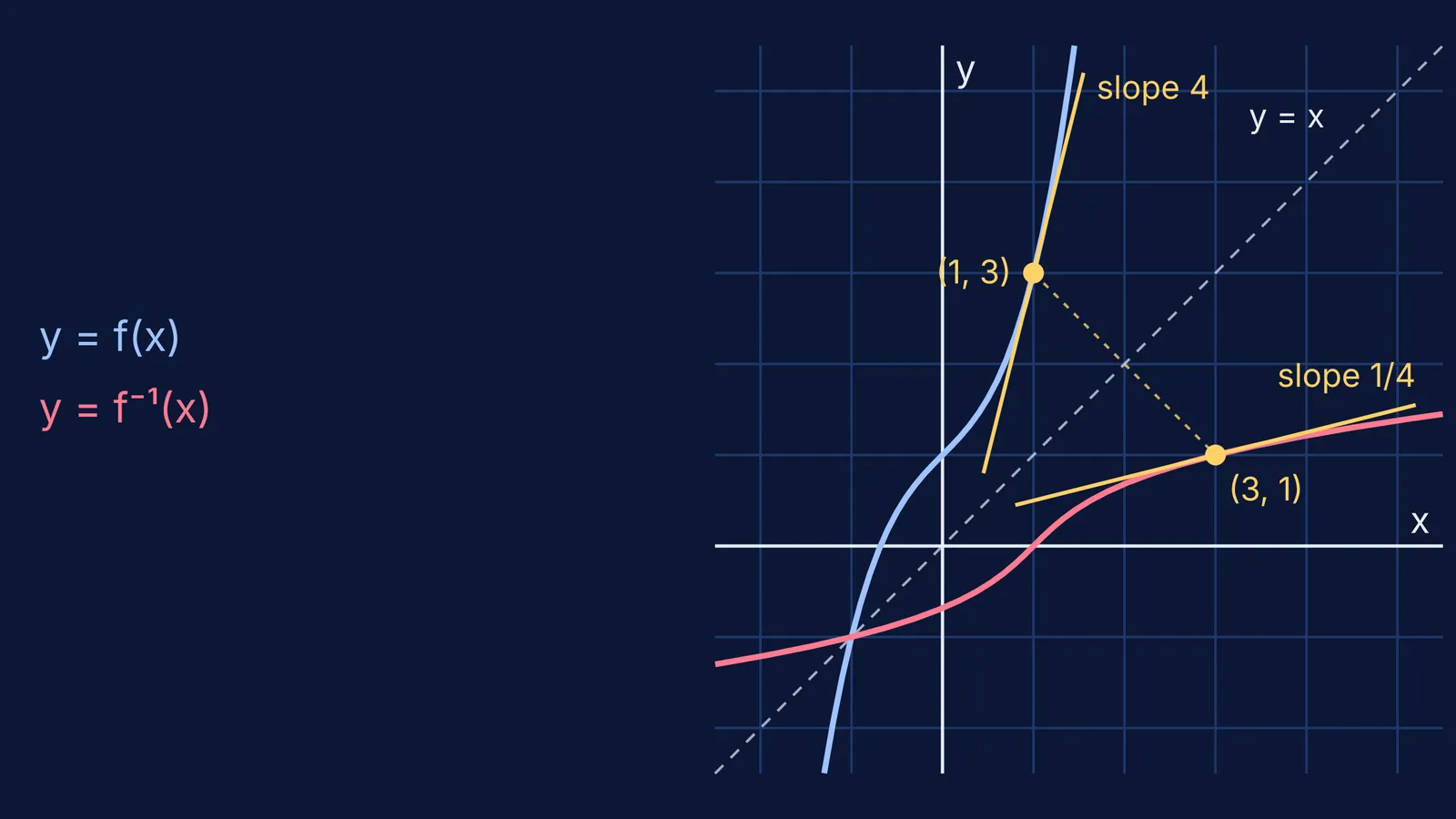
Why it works: f⁻¹(f(x)) = x for every x. Differentiate both sides with the chain rule and you get (f⁻¹)′(f(x)) · f′(x) = 1, so the two derivatives are reciprocals at matching points. The picture says the same thing. The graph of f⁻¹ is the graph of f reflected in the line y = x (we walk through that reflection in finding an inverse and reflecting its graph). Reflecting swaps rise and run, so a tangent of slope m at (a, b) becomes a tangent of slope 1/m at (b, a).
How do you find the derivative of an inverse function at a point?
Use the same four steps every time:
Check that f is one-one around the point. The quick test is that f′ keeps one sign there.
Solve f(x) = y for the given y. In exam questions the root is usually a value you can guess: try 0, 1, −1 or 2 first.
Work out f′(x) at that root.
Take the reciprocal. If f′(x) = 0, the inverse has a vertical tangent there and its derivative does not exist.
If your answers keep coming out wrong, check step 2 before the differentiation: putting the given y straight into f′ is an easy slip. The Fermi Problem Library has worked problems with a step-by-step solver that explains the reasoning, so you can see exactly where your method went off track.
Worked JEE-style examples
Example 1, a cubic: f(x) = x³ + x + 1. Find (f⁻¹)′(3).
f′(x) = 3x² + 1, which is always positive, so f is one-one. Solve f(x) = 3: x = 1 works, because 1 + 1 + 1 = 3. Then f′(1) = 4, so (f⁻¹)′(3) = 1/4.
The trap: writing 1/f′(3) = 1/28. That puts the output 3 into f′ as if it were an input.
Example 2, an exponential mix: f(x) = eˣ + x and g is its inverse. Find g′(1).
f′(x) = eˣ + 1 > 0. Solve eˣ + x = 1: x = 0. Then f′(0) = 2, so g′(1) = 1/2. Notice that g has no formula using the functions you meet in Class 12. The method doesn't care.
Example 3, the second derivative: differentiate g′(y) = 1/f′(g(y)) once more with the chain rule. Because g′(y) = 1/f′(x), you get g″(y) = −f″(x)/[f′(x)]³, where x = g(y).
For Example 1: f″(x) = 6x, so f″(1) = 6 and g″(3) = −6/4³ = −3/32.
Example 4, when the answer does not exist: f(x) = x + sin x. Here f′(x) = 1 + cos x ≥ 0 and it is zero only at isolated points, so f is still increasing and invertible.
At y = 0: f(0) = 0 and f′(0) = 2, so (f⁻¹)′(0) = 1/2. At y = π: f(π) = π but f′(π) = 1 − 1 = 0, so (f⁻¹)′(π) does not exist. The graph of f is flat at (π, π), so its reflection is vertical there. This is the condition f′ ≠ 0 from the theorem in action.
Where else does this rule show up?
Each inverse trigonometric derivative in Class 12 can be derived from this rule. Put y = sin⁻¹x, so x = sin y and dx/dy = cos y = √(1 − x²) on the principal branch. Flip it and you get dy/dx = 1/√(1 − x²). The OpenStax section derives the inverse sine derivative from the theorem in the same way. For the substitution tricks built on these results, see differentiating with inverse trig substitutions. The dx/dy = 1/(dy/dx) idea also sits behind differentiating one expression with respect to another.
If the chain rule step in the proof still feels shaky, the Fermi Concept Library gives each mathematics concept its own lesson and shows where it sits among the others, so you can patch the gap before moving on.
A 20-second check before you mark the answer
Did you put an x-value into f′, not the y-value from the question?
Does f(your x) really equal the given y? Substitute it back.
Is f′(x) non-zero? If it is zero, the answer is "does not exist".
For a second derivative, did you cube f′(x) and keep the minus sign?
Try it now: for f(x) = x⁵ + 3x − 2, find (f⁻¹)′(2). (Hint: f(1) = 2, so the answer is 1/f′(1) = 1/8.)


