

On this page
When you learn calculus, the derivatives of sin x and cos x are usually derived from first principles. But to find the derivatives of the other four trigonometric functions—sec x, cosec x, tan x and cot x—you do not need to start from scratch.
Because these functions can all be written as fractions of sine and cosine, the quotient rule/03%3A_Derivatives/3.05%3A_Derivatives_of_Trigonometric_Functions) is a reliable way to prove their derivatives. If you are ever unsure of a formula during an exam, you can recreate it in three lines using this method.
How does the quotient rule work?
Before proving the derivatives of the specific trigonometric ratios, it helps to recall the quotient rule itself. The quotient rule states that for a function f(x) = u/v, its derivative is given by:
f′(x) = (v u′ − u v′) / v²
Here, u is the numerator, v is the denominator, and u′ and v′ are their respective derivatives. You apply this rule by treating the reciprocal trigonometric functions as fractions. For example, if you need a quick refresher on differentiating with inverse trig substitutions in Class 12 or finding derivatives from first principles in Class 11, mastering these fractional proofs builds a strong foundation.
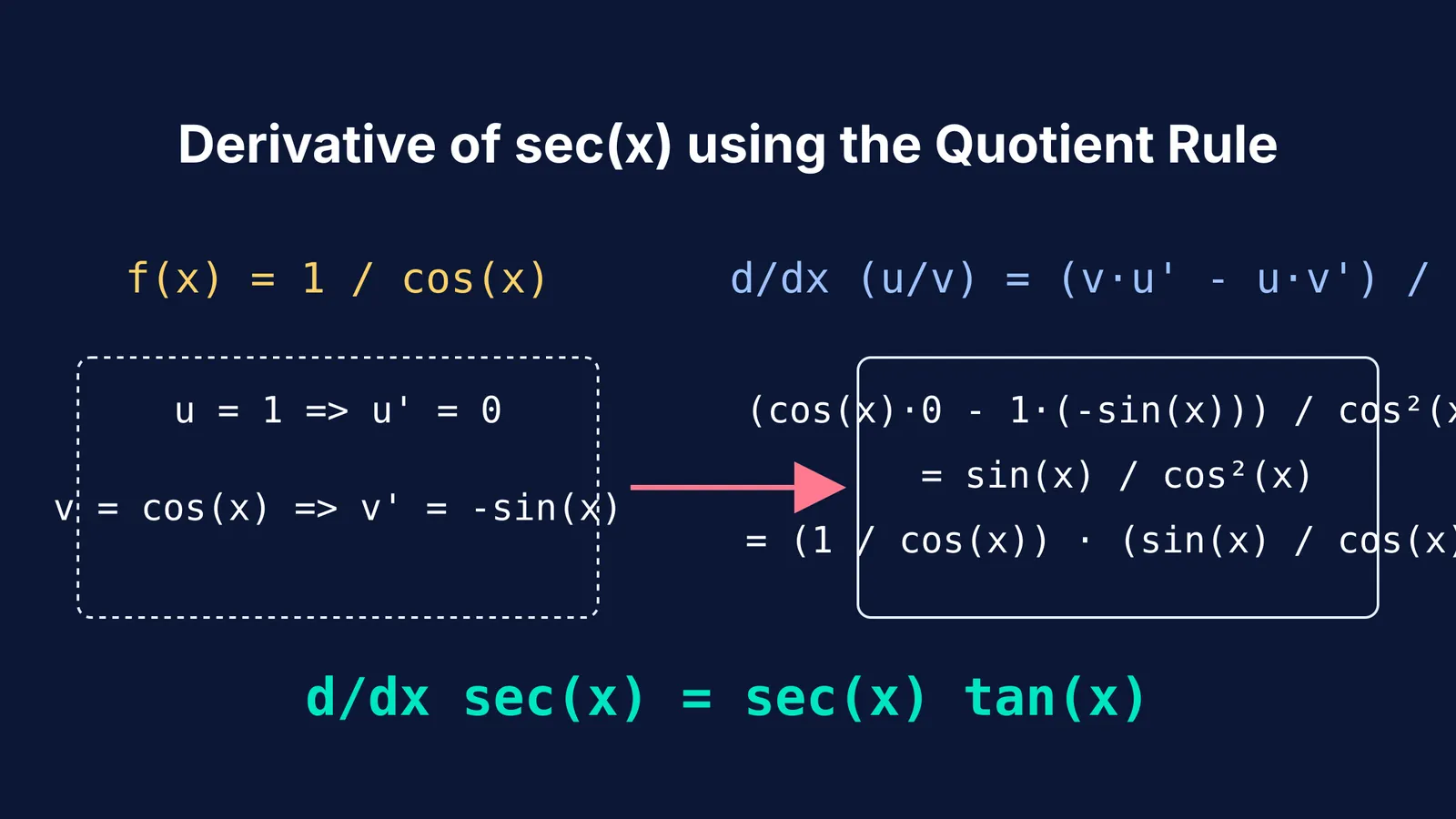
What is the derivative of sec x proof using quotient rule?
The target is to differentiate sec x with respect to x.
Write the function as a fraction. By definition, sec x = 1 / cos x.
Identify u and v for the quotient rule. Here, u = 1 and v = cos x.
Find their individual derivatives. The derivative of a constant is zero, so u′ = 0. The derivative of cos x is −sin x, so v′ = −sin x.
Plug these into the quotient rule formula:
d/dx (1 / cos x) = (cos x × 0 − 1 × (−sin x)) / (cos x)²
Simplify the numerator. The first term is 0, and subtracting a negative yields a positive:
d/dx (sec x) = sin x / cos²x
Separate the fraction to match standard trigonometric forms:
sin x / cos²x = (1 / cos x) × (sin x / cos x)
Convert back to standard ratios. Since 1 / cos x = sec x and sin x / cos x = tan x, you get the final proof:
d/dx (sec x) = sec x tan x
How do you prove the derivative of cosec x using the quotient rule?
The steps for cosec x mirror those for sec x exactly, but with sine in the denominator.
Write the function as a fraction: cosec x = 1 / sin x.
Identify the parts: u = 1 and v = sin x.
Find their derivatives: u′ = 0 and v′ = cos x.
Apply the shortened quotient rule (−v′ / v²) since the numerator is 1:
d/dx (1 / sin x) = −cos x / (sin x)²
Separate the fraction to make it recognisable:
−cos x / (sin x)² = −(1 / sin x) × (cos x / sin x)
Substitute the definitions back in. With 1 / sin x = cosec x and cos x / sin x = cot x, the result is:
d/dx (cosec x) = −cosec x cot x
If you have gaps in your underlying knowledge of these ratios, the Fermi Concept Library contains every concept in physics, chemistry, biology, mathematics and computing, each with its own lesson and its place in the map, so you can trace reciprocal functions back to their right-angled triangle origins.
What is the derivative of cot x using the quotient rule?
For cot x, the numerator is no longer 1. The quotient rule requires the full expansion.
Write the function as a fraction: cot x = cos x / sin x.
Identify the parts: u = cos x and v = sin x.
Find their derivatives: u′ = −sin x and v′ = cos x.
Apply the full quotient rule:
d/dx (cos x / sin x) = (sin x × (−sin x) − cos x × cos x) / (sin x)²
Multiply the terms in the numerator:
(−sin²x − cos²x) / sin²x
Factor out the negative sign:
−(sin²x + cos²x) / sin²x
Apply the Pythagorean trigonometric identity (sin²x + cos²x = 1):
−1 / sin²x
Convert the reciprocal back to the standard function:
d/dx (cot x) = −cosec²x
Like implicit and logarithmic differentiation for Class 12 and JEE, verifying these proofs a few times on paper makes them much harder to forget.
Is there a pattern to remember the signs?
When managing exams that require rapid recall, deriving formulas from scratch wastes precious minutes. It helps to memorise the outcomes, using the proofs only as a backup.
There is a consistent pattern in trigonometric derivatives that dictates which ones carry a negative sign: every "co-function" has a negative derivative.
Derivative of cos x is −sin x
Derivative of cosec x is −cosec x cot x
Derivative of cot x is −cosec²x
The functions that do not begin with "co" (sin, sec, tan) all have positive derivatives. If you are struggling with a complex homework question and keep dropping the negative sign, the Fermi Problem Library offers worked problems with a step-by-step solver that explains the reasoning rather than printing an answer, helping you spot the exact line where the minus sign was lost.


