On this page
If a JEE Main or JEE Advanced question asks you to add twenty tan⁻¹ terms, it expects you to spot that each term is secretly a difference of two angles, so almost everything cancels. This is the method of differences, the same idea behind telescoping sums with partial fractions.
What makes a tan inverse series telescope?
A telescoping sum has terms of the form aₙ − aₙ₋₁, so the first N terms collapse to a_N − a_0, and if aₙ approaches a limit L, the infinite sum is L − a_0 (Wikipedia: Telescoping series).
For inverse tangents, the tool is the tangent subtraction formula read backwards. The identity tan⁻¹u − tan⁻¹v = tan⁻¹((u − v)/(1 + uv)) comes from the formula for tan(α − β) and in general is true only up to a multiple of π (Wikipedia: Inverse trigonometric functions).
How do you write each term as tan⁻¹a − tan⁻¹b?
Use a three-step routine:
Find two expressions in r that differ by the numerator.
Make the denominator 1 + (their product), multiplying top and bottom by a constant if needed.
Check that ab > −1 (more below), then write the term as tan⁻¹a − tan⁻¹b.
Worked example 1. Find S = Σ tan⁻¹(1/(1 + r + r²)) from r = 1 to n.
The denominator is 1 + r(r + 1), and the numerator 1 equals (r + 1) − r. So each term is tan⁻¹(r + 1) − tan⁻¹r. Written out, the sum is (tan⁻¹2 − tan⁻¹1) + (tan⁻¹3 − tan⁻¹2) + … + (tan⁻¹(n + 1) − tan⁻¹n).
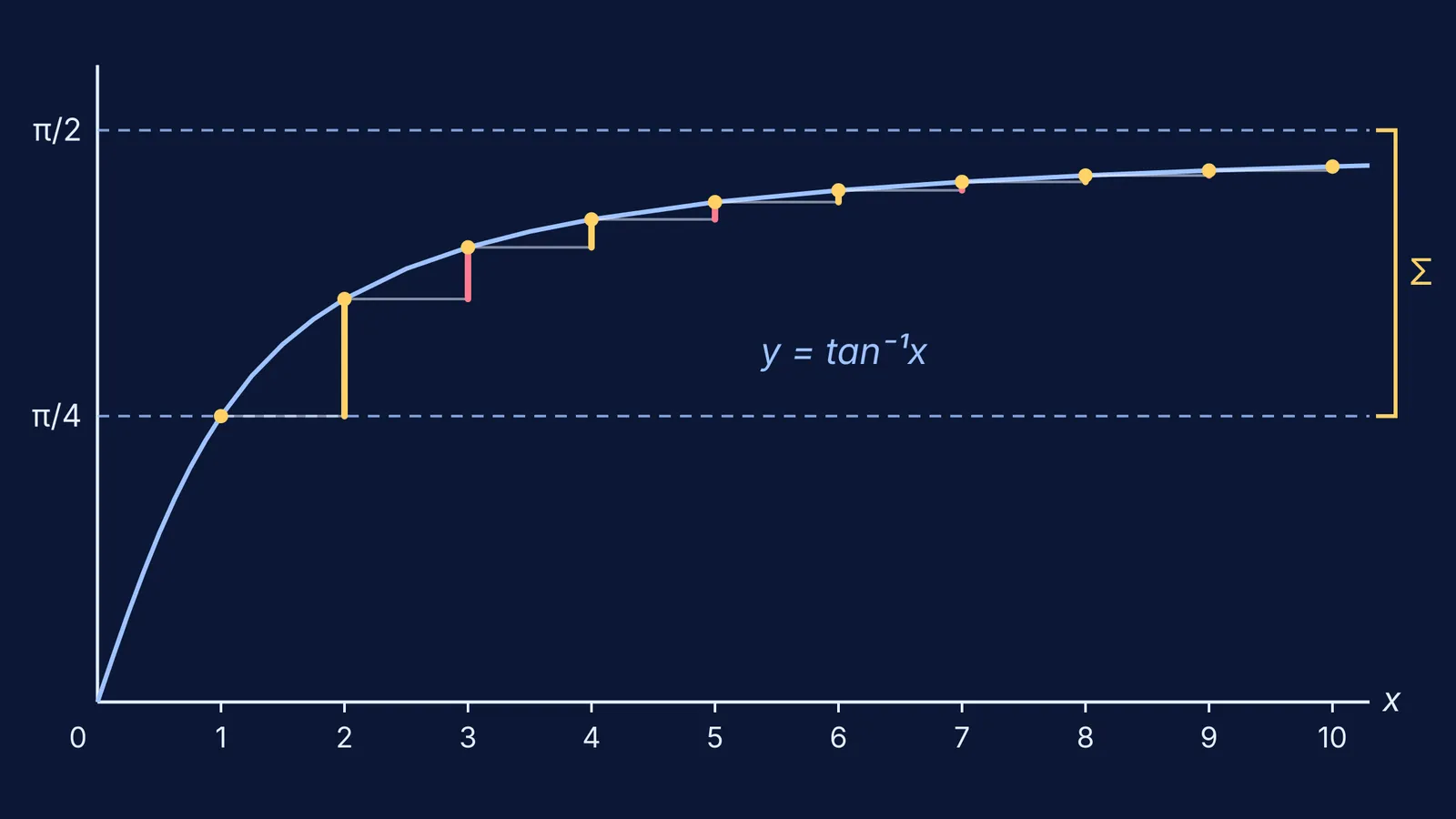
The middle cancels, leaving S = tan⁻¹(n + 1) − π/4. As n grows, tan⁻¹(n + 1) approaches π/2, so the infinite sum is π/2 − π/4 = π/4. In the diagram at the top, each coloured step is one term.
Worked example 2. Find Σ tan⁻¹(1/(2r²)) from r = 1 to n.
Multiply top and bottom by 2: 2/(4r²) = ((2r + 1) − (2r − 1))/(1 + (2r + 1)(2r − 1)). Each term is tan⁻¹(2r + 1) − tan⁻¹(2r − 1), so the sum to n terms is tan⁻¹(2n + 1) − π/4, and the infinite sum is again π/4.
When do the tan inverse sum and difference formulas fail?
Because the identity only holds up to π, you need the principal-value conditions:
Difference: tan⁻¹a − tan⁻¹b = tan⁻¹((a − b)/(1 + ab)) exactly when ab > −1, because only then does the difference stay between −π/2 and π/2. With positive a and b, as in most series, this always holds.
Sum with xy < 1: tan⁻¹x + tan⁻¹y = tan⁻¹((x + y)/(1 − xy)).
Sum with xy > 1 and x, y > 0: add π, giving π + tan⁻¹((x + y)/(1 − xy)). If x, y < 0, subtract π instead.
Sum with xy = 1 and x > 0: the answer is π/2, since tan⁻¹x + tan⁻¹(1/x) = π/2 for x > 0 (Wikipedia: List of trigonometric identities).
The same list gives π = tan⁻¹1 + tan⁻¹2 + tan⁻¹3. Since 2 × 3 > 1, the bare formula wrongly gives tan⁻¹2 + tan⁻¹3 = tan⁻¹(5/(1 − 6)) = −π/4. Adding π gives 3π/4, which matches.
For more on principal values, see our post on domains of inverse trig composites.
How do you find the infinite sum of a tan inverse series?
Find the finite sum first, then let n → ∞. The trap appears when terms cancel two apart instead of with their neighbours.
Worked example 3. Find Σ tan⁻¹(2/r²) from r = 1 to infinity.
Write 2/r² = ((r + 1) − (r − 1))/(1 + (r + 1)(r − 1)). Each term is tan⁻¹(r + 1) − tan⁻¹(r − 1), so two pieces survive at each end: S_n = tan⁻¹(n + 1) + tan⁻¹n − tan⁻¹1 − tan⁻¹0 = tan⁻¹(n + 1) + tan⁻¹n − π/4.
Now combine the first two. Here n(n + 1) ≥ 2 > 1, so you must add π: S_n = 3π/4 − tan⁻¹((2n + 1)/(n² + n − 1)). Check with n = 1: 3π/4 − tan⁻¹3 = tan⁻¹2, which is exactly the first term. As n → ∞ the fraction tends to 0, so the sum is 3π/4.
Forget the π and your limit is −π/4: a negative total for positive terms, which should be an instant warning sign. Whether a series settles to a limit at all is a separate question, covered in convergent and divergent series.
A checklist for exam day
Is the argument a fraction with 1 + (a product) underneath, or can a constant multiplier make it one?
Do the two pieces differ by exactly the numerator?
Do terms cancel with neighbours, or every second term?
Before combining the surviving tan⁻¹ terms, did you check whether xy < 1?
If you get stuck on the pattern-matching step, the Fermi Problem Library has worked problems with a step-by-step solver that explains the reasoning rather than printing an answer. To rebuild inverse trigonometry from the start, the Fermi Concept Library gives each concept its own lesson.