

On this page
Inverse trigonometric functions are a staple of competitive exams like JEE Main and board exams alike, yet they remain a significant source of errors. Many students struggle specifically with domain and range restrictions.
Before diving into complex expressions, you have to be rock-solid on the domains of the base functions.
What is the domain of sin⁻¹ x?
A trigonometric function like sine takes an angle and gives a ratio. Its inverse, sin⁻¹ x (or arcsin x), does the opposite: it takes a ratio and returns an angle. Because the sine of any real angle can only produce values between −1 and 1, you can only feed numbers between −1 and 1 into the inverse sine function.
Therefore, the domain of f(x) = sin⁻¹ x is the closed interval [−1, 1]. This means that the expression inside the inverse sine—no matter how complicated it looks—must evaluate to a number within this interval. The same rule applies to the inverse cosine function, cos⁻¹ x, which also demands an input strictly between −1 and 1. If you forget this rule, reviewing the principal values of inverse trigonometric functions is a good place to start.
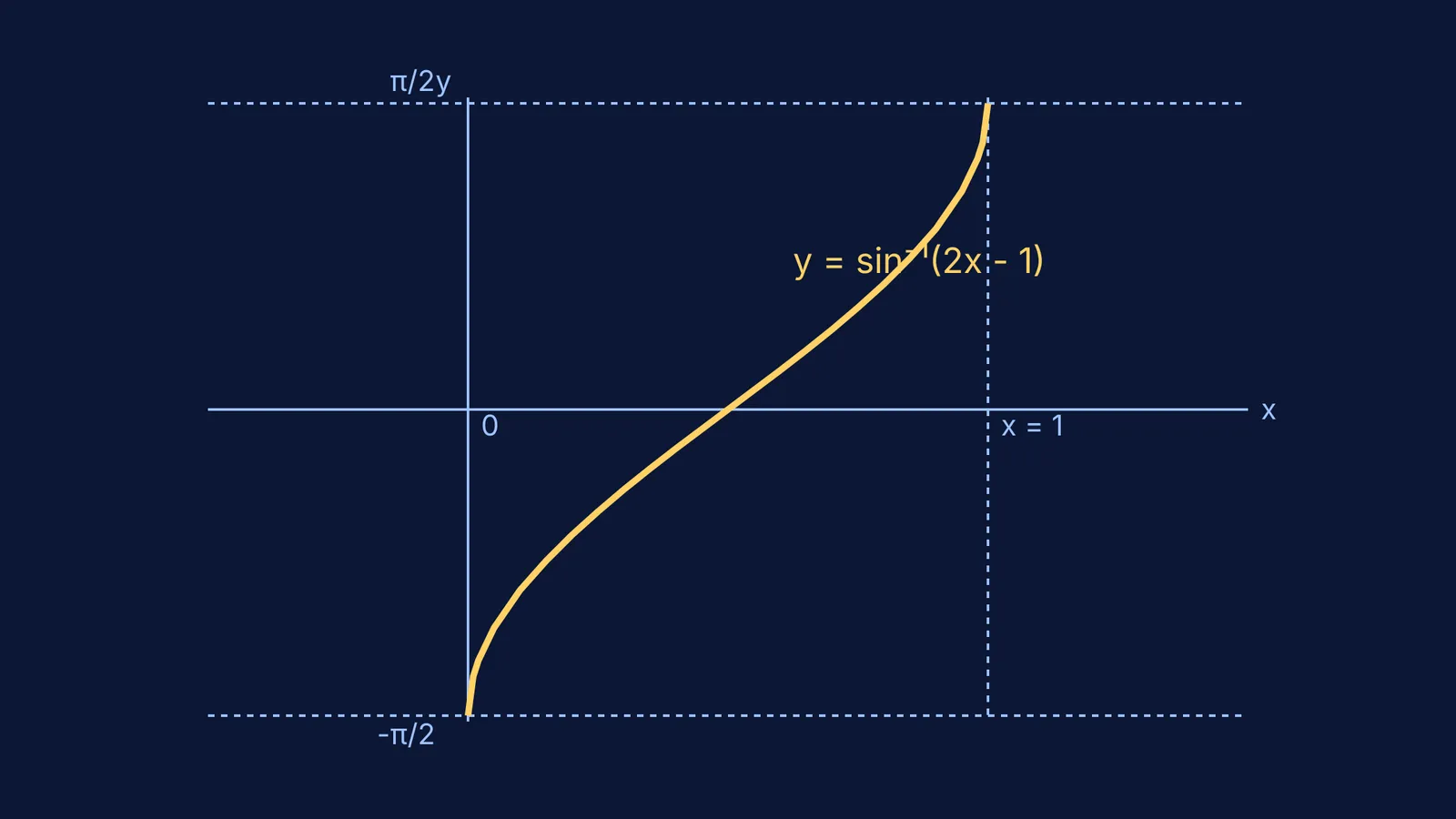
How do you find the domain of sin⁻¹(2x − 1)?
When the input is not just x but a composite expression like 2x − 1, the fundamental rule does not change. The entire inner expression must lie in [−1, 1].
To find the domain of y = sin⁻¹(2x − 1), you set up a compound inequality:
−1 ≤ 2x − 1 ≤ 1
Next, isolate x in the middle.
Step 1: Add 1 to all three parts of the inequality.
−1 + 1 ≤ 2x − 1 + 1 ≤ 1 + 1
0 ≤ 2x ≤ 2
Step 2: Divide the entire inequality by 2.
0 / 2 ≤ 2x / 2 ≤ 2 / 2
0 ≤ x ≤ 1
The domain is [0, 1]. Any value of x outside this interval will make the inner expression greater than 1 or less than −1, causing the inverse sine function to be undefined.
What happens when you combine it with other conditions?
In exams like JEE Main, you rarely get a single function. You are usually asked to find the domain of a function that combines inverse trigonometry with square roots, denominators or logarithms.
Consider the function f(x) = sin⁻¹(2x − 1) / √(1 − x²).
To find the domain here, you must satisfy two conditions simultaneously:
The numerator: We already know that the domain of sin⁻¹(2x − 1) requires x to be in [0, 1].
The denominator: The expression inside the square root must be non-negative, and because it is in the denominator, it cannot be zero. So, 1 − x² > 0, which means −1 < x < 1.
The final domain of f(x) is the intersection of these two sets: x ∈ [0, 1] ∩ (−1, 1).
Intersecting the closed interval [0, 1] with the open interval (−1, 1) means x can be 0, but it cannot be 1. The combined domain is therefore [0, 1).
When you tackle these problems, checking intersections accurately is critical. You can also explore how inverse functions behave outside standard principal intervals by looking at graphs like sin⁻¹(sin x) beyond its range.
If you are not sure how to set up the intersection, the Fermi Concept Library contains every concept in mathematics, each with its own lesson and its place in the map. The Fermi Problem Library has worked problems with a step-by-step solver that explains the reasoning rather than printing an answer. Finally, Fermi's AI tutor teaches rather than answers, holding a line of reasoning across a session to ensure you understand why an endpoint is open or closed before moving to the next step.


