

On this page
When you add up an infinite string of numbers, the result might spiral out of control, or it might narrow down to a single finite number. Understanding the difference is the foundation of calculus and mathematical analysis, and it underpins everything from calculating interest rates to solving physics problems.
What does it mean for a series to converge?
To see if an infinite series converges, you must look at its partial sums. A partial sum is the total you get when you add up only the first n terms. According to its formal mathematical definition, a series converges if the sequence of these partial sums tends to a finite limit.
In other words, as you include more and more terms, the running total settles down and gets arbitrarily close to a specific number. The formal definition states that for every error tolerance, there is a point after which all further partial sums stay within that tolerance of the limit. If the partial sums do not settle on a finite limit, but instead oscillate endlessly or grow without bound, the series is said to diverge.
When does a geometric series converge?
The geometric series is one of the most reliable models of convergence. In a geometric series, each term is found by multiplying the previous one by a constant common ratio, r.
If the absolute value of that ratio is strictly less than 1 (|r| < 1), the terms shrink fast enough that the series converges. The total sum of the infinite series is given by the precise formula S = a / (1 − r), where a is the very first term.
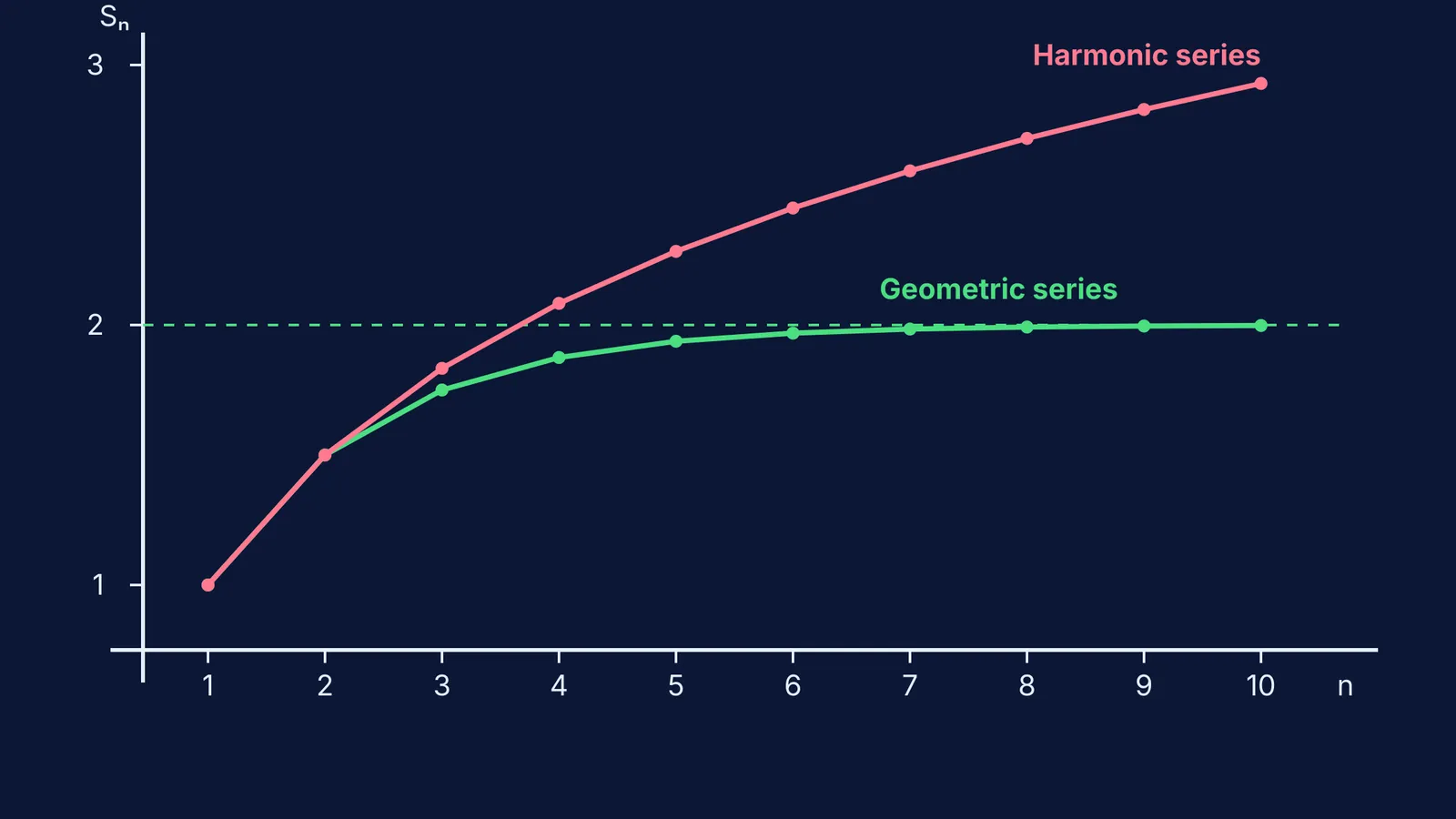
Take the geometric series where a = 1 and r = 1/2: 1 + 1/2 + 1/4 + 1/8 + ...
As you add more terms, the sequence of partial sums looks like this:
1
1.5
1.75
1.875
1.9375
Each step forward halves the remaining distance to the limit of 2. The sequence of partial sums settles exactly at 2. This predictable behaviour makes geometric progressions highly useful. (For a similar trick with repeating numbers, see Sums like 9 + 99 + 999 + …: rewriting them with a GP.)
Why does the harmonic series diverge?
It is tempting to think that any series with shrinking terms will converge. The classic counterexample to this intuition is the harmonic series, which simply adds the reciprocals of all the positive integers: 1 + 1/2 + 1/3 + 1/4 + 1/5 + ...
Even though the terms themselves get smaller and eventually approach zero, the total sum grows without bound. The first person to prove that the harmonic series diverges was the French philosopher and mathematician Nicole Oresme in approximately 1350).
Oresme used an elegant and simple grouping method. He left the first 1 + 1/2 alone, and then grouped the following terms into blocks that each sum to more than 1/2:
1/3 + 1/4 > 1/4 + 1/4 = 1/2
1/5 + 1/6 + 1/7 + 1/8 > 1/8 + 1/8 + 1/8 + 1/8 = 1/2
1/9 + ... + 1/16 > 8 × 1/16 = 1/2
Because you can keep grouping terms to produce an infinite number of halves, the sum must eventually become infinite. His technique laid the groundwork for the Cauchy condensation test used in modern analysis.
How do you test for convergence?
When preparing for competitive exams like JEE, you need a systematic way to test whether an unknown series converges.
The Divergence Test: Check the individual terms. If the n-th term does not approach zero, the series diverges immediately.
The Ratio Test: Compare consecutive terms. If the limit of their ratio is less than 1, the series behaves like a converging geometric series and settles to a limit. If it is greater than 1, it diverges.
The Comparison Test: Compare your series to one you already know. If your terms are smaller than a known converging series, yours converges too.
Sometimes you can spot an arithmetic or geometric progression directly, or use a trick like recovering aₙ from a formula for Sₙ.
If you are unsure where to start with sequences and limits, the Fermi Concept Library maps out every convergence test in the mathematics syllabus. And if you keep applying the wrong test to a complicated series, the step-by-step solver in the Fermi Problem Library explains the underlying reasoning rather than just printing the final limit.
Understanding convergence means moving past just adding numbers blindly, and learning to predict where an infinite journey will finally end.


