On this page
Age problems turn up in school algebra and aptitude tests. Nearly all follow one pattern, and the usual mistake comes before any solving: turning a sentence into symbols the wrong way round.
How do you set up age word problems with years ago and years hence?
Use one rule: the unknowns are the ages now.
Let the present ages be letters, for example F for the father and D for the daughter.
For "n years ago", subtract n from every person's age: F − n and D − n.
For "n years hence" (or "from now", or "later"), add n to every age: F + n and D + n.
Turn each sentence into one equation, using only those shifted ages.
Solve, then check against the original words, not against your equations.
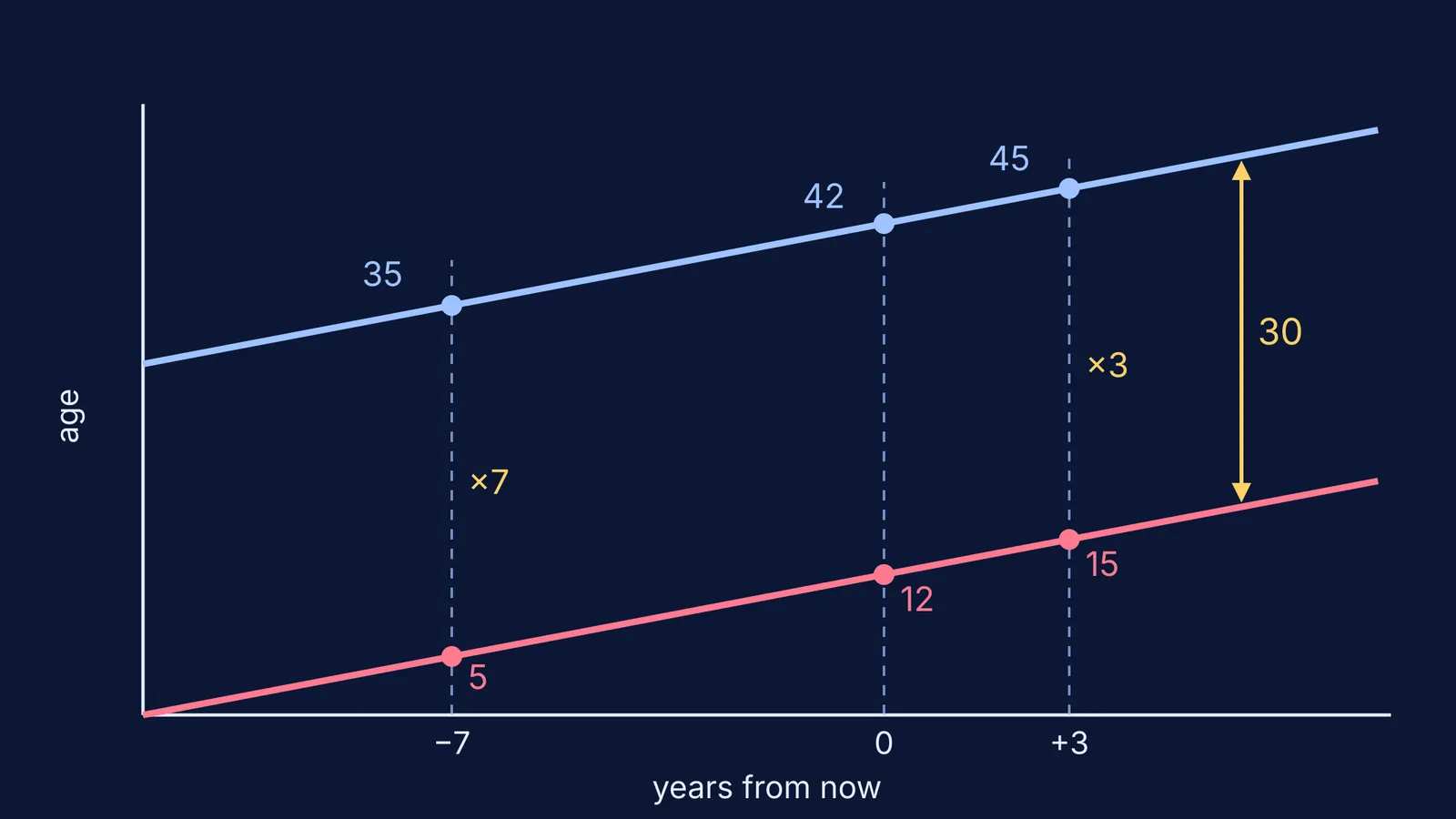
Write three short rows before any algebra: "ago", "now" and "hence", with each person's age in each row. The difference between two people's ages is the same in every row, because both get older at the same rate. Ratios change over time, but differences never do.
Worked example: "Seven years ago, I was seven times as old as you were then"
This is Example 5 in the NCERT Class 10 chapter on pair of linear equations. Aftab tells his daughter that seven years ago he was seven times as old as she was, and that three years from now he will be three times as old as she will be.
Let Aftab be s years old now and his daughter t.
Seven years ago: s − 7 = 7(t − 7), which gives s − 7t = −42.
Three years hence: s + 3 = 3(t + 3), which gives s − 3t = 6.
From the second equation, s = 3t + 6. Substituting into the first gives 3t + 6 − 7t = −42, so 4t = 48 and t = 12. Then s = 42.
Check in words. Seven years ago they were 35 and 5: seven times. In three years they will be 45 and 15: three times. The gap is 30 years in every row.
How do you solve ratio of ages problems?
When the question gives a ratio, write the present ages as multiples of one unknown, then shift both by the same number of years, never the ratio itself.
Say the ages of Riya and her brother are in the ratio 5 : 3, and four years hence the ratio will be 3 : 2. Write the ages now as 5k and 3k. In four years they are 5k + 4 and 3k + 4, so (5k + 4) ÷ (3k + 4) = 3 ÷ 2. Cross-multiplying gives 10k + 8 = 9k + 12, so k = 4. Riya is 20 and her brother is 12. Check: in four years they are 24 and 16, and 24 : 16 is 3 : 2.
Why do students write "times as old" backwards?
The classic trap is the reversal error. In a study of translation from words into algebra, Clement, Lochhead and Monk (1981) asked students to write an equation for "There are six times as many students as professors at this university." On a written test with 150 calculus-level students, 37 percent missed this problem, and two-thirds of the errors were reversals such as 6S = P (authors' copy). A later paper by John Clement (1982) traced reversals to two sources: matching the sentence's word order, and a "static comparison" that treats S as a label for students rather than their number.
Age problems invite the same slip. "The father is seven times as old as the daughter" is F = 7D, not 7F = D: if the daughter is 5, the father is 35.
How do you check if your answer makes sense?
Before moving on, check:
Every age is positive in every row, including the "years ago" row.
The difference between the two ages is the same in every row.
The older person stays older, and the gap between parent and child is believable.
Both original sentences are true when you read them with your numbers.
Ratio answers: the present ages really are in the stated ratio.
If an answer fails, recheck the setup first. For more, see how to form equations from word problems in Class 10, and for puzzles that are easier the other way round, solving word problems by working backwards.
Practice: two age problems from NCERT
The same NCERT chapter has two more. Exercise 3.2, Question 3(vi): five years hence, Jacob will be three times as old as his son, and five years ago he was seven times as old. Exercise 3.3, Question 2(ii): five years ago Nuri was thrice as old as Sonu, and ten years later Nuri will be twice as old. You should get Jacob 40 and his son 10, and Nuri 50 and Sonu 20.
If you get stuck on where a step went wrong, the Fermi Problem Library has worked problems with a step-by-step solver that explains the reasoning rather than printing an answer.