

On this page
Many Class 10 word problems go wrong at the set-up rather than the algebra. Chapter 3 of the NCERT Class 10 mathematics textbook, "Pair of Linear Equations in Two Variables", teaches substitution and elimination, then asks you to "form the pair of linear equations" for ages, digits, fractions and fares.
How do you form equations from a word problem?
Name the unknowns in words: "let n = Nuri's age now, in years", not just "let x".
Underline two separate facts. A pair of equations needs two independent conditions.
Translate each fact into one equation, using the phrase list below.
Check against the original sentences, not against your equations.
Which phrases turn into which symbols?
"x exceeds y by 18" or "x is 18 more than y": x − y = 18
"two less than twice x": 2x − 2
"incomes in the ratio 9 : 7": write them as 9x and 7x, as NCERT Example 8 does
"a two-digit number with tens digit x and units digit y": 10x + y; with the digits reversed, 10y + x
"2 is added to both numerator and denominator of x/y": (x + 2)/(y + 2)
Word order is the trap. John Clement, Jack Lochhead and George Monk asked students to write "There are six times as many students as professors in this university" as an equation (American Mathematical Monthly, 1981). A 2021 study in Pythagoras summarises the result: 68% of the incorrect responses were 6S = P, which reverses the correct 6P = S.
How do you set up age, digit, fraction and work problems?
The first three come from NCERT Exercise 3.3, Question 2.
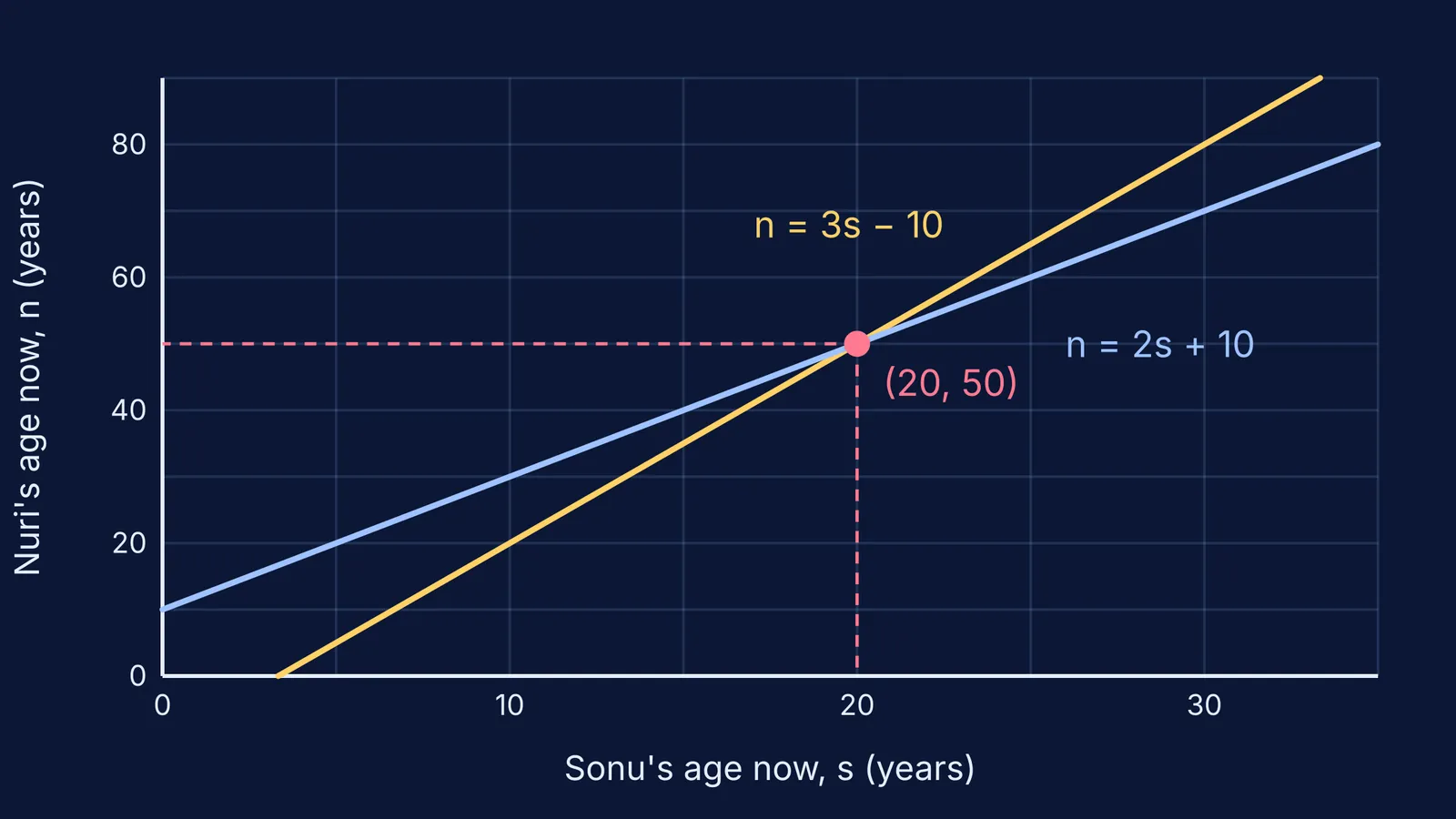
Age, Nuri and Sonu: "Five years ago, Nuri was thrice as old as Sonu. Ten years later, Nuri will be twice as old as Sonu." Let n and s be their ages now.
Five years ago: n − 5 = 3(s − 5), so n − 3s = −10
Ten years later: n + 10 = 2(s + 10), so n − 2s = 10
Subtracting gives s = 20, so n = 50. Check: 45 is three times 15, and 60 is twice 30.
Digits, nine times the number: "The sum of the digits of a two-digit number is 9. Also, nine times this number is twice the number obtained by reversing the order of the digits." Let the tens digit be x and the units digit y.
x + y = 9
9(10x + y) = 2(10y + x), which simplifies to 88x = 11y, so y = 8x
Then 9x = 9, so x = 1 and y = 8, and the number is 18. Check: 9 × 18 = 162, which is 2 × 81.
Fraction: "If we add 1 to the numerator and subtract 1 from the denominator, a fraction reduces to 1. It becomes 1/2 if we only add 1 to the denominator." Let the fraction be x/y.
(x + 1)/(y − 1) = 1, so x − y = −2
x/(y + 1) = 1/2, so 2x − y = 1
Subtracting gives x = 3, so y = 5 and the fraction is 3/5.
Work, with the unknown in a denominator (our example): "2 women and 5 men finish a job in 4 days; 3 women and 6 men finish it in 3 days. How long would one woman, or one man, take alone?" If a woman alone takes w days and a man m days, they do 1/w and 1/m of the job daily. Put p = 1/w and q = 1/m.
2p + 5q = 1/4, so 8p + 20q = 1
3p + 6q = 1/3, so 9p + 18q = 1
Elimination gives q = 1/36 and p = 1/18, so a woman takes 18 days and a man 36.
What should you check before solving?
Units match: km with km, hours with hours.
Both people's ages move by the same number of years.
Digits are whole numbers from 0 to 9, and the tens digit is not 0.
Every "times" sentence passes a small-number test.
If eliminating a variable leaves a false statement such as 0 = 9, there is no solution; a true one such as 18 = 18 means infinitely many (NCERT Examples 9 and 6). Re-read the question before blaming the algebra.
To see why a pair can have one solution, none or infinitely many, predict the graph of consistent and inconsistent linear equations. For boards, see how to write maths steps in board exams.
If your equations keep coming out wrong, the Fermi Problem Library has worked problems with a step-by-step solver that explains the reasoning rather than printing an answer, so you can compare its set-up with yours line by line. To use AI without letting it do the thinking, read how to use AI to turn maths word problems into equations.


