

On this page
Does step marking actually work in board exams?
Yes, and it is a core part of how answer sheets are evaluated. When you sit for the CBSE Class 12 mathematics exam, the examiner does not look solely at the final answer. Instead, they check your reasoning and method against a standard framework. This means that if you know how to begin a problem but stumble near the end, you will not lose all the marks for that question.
For students aiming for full marks, or those who find themselves making careless calculation errors under pressure, presenting answers clearly in steps acts as a safety net. It tells the examiner exactly what you are doing, making it easier for them to award you the marks you deserve. For more on structuring your exam papers effectively, read our guide on physics derivations in CBSE boards.
How are marks distributed across a math problem?
While the exact weightage varies depending on whether it is a 3-mark or a 5-mark question, a typical long-answer math problem in CBSE follows a predictable breakdown. Understanding this distribution helps you prioritise your time during the exam.
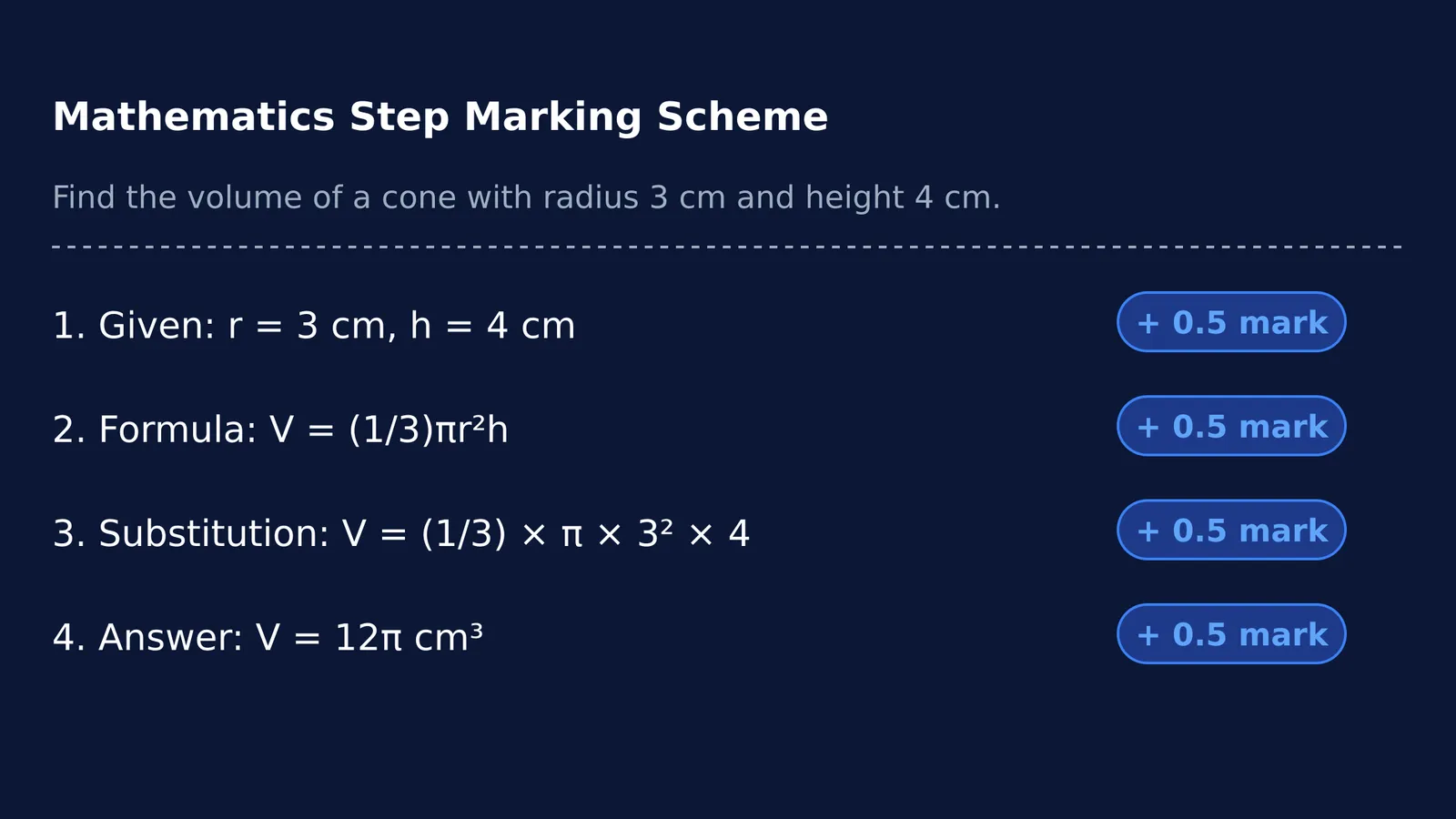
Given and To Find: Start by stating what is provided in the question and what needs to be solved. This grounds your answer and helps you avoid misreading data.
Formula or Theorem: Stating and applying the correct theorem, formula or identity is crucial. According to the official CBSE marking scheme, this typically assigns ½ to 1 mark just for the correct mathematical rule.
Substitution: Plugging the given values accurately into the formula often carries another 1 mark. Even if the calculation goes wrong later, this step proves you knew how to apply the rule.
Intermediate steps: Logical progression, algebraic simplification and solving the equation will fetch you the bulk of the credit (usually 1.5 to 3 marks).
Final answer with units: Getting the correct numerical value and writing it with its correct unit (such as cm², m/s or degrees) awards the final ½ to 1 mark. Forgetting the unit will cost you a half mark.
Because every stage is independently assessed, a simple arithmetic error in the last line of a 5-mark problem will only cost you the ½ mark assigned to the final result, leaving you with 4.5 marks if all previous steps were fundamentally sound.
What is a practical framework for writing your answers?
To ensure you never miss out on partial credit, treat every descriptive math problem as a five-part essay. Use this checklist as you practice past papers:
State the given data: Write "Given:" followed by the variables.
Write the formula: Write out the standard formula before any numbers enter the equation.
Show the substitution: Replace the variables with the numbers provided.
Detail the calculation: Break the algebra down into at least two or three readable lines.
Declare the answer: Write the final result clearly with its correct units.
If you struggle to show your reasoning or find yourself skipping straight to the answer, see our specific advice on Class 10 CBSE maths: board answer mistakes and how to show working.
Which presentation habits save marks?
Getting full marks is about making it effortless for the examiner to see your understanding. Here are three simple habits you can adopt:
Box your final answer: When you finish a calculation, draw a neat rectangle around the final result. This signals to the examiner that you have arrived at a conclusion, making it easy for them to verify the answer at a glance.
Use standard notation: Always use standard mathematical symbols. This makes your reasoning transparent.
Show rough work on the same page: Draw a line on the right side of your sheet and do your rough calculations there. If you make a transcription error while copying the result to the main body, an examiner can see the correct calculation in your rough margin and might be more lenient.
Avoid skipping steps or trying to perform multiple operations in your head. When an answer lacks working, examiners cannot tell if you reasoned it out or guessed it, and they are instructed to withhold step marks entirely.
How does Fermi help you practice step-by-step?
One reason students struggle with step marking is that standard textbook solutions often skip intermediate steps to save space, making it hard to learn how to present a full answer.
When you practice with the Fermi Problem Library, you get worked problems with a step-by-step solver that explains the reasoning rather than printing an answer. If you have a habit of making wrong-method mistakes, Fermi's AI tutor holds a line of reasoning across a session, notices where a student is stuck, and checks understanding as it goes. This actively trains you to break down your thought process into clear, logical stages — exactly the skill you need to secure every possible mark in your board exams.


