On this page
The hard step in a word problem is turning sentences into an equation. An AI chatbot will happily do it for you, and it is exactly the step you need to practise.
Why are word problems harder than the equations behind them?
It is often the translation, not the arithmetic. In a 2004 study, Kenneth Koedinger and Mitchell Nathan found that beginning algebra students were more successful solving simple story problems than the matching equations, and traced this to difficulty with the symbolic form itself (Journal of the Learning Sciences).
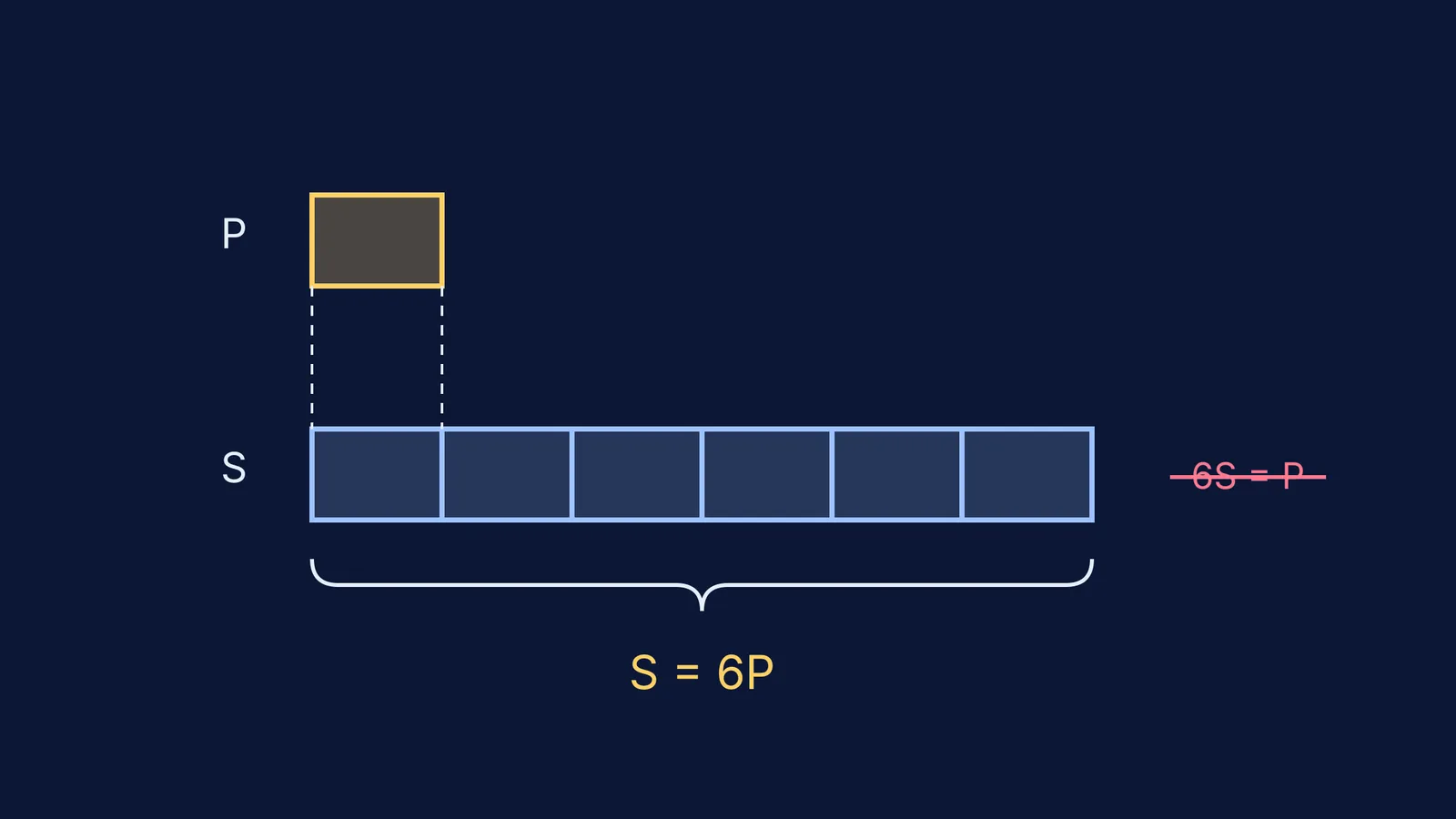
The classic example is the students-and-professors problem posed by John Clement and colleagues (Clement, 1982). As a 2021 paper in Pythagoras gives it, students were asked to write an equation for "There are six times as many students as professors in this university". The correct answer is S = 6P. The same paper reports that in Clement, Lochhead and Monk's 1981 study, 68% of the incorrect answers were the reversed equation 6S = P. "Six times" sits next to "students", so the 6 lands next to S. It feels right and is wrong, and you only learn to catch it by translating many problems yourself.
Does letting AI solve word problems hurt learning?
It can. In a field experiment published in PNAS, Hamsa Bastani and colleagues gave nearly a thousand high school maths students access to GPT-4, either as a standard ChatGPT-style interface or as a tutor with prompts designed to safeguard learning (PNAS, 2025). With the standard interface, grades on practice problems rose by 48% while students had access. When access was later taken away, those students scored 17% lower than students who never had it. The safeguards in the tutor version largely mitigated that harm. The lesson is not to avoid AI, but to choose its job. We explain the research behind that choice in hints or answers: what tutoring research says about the right help.
How do I practise word problems with AI without letting it solve them?
You do the setup; the AI only checks it.
Read the problem once, then underline every quantity and every relation word ("more than", "times", "in 5 years").
Define each variable in a full sentence, with units: "Let b = brother's age now, in years." Not just "let x be the age".
Translate one sentence of the problem into one line of algebra.
Test your equation with made-up numbers. With P = 10, S = 6P gives 60 students, which makes sense; 6S = P would give fewer students than professors.
Only now ask the AI to critique your setup, using the script below.
Solve it yourself, then check the answer against every sentence of the problem.
If the AI solves it anyway, say: "Stop. Only point to the sentence." Chatbots also make maths mistakes, so treat a critique as a prompt to reread, not a verdict; see why AI chatbots get maths wrong.
What does a good AI critique of your equation look like?
Problem: Riya is three times as old as her brother. In 5 years, she will be twice as old as he will be. How old are they now?
A student's first setup:
Let b = brother's age now, in years.
Riya's age now = 3b.
In 5 years: 3b + 5 = 2b + 5.
A useful critique does not fix this. It says something like: "Your variable is clear. Look again at 'twice as old as he will be'. How old will your brother be in 5 years?" That question sends you back to the sentence, where you see that 5 years passes for him too.
The corrected line is 3b + 5 = 2(b + 5). Solving gives b = 5, so the brother is 5 and Riya is 15. Check against the words: in 5 years they are 20 and 10, and 20 is twice 10.
A poor critique just prints "b = 5, Riya is 15", and you lose the practice. For more problems of this type, try our guide to quadratic word problems in Class 10: speed, age and area.
What if I am completely stuck on the setup?
Ask for the smallest hint first: "Which quantity should I make the variable?" After two hints, look at one full setup, close it, and redo the problem from a blank page the next day.
Fermi's AI tutor is built to teach rather than answer: it notices where you are stuck and decides whether to explain, ask or show. When you want to see full reasoning after your own attempt, the Fermi Problem Library has worked problems with a step-by-step solver that explains the reasoning rather than printing an answer.
Pick three word problems tonight, define every variable in a sentence before writing any algebra, and let the AI check only your setup.