

On this page
In short When a maths word problem describes a sequence of operations and provides the final outcome, reversing those steps is often the most direct path to the solution. An experimental study of eighth-grade students found that learning this working backwards strategy significantly improved their mathematical problem-solving ability, with 31 out of 35 students reaching a skilled or highly skilled level.
Word problems that describe a sequence of events—like spending money, giving away items, or travelling parts of a journey—often confuse students. When you read the problem from start to finish, the unknown starting value makes it hard to write an equation.
Instead of guessing the initial amount, you can start with the final result and trace the steps in reverse. This approach is called working backwards.
Why do students get stuck on word problems?
When a student tries to translate a story into algebra, they have to hold the rules, the operations, and the sequence in their working memory. A 1988 study by John Sweller on cognitive load theory noted that conventional problem-solving requires a relatively large amount of cognitive processing capacity, leaving less mental space for learning the underlying concepts.
If a student attempts to set up a complex equation with variables, a single mistake in a sign or bracket derails the whole solution. Breaking the problem down into sequential steps reduces this cognitive burden.
What is the working backwards strategy?
The mathematician George Polya formally defined the working backwards heuristic in his 1945 book *How to Solve It*. Polya observed that when the final state of a problem is clearly given, tracing the path from the goal back to the initial data is often simpler than working forwards.
To use this strategy, you must identify every operation in the story and apply its inverse in reverse order:
Addition becomes subtraction.
Subtraction becomes addition.
Multiplication becomes division.
Division becomes multiplication.
How to work backwards: a step-by-step example
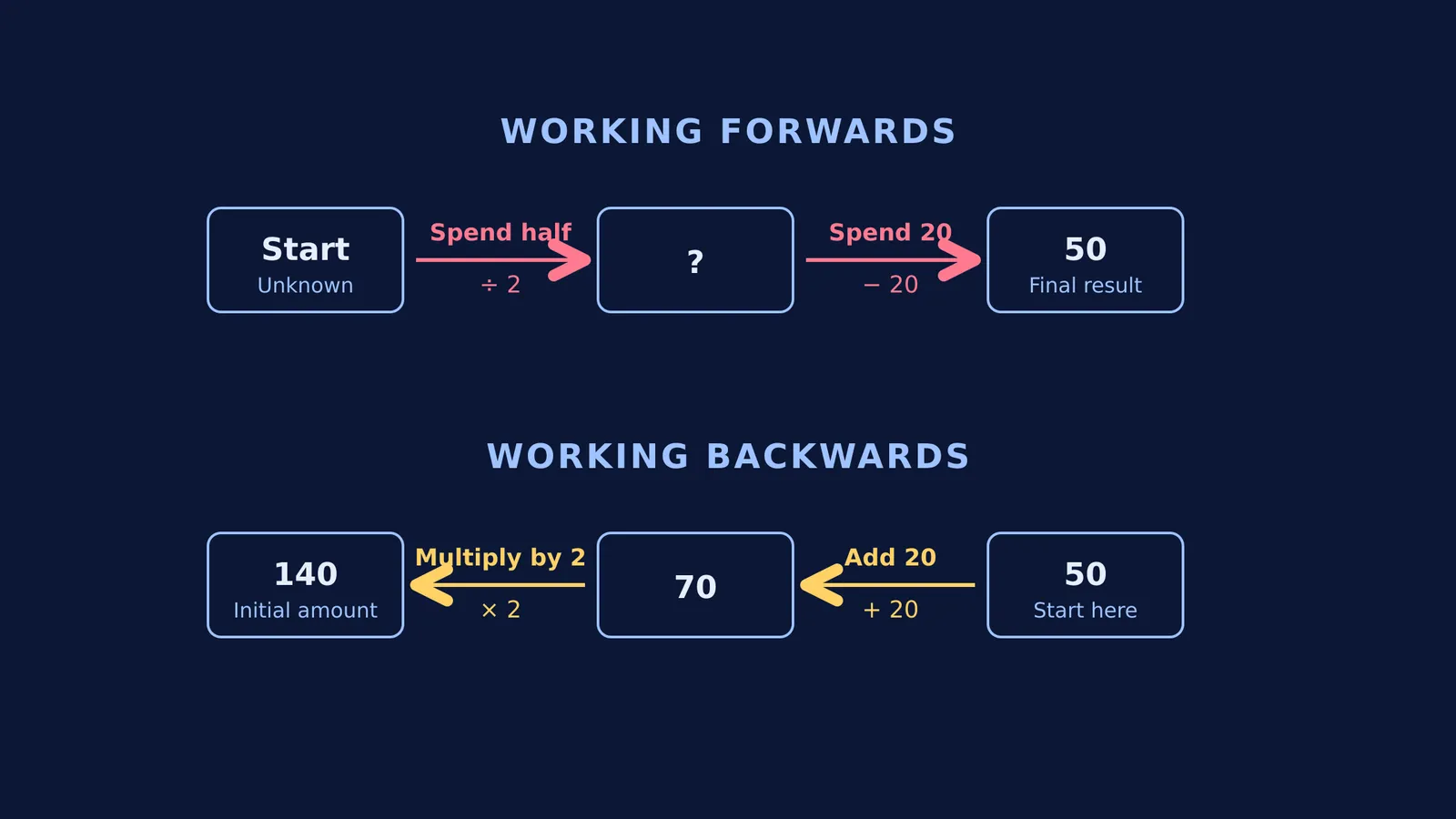
Consider this classic problem: *A student goes to a fair. They spend half of their pocket money on rides, and then spend 20 rupees on snacks. If they are left with 50 rupees, how much money did they start with?*
Here is how you reverse the operations step by step.
Step 1: Write down the final state The student finishes with 50 rupees.
Step 2: Reverse the last operation Before having 50 rupees, they spent 20 rupees on snacks. To reverse spending (subtraction), we add. *50 + 20 = 70 rupees.* They had 70 rupees before buying snacks.
Step 3: Reverse the previous operation Before they had 70 rupees, they spent half their total money on rides. Spending half means dividing the total by 2. To reverse division, we multiply by 2. *70 × 2 = 140 rupees.*
The student started with 140 rupees.
If you are solving physics problems step by step or working through a maths assignment, writing out the operations and their inverses as a table helps avoid careless errors.
Does reversing operations improve test scores?
Teaching students to actively use heuristics changes how they approach unseen questions. A 2017 experimental study in Indonesia looked at eighth-grade students solving mathematical problems. The researchers found that students taught using problem-based learning combined with a working backwards strategy achieved strong results. Out of the 35 students observed, 10 were rated as highly skilled in problem-solving, 21 as skilled, and 4 as skilled enough.
By having a concrete strategy to fall back on, students are less likely to leave a difficult question blank. Instead, they can break a hard JEE problem into steps and chip away at it from the end.
How to practice working backwards for exams
When you are stuck on a problem and do not know how to set up the algebra, look for the final given value. The Fermi Problem Library is a great place to practice these questions. If you get the inverse operations wrong, Fermi's AI tutor notices where you are stuck and guides you back to the correct path, ensuring you build the right mental habits instead of just copying an answer key.
To master this technique, write down three columns on a rough sheet:
The event: (e.g., spent 20 rupees)
The forward operation: (− 20)
The backward operation: (+ 20)
Once you list the backward operations, you can just apply them to the final number. If you find yourself consistently making the same error—such as forgetting to invert a fraction—you can even ask AI to find your pattern of mistakes.


