

On this page
When you finish a mock paper or practice set for Class 11 or 12, a red pen mark on Question 7 often feels like an isolated accident. Most students check the official marking scheme, copy the right derivation into their notebook, and tell themselves to concentrate harder next time. But treating errors one problem at a time rarely stops them from reappearing in the next test.
Instead of treating every slip as a separate disaster, you can paste an unformatted log of your last ten to twenty wrong answers into an AI chatbot and ask it to group them. This converts a scattered notebook of red crosses into an objective diagnostic report. We know why mistakes help learning when they are investigated rather than hidden, but finding their underlying pattern is what makes that practice systematic.
Why do mistakes follow repeatable patterns?
Decades of educational research show that academic errors are rarely random lapses of attention. In a landmark 1979 study on mathematics learning published in the *Journal for Research in Mathematics Education*, researcher Hendrik Radatz established that student errors act as systematic symptoms of underlying cognitive processes: https://doi.org/10.5951/jresematheduc.10.3.0163. Radatz classified mathematical errors into five distinct cognitive mechanisms, including semantic translation breakdowns between natural and technical language, deficiencies in prerequisite facts, and the rigid application of irrelevant rules. When you calculate an incorrect trajectory in mechanics or drop a negative sign in electrostatics, you are usually following an ingrained flawed habit rather than making an unpredictable slip.
Modern cognitive science confirms that analyzing these systematic missteps produces durable retention. In a review in the *Annual Review of Psychology*, Columbia University psychologist Janet Metcalfe showed that making errors accompanied by corrective feedback significantly enhances learning outcomes compared to passive error avoidance: https://doi.org/10.1146/annurev-psych-010416-044022. Metcalfe highlighted the hypercorrection effect, where mistakes committed with high confidence are corrected more readily once a student discovers why their reasoning failed. To capitalize on this, you need a diagnostic mirror that reveals which flawed assumptions drive your repeated errors.
This is where Fermi's AI tutor helps during daily revision. Fermi works out what you already know, builds a plan for the session, and notices where you are stuck, so you spend your time repairing the exact concept gaps that cause wrong answers.
How can you prompt AI to cluster your errors?
Large language models excel at finding semantic patterns across raw text. To get an accurate error diagnosis, do not ask the AI to solve the questions for you. Instead, supply the raw log of what you did and where your answer broke down. You can learn more about getting useful AI feedback on your step-by-step solutions by submitting your actual reasoning.
Here is a structured prompt template you can paste into any AI tool:
"Here is a raw list of mistakes I made across my recent physics and maths practice papers. For each item, I have noted the topic, what I wrote, and what went wrong. Please analyze this list and do three things:
Group these mistakes into 3 to 5 cognitive clusters (for example: question misinterpretation, missing conceptual prerequisite, algebraic manipulation slip, or units and sign conventions).
For each cluster, explain the exact root cause of the error rather than just summarizing the topic.
Identify the single cluster with the highest recurrence, and give me three concrete rules to eliminate it over the next seven days."
What does an error analysis look like in practice?
Consider a student preparing for competitive STEM exams such as JEE and board finals. Over three days of solving mechanics and calculus problems, the student logged ten errors:
Kinematics: Used horizontal speed instead of initial velocity component when finding projectile flight time.
Thermodynamics: Wrote work done by gas as positive during a compression cycle.
Definite Integrals: Forgot to flip limits after substituting u = -x.
Circular Motion: Omitted normal force at the highest point of a vertical loop.
Trigonometry: Confused sin(180° - θ) with cos θ during vector resolution.
Gas Laws: Substituted pressure in bar without converting to Pascals in the ideal gas equation.
Differential Equations: Divided by zero while separating variables without checking boundary conditions.
Electrostatics: Treated electric potential as a vector and took directional components.
Rotational Dynamics: Used moment of inertia about the centre of mass instead of the hinge point.
Vectors: Misread 'parallel to vector B' as 'perpendicular to vector B' in the question text.
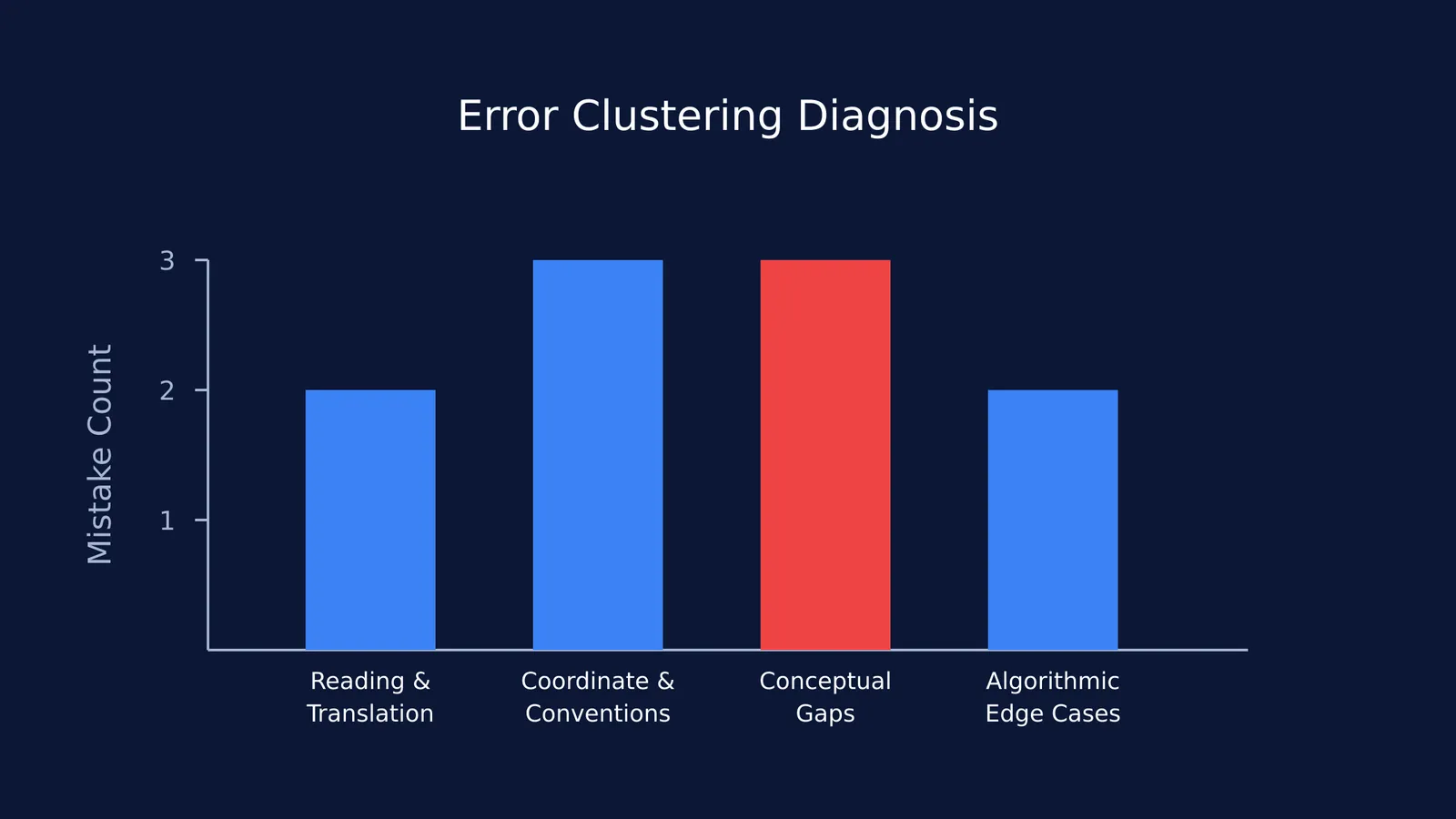
When you ask the AI to cluster this list, it ignores textbook chapter boundaries and groups them by cognitive failure points:
Cluster 1: Reading and translation slips (Items 1 and 10), where problem constraints were decoded inaccurately.
Cluster 2: Coordinate and convention oversights (Items 2, 3, and 6), where sign rules and SI base units were skipped.
Cluster 3: Conceptual model gaps (Items 4, 8, and 9), such as confusing scalar potentials with vectors or omitting contact forces.
Cluster 4: Algorithmic edge-case slips (Items 5 and 7), where formula transformations lacked boundary checks.
Once you identify that Cluster 3 accounts for your most severe conceptual leaks, you can turn to the Fermi Concept Library, which covers every concept in physics, chemistry, biology, mathematics and computing, each with its own lesson and its place in the map. When wrong-method mistakes dominate, the Fermi Problem Library provides worked problems with a step-by-step solver that explains the reasoning rather than printing an answer.
How should you fix one error cluster this week?
Trying to overhaul your entire problem-solving method in a single weekend leads to cognitive overload. In their classic 1993 study in *Psychological Review*, researchers K. Anders Ericsson, Ralf Krampe, and Clemens Tesch-Römer demonstrated that deliberate practice requires targeting specific, constrained aspects of performance with immediate self-monitoring: https://doi.org/10.1037/0033-295X.100.3.363. Rather than solving fifty mixed questions hoping your marks improve, spend the entire week eradicating just one identified cluster.
If your dominant cluster is coordinate and sign conventions, establish a mandatory pre-flight routine. Before multiplying any numbers, draw your coordinate axes, state the positive direction in writing, and convert all quantities into standard SI units. Research on self-explanation by Michelene Chi and colleagues (Cognitive Science, 1989) showed that high-performing students actively justify each problem step against underlying principles. Adopting neat working cuts exam errors by making sign checks visible before your pencil reaches the final step.
At the end of seven days, run a targeted ten-question drill focused exclusively on that weak point. Once that error pattern drops to zero, paste your next batch of mistakes into the AI and pick the next pattern to dismantle.


