

On this page
A hard JEE problem rarely tests one idea. It chains several, and students often get stuck on the order: which idea comes first, and what does it hand to the next? An AI chatbot can help with that, if you ask it for the plan and keep the solving for yourself.
Why ask AI for a plan instead of the solution?
Because answers during practice can cost you later. In a field experiment published in PNAS in 2025, researchers gave nearly a thousand high school maths students access to GPT-4 tutors during practice (Bastani et al., PNAS). With a standard ChatGPT-style interface, practice grades rose 48%, but once the AI was taken away those students scored 17% lower than students who never had it. A second version, with prompts designed to safeguard learning, largely removed that harm.
The plan is also the part worth learning. A subgoal is a named intermediate step in a method, such as "find the speed just before the collision". In a study in Learning and Instruction, learners who received subgoal labels in both the explanation and the worked example solved novel problems better than learners who did not (Margulieux and Catrambone, 2016). That study taught programming, not physics, so treat it as a reason to try this, not a promise.
How do you ask AI to break a JEE problem into steps?
First attempt the problem on paper until you are truly stuck, so you know where the trouble is. Then paste the full problem and send this:
"Do not solve this problem. Do not give formulas, numbers or the final answer. Split it into three to five sub-questions in the order I should answer them. For each one, say only what it asks for and which earlier result it needs. Then wait for my working."
Read one sub-question at a time and solve it on paper before looking at the next. If the chatbot solves the problem anyway, stop reading and ask again. For more on this, see how to get hints instead of answers from an AI tutor.
Worked example: one problem, three sub-questions
Here is a JEE Main-style problem we wrote for this post (take g = 10 m/s²):
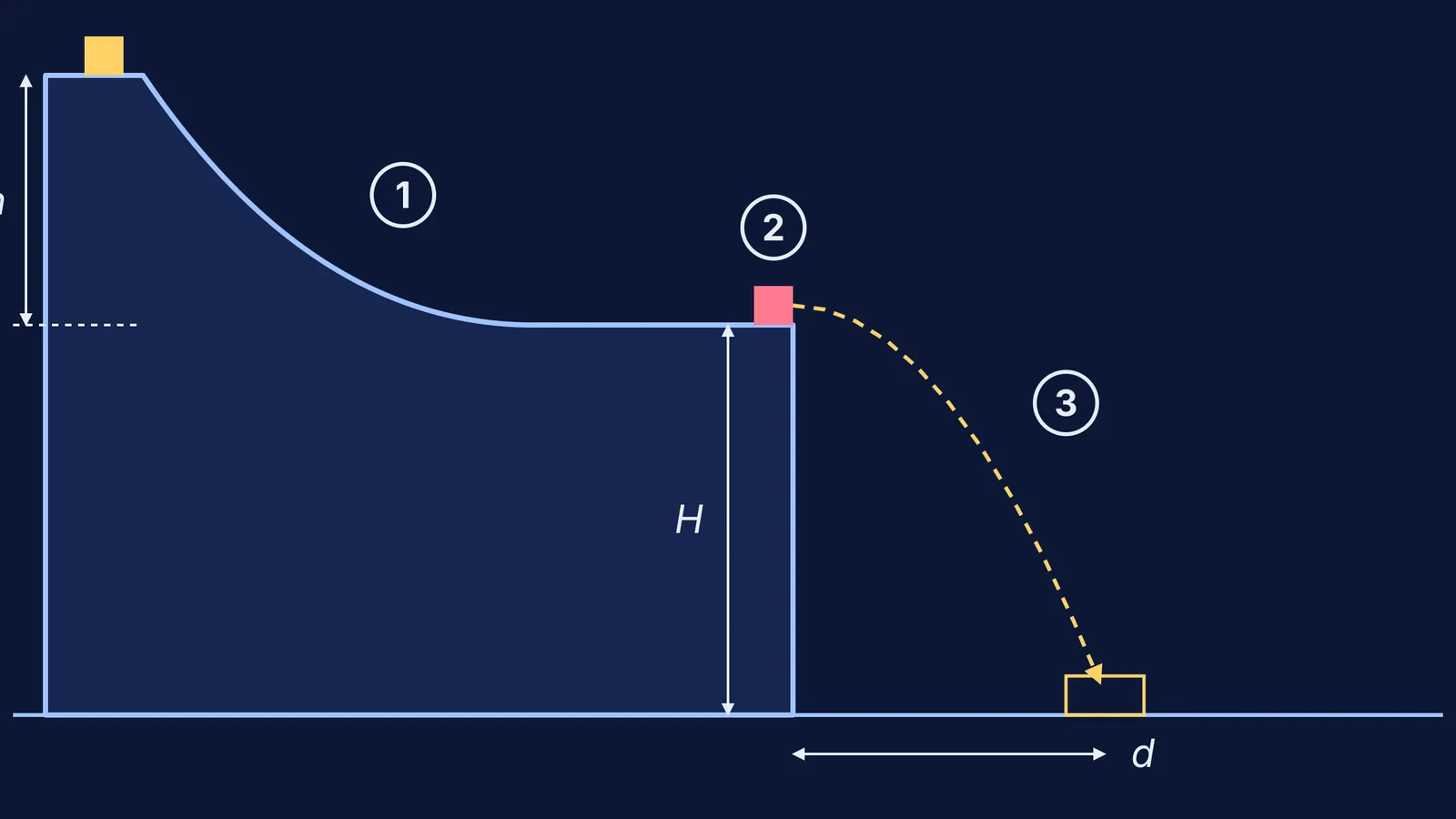
A block is released from rest at the top of a smooth curved ramp of height h = 0.8 m. At the bottom it slides along a smooth table and sticks to an identical block resting at the table's edge. The table is H = 1.25 m high. How far from the edge do the blocks land?
A good AI plan looks like this:
What is the first block's speed at the bottom of the ramp? (Needs: h.)
What is the speed of the joined blocks just after they stick? (Needs: answer 1.)
How long do the blocks take to fall H, and how far do they move sideways in that time? (Needs: answer 2.)
Now your attempt. Energy conservation gives v = √(2gh) = 4 m/s. Momentum conservation for two equal masses that stick together halves it to 2 m/s. The fall takes t = √(2H/g) = 0.5 s, so the blocks land 2 × 0.5 = 1 m from the edge.
The tempting wrong answer is 2 m, from skipping sub-question 2 and launching the blocks at 4 m/s. The plan shows the collision as its own step, so you cannot quietly drop it.
How do you compare your attempt with the AI's plan?
Put your working beside the plan and give each sub-question one of four labels:
Matched: you found the same step and got it right. Move on.
Missed: you skipped a step the plan has, like the collision above. Write the missing step in one line in your mistakes notebook.
Different route: you got there another way. Ask the AI whether both routes are valid and which is quicker.
Stuck: you understood the sub-question but could not answer it. That is a concept gap, not a planning gap, so revise the topic before doing more problems.
Then close the chat, take a similar problem from your book and write your own sub-questions first. Our guide to when to study worked examples and when to solve problems yourself explains how to remove that support step by step.
What if the AI's plan is wrong?
It can be: chatbots sometimes miss a step or add one the problem does not need. Check that every given quantity is used and each step only needs what earlier steps supply. If not, ask for a revised plan.
If you keep losing marks to the wrong method rather than the wrong arithmetic, the Fermi Problem Library has worked problems with a step-by-step solver that explains the reasoning rather than printing an answer; here is how to use a step-by-step solver without copying it. If you do not know where to start at all, Fermi's AI tutor works out what you already know and builds a plan for the session, so you sit down to a clear next step.
Try it tonight on the one problem from your last mock test that you could not even begin.


