

On this page
When a mathematical series looks impossibly long to add up, the terms are often designed to destroy each other.
A telescoping series is a mathematical series where partial sums simplify through the cancellation of consecutive terms, leaving only the initial and final values (Wikipedia). The name comes from how a collapsible pirate's spyglass folds in on itself, shrinking a long tube down to just its outer ends.
Instead of adding an endless string of tiny fractions, you rewrite the problem so that almost every number you add is immediately subtracted away by the next step. This technique is a fundamental tool for solving series in competitive exams and higher mathematics.
What is the sum of 1 over n n plus 1?
The series of reciprocals of pronic numbers, ∑ 1/n(n+1), converges to 1 (Wikipedia). To see why this surprising result is true, we use a technique called partial fraction decomposition. We can split the general term into two simpler fractions:
1 / n(n + 1) = 1/n − 1/(n + 1)
You can verify this by finding a common denominator for the right side: (n + 1 − n) / n(n + 1), which returns directly to the original fraction.
Now, let us write out the sum of the first N terms, calling it S_N. We replace n with 1, 2, 3 and so on, all the way up to N:
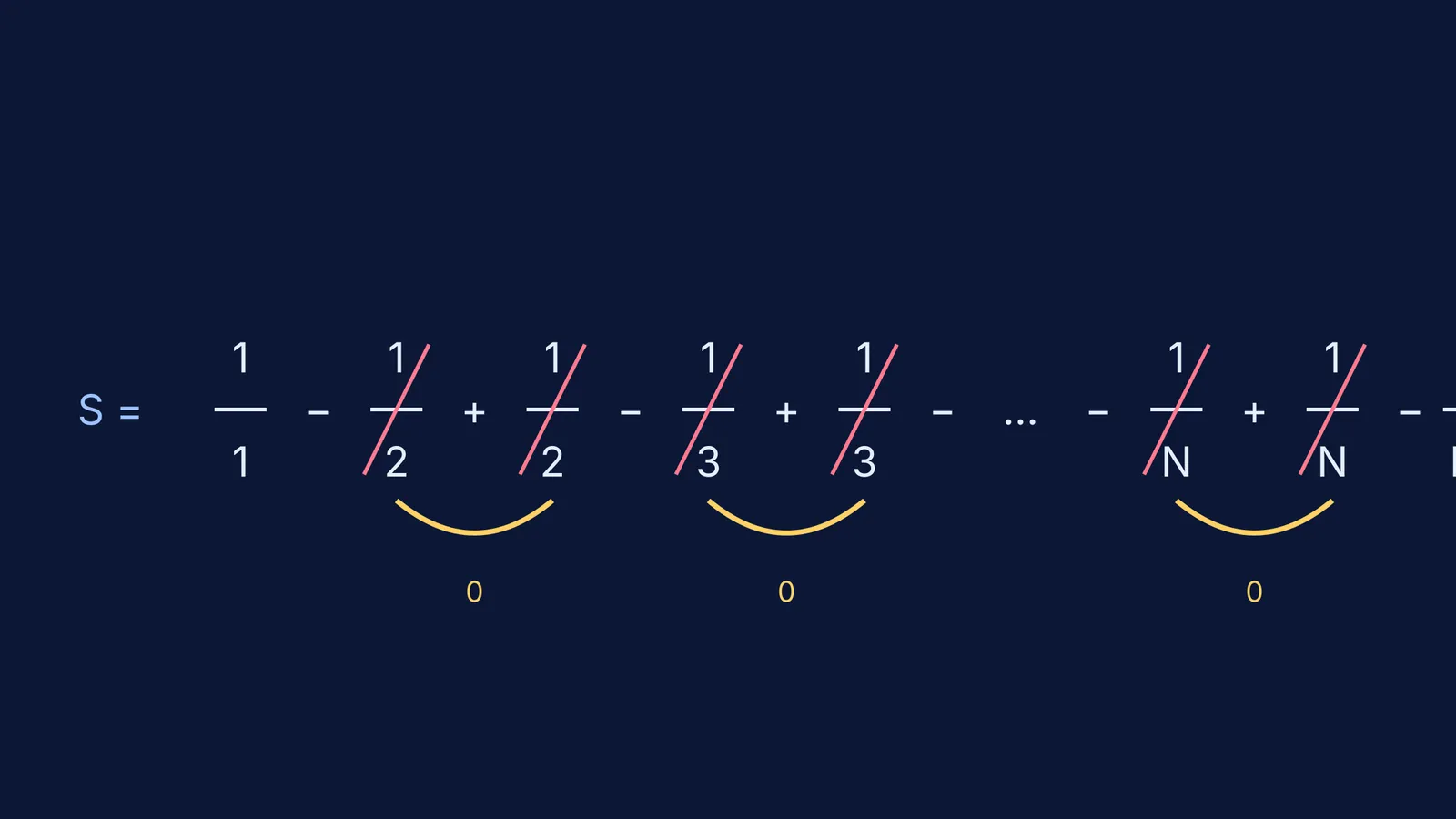
S_N = (1/1 − 1/2) + (1/2 − 1/3) + (1/3 − 1/4) + … + (1/N − 1/(N + 1))
Because we add a term and immediately subtract it, almost everything vanishes in a chain reaction of cancellations. The −1/2 is cancelled by the +1/2, the −1/3 by the +1/3, and so on. This massive string of additions collapses completely. Only the very first number and the very last fraction survive the process:
S_N = 1 − 1/(N + 1)
If we want the infinite sum, we let N grow to infinity. As the denominator N + 1 becomes infinitely large, the fraction 1/(N + 1) approaches zero. The final infinite sum is simply 1.
What is the sum of 1 / n(n + 1)(n + 2)?
Exam papers often extend the pattern to three terms in the denominator. The general formula for such a series shows that the infinite sum of 1 / n(n + 1)(n + 2) converges to 1/4 (Wikipedia).
To prove it, we split the term so that we can create a new difference that will trigger the telescoping effect:
1 / n(n + 1)(n + 2) = (1/2) × [ 1 / n(n + 1) − 1 / (n + 1)(n + 2) ]
When we write out the partial sum S_N for this sequence, we keep the constant factor of 1/2 on the outside and expand the brackets to see the pattern:
S_N = (1/2) × [ (1 / 1×2 − 1 / 2×3) + (1 / 2×3 − 1 / 3×4) + … + (1 / N(N+1) − 1 / (N+1)(N+2)) ]
Once again, the interior blocks cancel perfectly. The second part of each bracket destroys the first part of the next bracket. We are left with the first part of the first bracket and the second part of the last bracket:
S_N = (1/2) × [ 1 / (1×2) − 1 / (N+1)(N+2) ]
As N goes to infinity, the denominator of the final fraction grows without bound, so the fraction itself disappears to zero. The sum is simply the remaining numbers: (1/2) × (1/2) = 1/4.
How to spot telescoping series in exams?
When you are tackling competitive maths problems in exams like JEE Main or JEE Advanced, a telescoping sum is rarely handed to you in a neat, ready-to-cancel format. The examiners will disguise the sequence. If you have concept gaps when breaking down complex sequences, the Fermi Concept Library has a lesson for every concept in mathematics to help you map out the required algebraic patterns.
To spot a telescoping opportunity on a test, follow these steps:
Look for products in the denominator: If a series has terms like 1 / (4n² − 1), you should factorise it into 1 / (2n − 1)(2n + 1).
Apply partial fractions: Force the term into a difference. For the previous example, you would write it as (1/2) × [ 1/(2n − 1) − 1/(2n + 1) ].
Write it out: Always write down the first three terms and the final term. The cancellation pattern is often offset, meaning a term might cancel with one that appears two or three steps later rather than immediately adjacent.
Telescoping is a versatile structural trick that appears across all areas of algebra. You will also use it to simplify sums of binomial coefficients, evaluate complicated integrals with heavy fractions, or when calculating geometric sums like 9 + 99 + 999 + …. Once you learn to look for the collapsing pattern, problems that seem to require infinite additions reduce to finding the beginning and the end.


