On this page
If a question asks you to turn an aldehyde or ketone into an alkene with the double bond in one exact place, the Wittig reaction is the tool. A phosphorus ylide trades its carbon for the carbonyl's oxygen, so the new C=C sits exactly where the C=O was. Here is how it works, why it beats the dehydration route, and a method for planning one backwards.
What does the Wittig reaction do?
The Wittig reaction makes an alkene by reacting an aldehyde or ketone with an ylide made from a phosphonium salt, as the Organic Chemistry Portal puts it. In plain terms, the carbonyl oxygen leaves and a carbon takes its place: R₂C=O becomes R₂C=CHR′.
Georg Wittig and Ulrich Schöllkopf reported triphenylphosphine methylenes as olefin-forming reagents in Chemische Berichte in 1954. Wittig shared the 1979 Nobel Prize in Chemistry with Herbert C. Brown "for their development of the use of boron- and phosphorus-containing compounds, respectively, into important reagents in organic synthesis". The story of the chemist himself is in our post on how Georg Wittig placed a double bond exactly.
How does a phosphorus ylide turn an aldehyde into an alkene?
The LibreTexts chapter on phosphorus ylides/19%3A_Aldehydes_and_Ketones-_Nucleophilic_Addition_Reactions/19.11%3A_Nucleophilic_Addition_of_Phosphorus_Ylides-_The_Wittig_Reaction) sets out the sequence:
Make the phosphonium salt: triphenylphosphine, Ph₃P, attacks an alkyl halide in an SN2 reaction.
Make the ylide: a strong base such as n-butyllithium removes a hydrogen from the carbon next to phosphorus, giving Ph₃P=CHR′, a negative carbon beside a positive phosphorus.
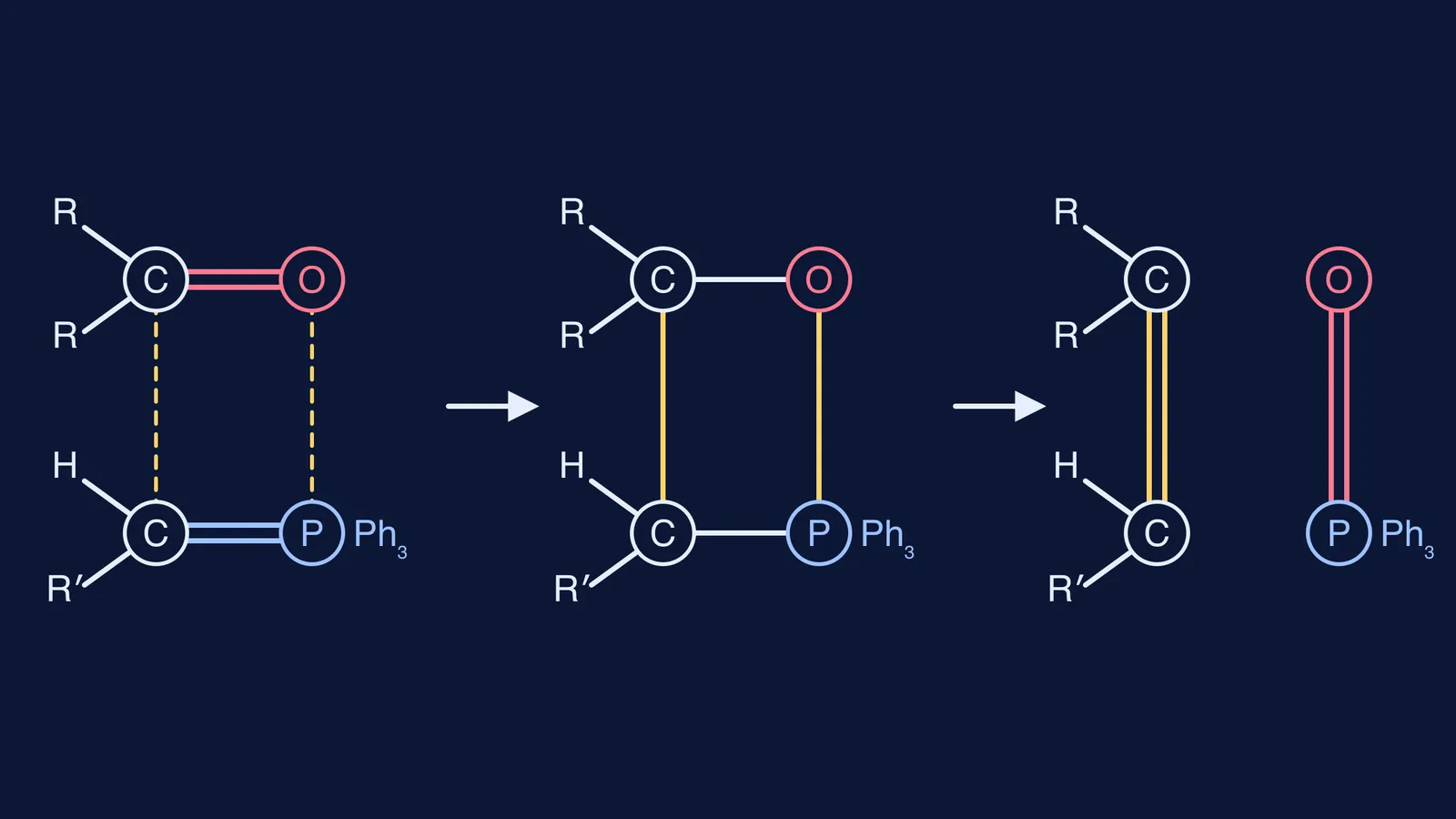
Add the carbonyl: the ylide carbon attacks the carbonyl carbon and the oxygen bonds to phosphorus, closing a four-membered ring called an oxaphosphetane.
Split the ring: it falls apart into the alkene and triphenylphosphine oxide, Ph₃P=O.
The driving force is the formation of a very stable phosphine oxide, according to the Organic Chemistry Portal.
Why use Wittig instead of dehydrating an alcohol?
The main advantage of the Wittig route is that the location of the double bond is absolutely fixed, in contrast to the mixtures alcohol dehydration often produces, as the LibreTexts chapter/19%3A_Aldehydes_and_Ketones-_Nucleophilic_Addition_Reactions/19.11%3A_Nucleophilic_Addition_of_Phosphorus_Ylides-_The_Wittig_Reaction) explains.
Take a target: methylenecyclohexane, a six-carbon ring with a =CH₂ hanging off it.
Dehydration route: add CH₃MgBr to cyclohexanone to get 1-methylcyclohexanol, then heat it with acid. The carbocation can lose a hydrogen from the CH₃ (giving your target) or from the ring (giving 1-methylcyclohexene). The ring alkene is more substituted, so Saytzeff's rule predicts it as the major product: the wrong one. Our guide to the carbocation route in alcohol dehydration walks through why.
Wittig route: cyclohexanone plus Ph₃P=CH₂ gives methylenecyclohexane and Ph₃P=O. The double bond can only form at the old carbonyl carbon, so there is no second alkene to worry about.
Which alkene isomer forms, E or Z?
The position is fixed; the geometry is not always. The Organic Chemistry Portal states that stabilized ylides give mainly (E)-alkenes, while non-stabilized ylides lead to (Z)-alkenes. A stabilized ylide carries an electron-withdrawing group, such as an ester, on the ylide carbon; a non-stabilized one carries plain alkyl groups.
Benzaldehyde + Ph₃P=CHCH₃ (non-stabilized) gives 1-phenylpropene, mainly Z.
Benzaldehyde + Ph₃P=CHCO₂Et (stabilized) gives ethyl cinnamate, mainly E.
Any alkene with two identical groups on one end, such as methylenecyclohexane, has no E/Z question at all.
Even simple ylides often give some E alongside the Z, the LibreTexts chapter/19%3A_Aldehydes_and_Ketones-_Nucleophilic_Addition_Reactions/19.11%3A_Nucleophilic_Addition_of_Phosphorus_Ylides-_The_Wittig_Reaction) notes, so say "mainly", not "only".
How do you plan a Wittig synthesis backwards?
Use this five-step check whenever a question gives you the alkene and asks for the starting materials.
Find the C=C in the target and cut it in two.
Put =O on one end (your aldehyde or ketone) and =PPh₃ on the other (your ylide).
Prefer the cut where the ylide comes from a primary halide. The LibreTexts chapter/19%3A_Aldehydes_and_Ketones-_Nucleophilic_Addition_Reactions/19.11%3A_Nucleophilic_Addition_of_Phosphorus_Ylides-_The_Wittig_Reaction) notes that ylide formation from most secondary halides is inefficient, which is why Wittig reagents are rarely used for tetrasubstituted alkenes.
Count carbons: carbonyl carbons plus ylide carbons must equal the target's carbons. The phenyl groups on phosphorus leave as Ph₃P=O and never count.
Check the geometry the question wants against the ylide type.
Worked example: make PhCH=CHCH₃ (1-phenylpropene, nine carbons).
Cut A: benzaldehyde (seven carbons) + Ph₃P=CHCH₃ (two carbons, from bromoethane). Nine. Valid.
Cut B: ethanal (two carbons) + Ph₃P=CHPh (seven carbons, from benzyl bromide). Nine. Also valid.
Both halides are primary, so both cuts pass step 3. Cut A uses a simple alkyl ylide, so step 5 tells you to expect mainly the Z isomer.
If you keep putting the oxygen on the wrong end, practise with the Fermi Problem Library, which has worked problems with a step-by-step solver that explains the reasoning rather than printing an answer. If ylides or carbocations still feel shaky, the Fermi Concept Library gives every chemistry concept its own lesson and its place in the map.
Next time you see a C=O and a target alkene, cut the double bond first and the reagents will follow.