

On this page
Many of the ways you learn to make alkenes in school are eliminations. You pull water or HX off a molecule, and the double bond goes wherever the molecule prefers, which is usually the more substituted position, as Zaitsev's rule predicts. When that isn't the alkene you want, you need a reaction that lets you choose. Georg Wittig found one.
What did Georg Wittig discover in 1954?
Wittig was born in Berlin on 16 June 1897 and died in Heidelberg on 26 August 1987, according to his Nobel Prize facts page. He was a professor in Freiburg, Tübingen and Heidelberg, notes the Royal Swedish Academy of Sciences in its 1979 Nobel press release. In 1953 he and Georg Geissler published a paper on how pentaphenylphosphorus and some related compounds react, which the 1954 paper cites.
In September 1954, Wittig and his co-worker Ulrich Schöllkopf published a paper on triphenylphosphine-methylenes as alkene-forming reagents in Chemische Berichte. The paper's abstract, in German, reports that when these reagents react with aldehydes and ketones, the doubly bonded oxygen is swapped for the carbon group, giving triphenylphosphine oxide and the alkene. The authors said the new method's advantage was that the C=C bond forms at the exact position of the original C=O bond, with no shifting.
That one sentence is the whole point. The carbonyl group tells you exactly where the double bond will be.
How does the Wittig reaction work?
The 1979 Nobel press release describes the reagent as an organic phosphorus compound with a formal double bond between phosphorus and carbon, which reacts with a carbonyl compound so that the carbonyl oxygen is exchanged for carbon. Chemists call this reagent a phosphorus ylide. Following the LibreTexts organic chemistry chapter on the Wittig reaction/20:_Nucleophilic_Addition_Using_Strong_Nucleophiles/20.04:_The_Wittig_reaction), it runs in four steps:
Triphenylphosphine reacts with an alkyl halide by SN2 to give a phosphonium salt.
A strong base such as n-butyllithium removes a proton next to phosphorus, giving the ylide.
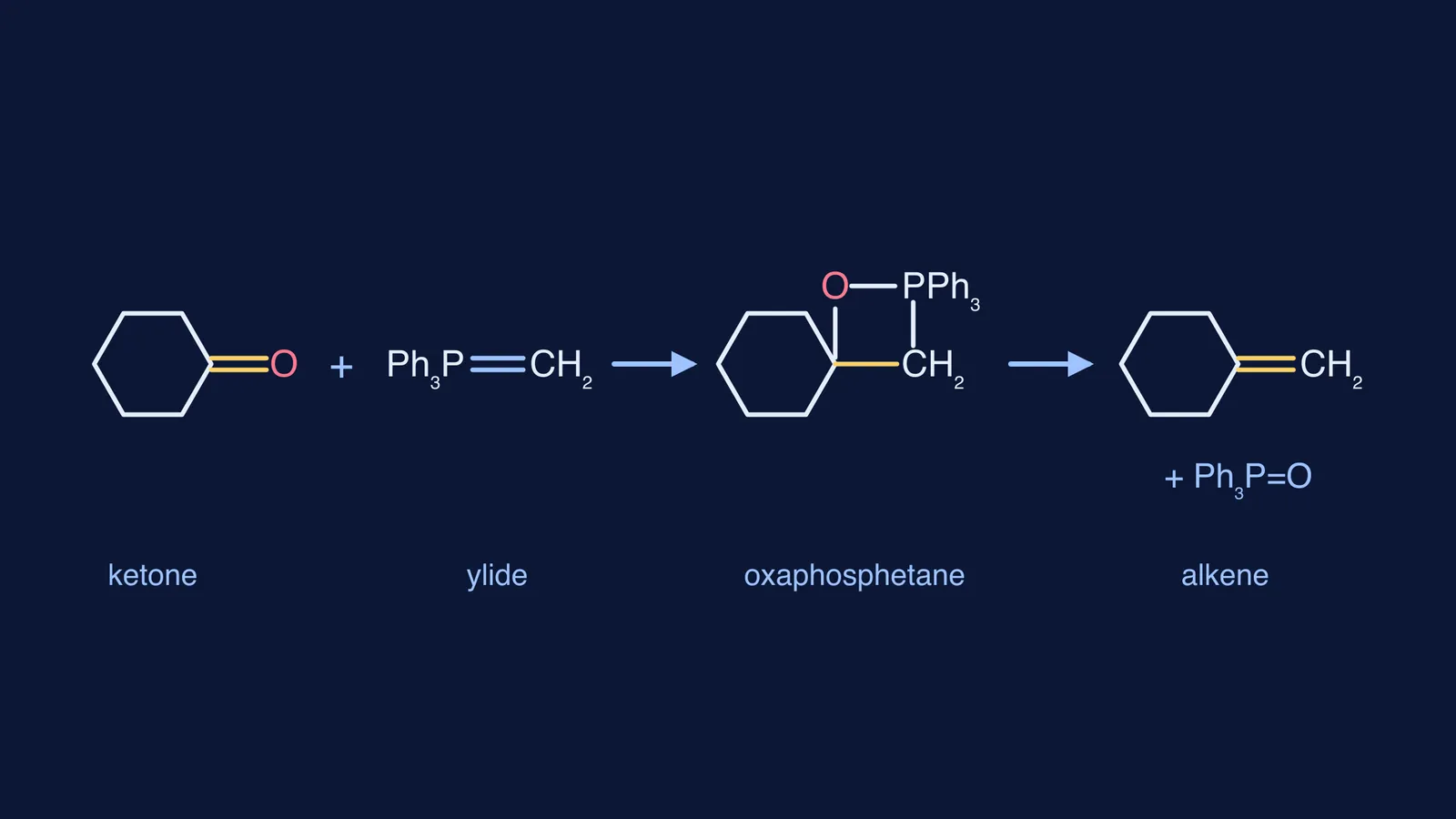
The ylide's carbon attacks the carbonyl carbon, and the atoms close into a four-membered ring called an oxaphosphetane.
The ring breaks apart into the alkene and triphenylphosphine oxide, Ph₃P=O. Forming this very stable oxide is what drives the reaction.
The same chapter covers geometry: ylides carrying simple alkyl groups mostly give the Z-alkene, while stabilised ylides usually give the E-alkene.
Why does placing the double bond exactly matter?
Here is a worked example. Say your target is methylenecyclohexane, a six-membered ring with a CH₂ attached outside the ring by a double bond.
Route A, elimination. Dehydrating 2-methylcyclohexanol gives mainly 1-methylcyclohexene, where the double bond sits inside the ring. Methylenecyclohexane appears only as a side product, as its reference entry notes.
Route B, Wittig. Cyclohexanone plus Ph₃P=CH₂ gives methylenecyclohexane, by the same source. The ring carbon that held the oxygen now holds the double bond to CH₂.
The LibreTexts chapter puts it plainly: the double bond's location is absolutely fixed, unlike the mixtures that E1 or E2 eliminations often give. For more on the elimination side, see our guide to how alkenes are prepared by elimination and alkyne reduction.
The reaction matters outside the classroom too. The 1979 press release notes that vitamin A is made industrially using the Wittig reaction. That year Wittig shared the Nobel Prize in Chemistry with Herbert C. Brown, "for their development of the use of boron- and phosphorus-containing compounds, respectively, into important reagents in organic synthesis". Crossref's metadata for the 1954 paper lists more than 1,000 citing works.
How do you plan a Wittig synthesis in an exam answer?
Work backwards from the alkene you want:
Find the C=C in the target molecule.
Cut it in half. One carbon becomes the C=O of an aldehyde or ketone. The other becomes the ylide carbon, attached to PPh₃.
Pick which half gets the phosphorus. The phosphonium salt is made by an SN2 step, so give phosphorus the side whose halide would do SN2 easily.
Write the reagents in order: PPh₃ plus the alkyl halide, then a strong base, then the carbonyl compound.
Predict the geometry. A simple alkyl ylide usually gives Z; a stabilised ylide usually gives E.
Don't forget Ph₃P=O as the by-product when you balance the equation.
Check yourself on methylenecyclohexane. The C=C sits between a ring carbon and CH₂. The ring side becomes cyclohexanone. The CH₂ side becomes Ph₃P=CH₂, made from methyl bromide, which does SN2 easily.
If you keep reaching for an elimination when a question needs the double bond in one fixed place, the Fermi Problem Library has worked problems with a step-by-step solver that explains the reasoning rather than printing an answer. If ylide or oxaphosphetane still feel fuzzy, the Fermi Concept Library gives each chemistry concept its own lesson.
Wittig's reaction was one Nobel-winning answer to a big question in synthesis: how to join carbon pieces exactly where you want them. For a more recent answer, read how Akira Suzuki's coupling reaction builds drugs and OLEDs.


