

On this page
If you study from the NCERT Class 12 chemistry book, you meet this rule in Unit 6, Haloalkanes and Haloarenes. NCERT's chapter states it as: "in dehydrohalogenation reactions, the preferred product is that alkene which has the greater number of alkyl groups attached to the doubly bonded carbon atoms." It credits the pattern to the Russian chemist Alexander Zaitsev, "also pronounced as Saytzeff", in 1875. Behind that line is a story about two rival students from Kazan.
Who was Alexander Zaitsev?
Most of what follows comes from a history paper by the chemist David E. Lewis, "Feuding rule makers", in the Bulletin for the History of Chemistry (2010).
Aleksandr Mikhailovich Zaitsev (1841-1910) entered Kazan University to study economics, not chemistry. The organic chemist Aleksandr Butlerov drew him into the subject. Zaitsev then worked with Hermann Kolbe in Germany, where he discovered the sulfoxides and sulfonium salts, and with Adolphe Wurtz in Paris. Back in Kazan he became a professor and stayed for about 40 years.
Why two spellings? Zaitsev is a transliteration from Cyrillic; his papers in German journals were printed under "Saytzeff", the spelling your textbook still mentions.
What did Zaitsev's 1875 paper actually say?
The paper appeared in Justus Liebigs Annalen der Chemie, volume 179, pages 296-301, as "Zur Kenntniss der Reihenfolge der Anlagerung und Ausscheidung der Jodwasserstoffelemente in organischen Verbindungen", roughly "on the order in which hydrogen iodide adds to and leaves organic compounds".
Lewis describes it as largely a literature review, with new results from Zaitsev's students Grabovskii and Vagner. In it Zaitsev set out what we now call his rule: when a halide can lose hydrogen from more than one β-carbon, the hydrogen tends to leave the β-carbon that has fewer hydrogens, so the double bond forms between the more substituted carbons.
How did the Saytzeff rule connect to a rivalry with Markovnikov?
Vladimir Markovnikov, another Butlerov student at Kazan, published his addition rule in 1870, according to Lewis. In his dissertation he also argued that elimination should be the reverse of addition. Since hydrogen iodide adds to 1-butene to give 2-iodobutane, removing hydrogen iodide from 2-iodobutane should then give mostly 1-butene.
Zaitsev's rule predicts the opposite: mostly 2-butene. Lewis documents a feud between the two men that lasted their whole careers, and suggests, while calling it speculation, that the rule may partly have been Zaitsev's answer to Markovnikov.
Lewis also notes a question of credit. Aleksandr Popov, another Kazan chemist, had speculated about the direction of elimination a few years earlier, and Zaitsev did not cite him in 1875.
Why does the more substituted alkene form?
Alkyl groups on the carbons of a double bond make the alkene more stable, mainly through hyperconjugation. The pathway to the more stable alkene is usually the faster one, so that alkene dominates. You can see the stability order in real data in our post on ranking alkene stability with heats of hydrogenation.
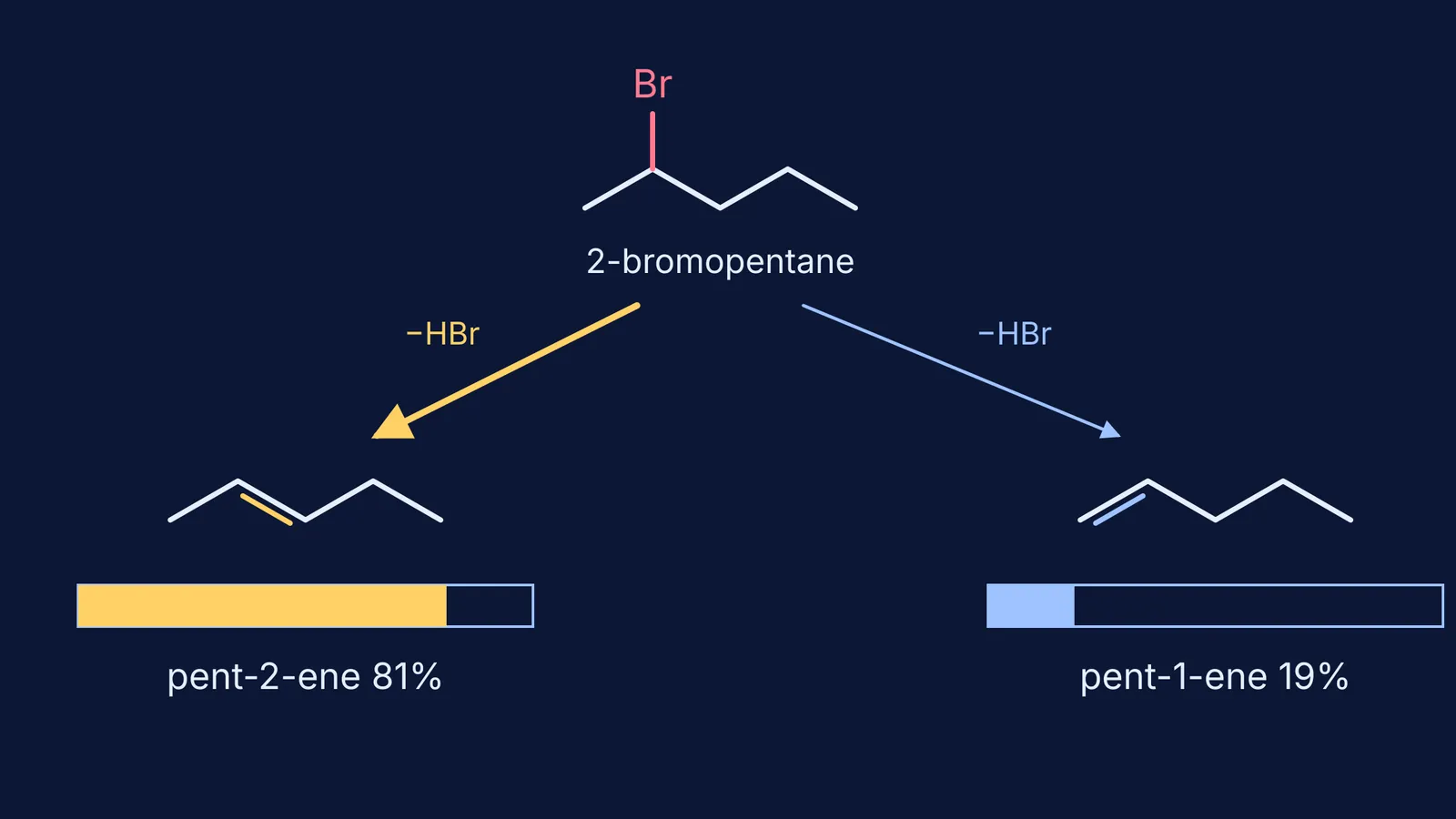
NCERT's own example puts numbers on it: 2-bromopentane gives 81% pent-2-ene and 19% pent-1-ene.
How do you apply the Saytzeff rule in an exam?
Use the same five steps every time:
Mark the α-carbon, the one holding the halogen.
List every β-carbon that carries at least one hydrogen.
Draw the alkene each β-carbon would give.
Count the alkyl groups on the two double-bond carbons of each alkene. The one with more is the Saytzeff product.
Check the base before you write the answer.
Worked example: 2-bromo-2-methylbutane with alcoholic KOH
The structure is (CH3)2CBr-CH2CH3. The α-carbon holds Br and has three neighbours: two identical CH3 groups and one CH2.
Lose H from a CH3: you get CH2=C(CH3)CH2CH3, 2-methylbut-1-ene, with two alkyl groups on its double-bond carbons.
Lose H from the CH2: you get (CH3)2C=CHCH3, 2-methylbut-2-ene, with three alkyl groups on its double-bond carbons.
Answer: 2-methylbut-2-ene is the major product. In a board answer, draw both alkenes and label the major one, so the examiner sees your reasoning.
That exception gives the Hofmann product; our explainer on when elimination gives the less substituted Hofmann alkene works through it. If E2 geometry confuses you, read why E2 elimination needs an anti-periplanar hydrogen.
If you can draw both alkenes but cannot explain why one wins, that is a concept gap, not a memory gap. The Fermi Concept Library gives every chemistry concept its own lesson, and the Fermi Problem Library has worked problems with a step-by-step solver that explains the reasoning rather than printing an answer.
Try it now: run the five steps on 2-iodobutane, the compound Markovnikov's reasoning said should give mostly 1-butene, and see whose side you land on.


