

On this page
When an alkyl halide undergoes bimolecular elimination (E2), a strong base abstracts a proton from a β-carbon while the leaving group departs from the α-carbon. In classical E1 and E2 elimination mechanisms, the base usually removes hydrogen from the β-carbon with fewer hydrogen atoms. Russian chemist Alexander Saytzeff formulated this principle in Justus Liebigs Annalen der Chemie (1875), observing that dehydrohalogenation of secondary alkyl halides preferentially forms the more substituted, thermodynamically stable alkene. For instance, reacting 2-bromobutane with potassium ethoxide yields 81% 2-butene and only 19% 1-butene, as documented in the Journal of the American Chemical Society (1956), while alcoholic KOH promotes dehydrohalogenation over substitution.
Alkene stability drives Saytzeff's rule: internal double bonds have more hyperconjugative C–H interactions than terminal double bonds. In unhindered transition states, developing double bonds reflect product stability, lowering the barrier for the more substituted alkene. A similar preference governs acid-catalysed alcohol dehydration.
If you are mapping reaction coordinates or reviewing organic mechanisms, the Fermi Concept Library covers every concept in chemistry, each with its own lesson and its place in the map.
How do bulky bases force Hofmann elimination?
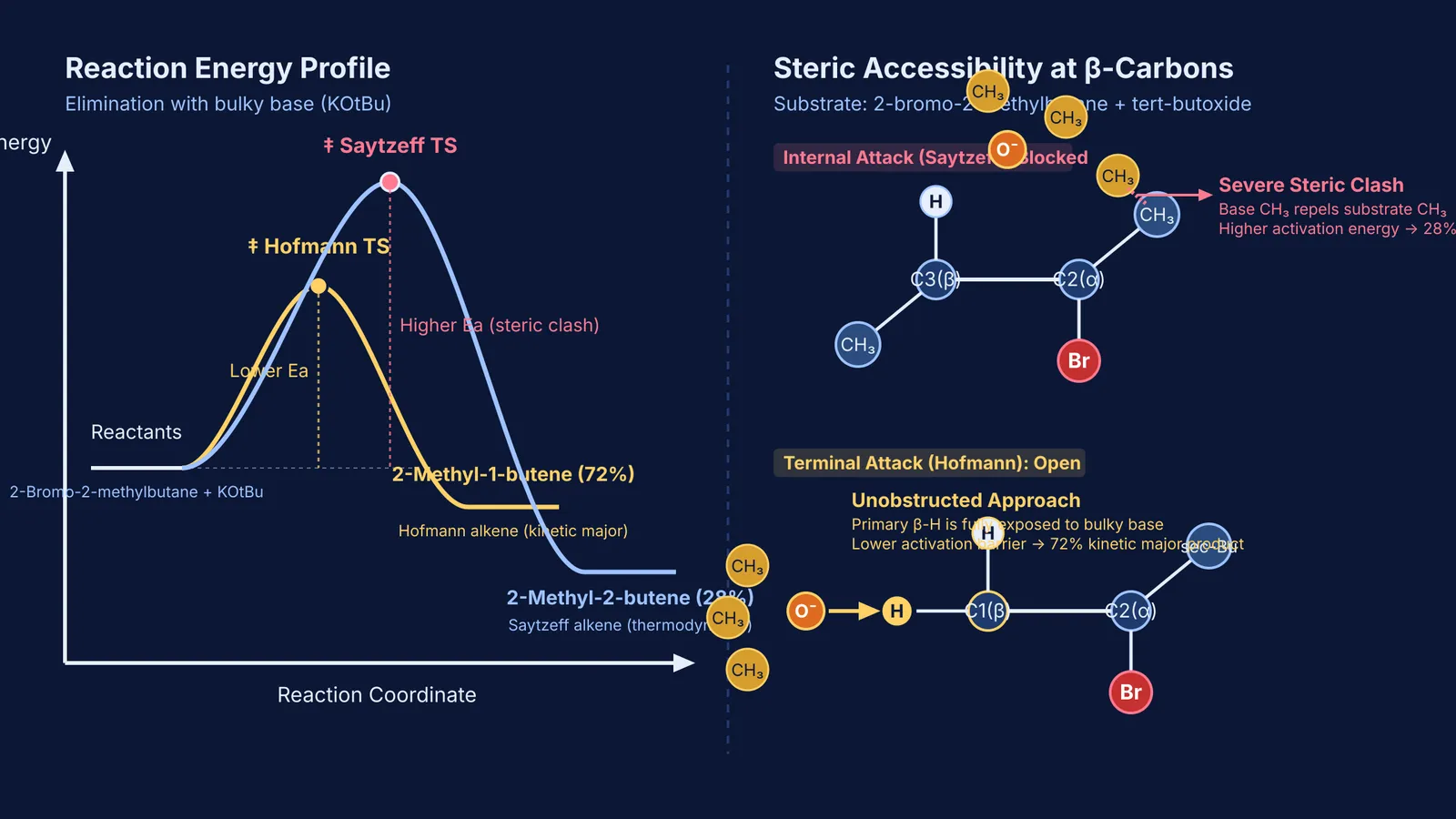
This thermodynamic preference breaks down when the attacking base is bulky. Bulky bases like potassium tert-butoxide, potassium tert-amyloxide, and lithium diisopropylamide (LDA) carry large alkyl groups around their basic centre. When approaching a secondary or tertiary β-carbon, severe steric repulsions arise between the alkyl groups of the base and the substrate substituents.
To avoid this steric clash, the bulky base abstracts a proton from the most accessible site: a primary β-hydrogen on an exposed terminal methyl group. While the resulting terminal alkene is thermodynamically less stable, its transition state avoids steric crowding, lowering its activation energy below that of the internal pathway.
This steric reversal was rigorously measured by Herbert C. Brown, Ichiro Moritani, and Y. Okamoto in the Journal of the American Chemical Society (1956). Reacting 2-bromo-2-methylbutane with potassium ethoxide gave 70% of the internal Saytzeff alkene (2-methyl-2-butene) and 30% of the terminal Hofmann alkene (2-methyl-1-butene). Swapping potassium ethoxide for bulky potassium tert-butoxide inverted the outcome: 2-methyl-1-butene jumped to 72%, leaving 2-methyl-2-butene at 28%, according to the Journal of the American Chemical Society (1956).
When does elimination give less substituted alkene products?
Bulky bases are the most common laboratory tool for directing an elimination toward the Hofmann product, but they are not the only cause. An elimination gives the less substituted alkene whenever kinetic accessibility, steric hindrance, or electronic effects disfavour internal proton removal. Four distinct conditions trigger this reversal:
Bulky bases: Reagents like potassium tert-butoxide ((CH3)3CO⁻K⁺) or LDA abstract the unhindered primary hydrogen because adjacent alkyl groups block internal β-protons.
Bulky onium leaving groups: Large leaving groups like quaternary ammonium (–N(CH3)3⁺) or sulfonium (–S(CH3)2⁺) ions sterically force attack at the outer methyl group, as August Wilhelm von Hofmann identified in the Philosophical Transactions of the Royal Society of London (1851).
Poor, electronegative leaving groups: Alkyl fluorides react via carbanion-like transition states. Because primary carbanions are less destabilised by inductive electron donation than secondary carbanions, the terminal proton departs faster.
Crowded substrates: Heavily branched β-carbons hinder internal approach even for standard bases, directing elimination to the terminal site.
When you practice contrasting reaction conditions, the Fermi Problem Library provides worked problems with a step-by-step solver that explains the reasoning rather than printing an answer.
How do you predict the major alkene on exams?
Competitive examinations like JEE Advanced and NEET regularly test whether you can recognise when a reaction switches from Saytzeff to Hofmann regiochemistry. You can avoid traps by following a four-step evaluation sequence before writing the product:
Identify β-carbons: Locate the α-carbon bearing the leaving group, then find every adjacent carbon with hydrogen.
Inspect the leaving group: Neutral halides (Cl⁻, Br⁻, I⁻) favour Saytzeff alkenes; bulky onium ions (–N(CH3)3⁺) or fluoride favour Hofmann alkenes.
Inspect base size: Small bases (OH⁻, CH3CH2O⁻) give the more substituted alkene; bulky bases (potassium tert-butoxide, LDA) give the less substituted alkene.
Verify stereoelectronics: Confirm the β-hydrogen and leaving group can achieve an anti-periplanar 180° dihedral angle. In rigid rings, anti alignment dictates the product regardless of substitution.
Worked example: Dehydrohalogenation of 2-bromo-2-methylbutane:
Case A (Small base, KOEt): The base reaches the secondary C3 hydrogen. The resulting trisubstituted 2-methyl-2-butene has six hyperconjugative α-hydrogens, forming the major Saytzeff product.
Case B (Bulky base, KOtBu): Tert-butoxide's methyl groups clash with C2 substituents. The base abstracts an exposed hydrogen from C1 instead, forming disubstituted 2-methyl-1-butene as the major Hofmann product.
Reviewing both steric crowding and stereoelectronic alignment ensures you identify the major alkene product quickly on any examination.


