

On this page
When a strong base plucks a proton from an alkyl halide, the molecule does not just fall apart randomly. When choosing between substitution or elimination with KOH, the base matters, but the 3D geometry of the molecule is just as critical. The E2 (bimolecular elimination) reaction is a concerted process: the base pulls the hydrogen, the carbon-carbon double bond forms, and the leaving group departs all in the same split second.
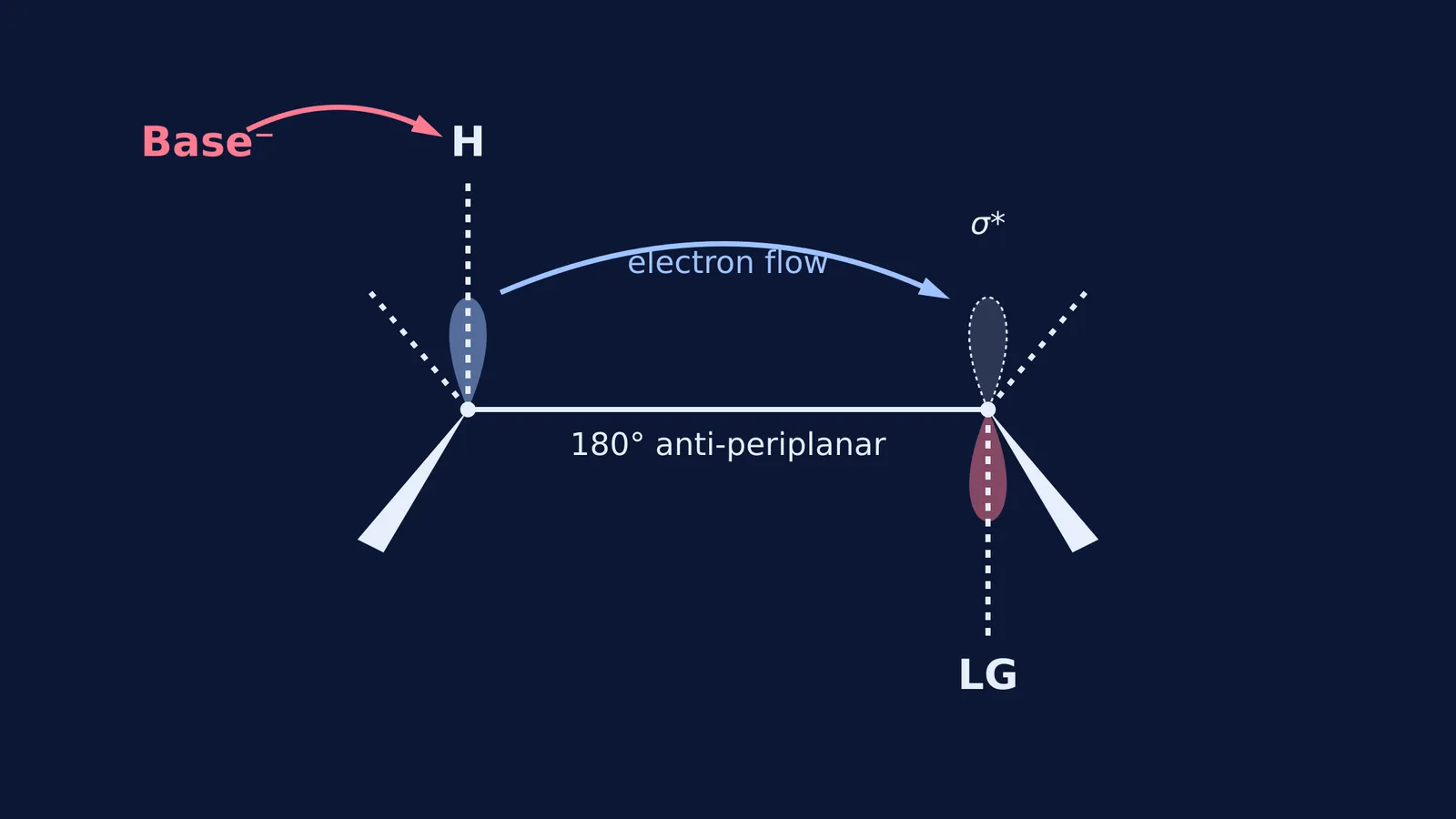
For this precise timing to work, the reacting atoms must line up perfectly. The leaving group and the β-hydrogen (the hydrogen on the adjacent carbon) must be anti-periplanar—sitting in the same plane but pointing in opposite directions. This 180° arrangement is a strict stereochemical rule that decides which alkene you get, and sometimes forces the reaction to yield a less stable product.
What is the anti-periplanar requirement?
In stereochemistry, "periplanar" means lying in the same plane. The four key atoms in an E2 elimination—the hydrogen, the two carbons, and the leaving group—must be coplanar so their orbitals can interact.
"Anti" means the hydrogen and the leaving group are positioned on opposite sides of the carbon-carbon bond, creating a dihedral angle of exactly 180°. If you look down the carbon-carbon bond in a Newman projection, the molecule is in a staggered conformation, with the hydrogen pointing straight up and the leaving group pointing straight down.
The alternative is a syn-periplanar geometry, where the hydrogen and leaving group are eclipsed at a 0° angle. While this also puts the atoms in the same plane, it is much higher in energy due to steric strain and is rarely how the reaction happens.
Why does E2 elimination need an anti-periplanar hydrogen?
The anti-periplanar rule exists because of how electrons flow during the reaction. Unlike the dehydration of alcohols to a major alkene (an E1 process that goes through a planar carbocation), the concerted E2 mechanism gives the molecule no time to rearrange.
For the new π bond to form, the sp³ orbitals on the adjacent carbons must transition into parallel p orbitals. This requires the electrons from the breaking C–H bond to be donated directly into the empty, antibonding orbital (σ*) of the C–X bond.
The antibonding orbital sits directly behind the C–X bond. When the hydrogen is 180° away in the anti-periplanar position, its bonding electrons are perfectly aligned to flow into the back lobe of the leaving group's antibonding orbital. This optimal orbital overlap provides the "push" that kicks out the leaving group. Additionally, placing the electron-rich base and the leaving group on opposite sides of the molecule minimizes electrostatic repulsion during the transition state.
Cyclohexane rings and the trans-diaxial rule
The anti-periplanar requirement is most visible in rigid systems like cyclohexane rings. In a chair conformation, bonds on adjacent carbons can only be 180° apart if they are both pointing straight up or down.
For an E2 elimination to happen in a six-membered ring, the leaving group and the β-hydrogen must both be in axial positions (trans-diaxial). If the leaving group is in an equatorial position, it sits at a 60° (gauche) angle to its neighboring hydrogens. The reaction cannot proceed until the ring undergoes a chair flip to put the leaving group into an axial position.
Because of this strict rule, the spatial arrangement of the starting molecule heavily dictates the outcome. If the only available axial hydrogen leads to a less substituted alkene, the E2 reaction will ignore Zaitsev's rule and form the less stable product.
How Fermi's AI tutor teaches stereochemistry
Visualizing 3D molecular structures and orbital overlaps is one of the hardest parts of organic chemistry. When you bring a reaction mechanism to Fermi's AI tutor, it doesn't just tell you the product. The tutor guides you through drawing the chair conformations, asks you to spot the axial and equatorial groups, and helps you find the anti-periplanar hydrogens.
If you struggle to picture the transition state, you can open the Fermi Concept Library to explore the lesson on stereochemical rules, ensuring you understand exactly why a reaction behaves the way it does.


