

On this page
Carbon atoms are stable and do not easily react with one another. For decades, chemists struggled to join carbon atoms from two different molecules without creating a mess of unwanted by-products. Akira Suzuki solved this problem by using a palladium catalyst as a matchmaker, a breakthrough that won him a share of the 2010 Nobel Prize in Chemistry alongside Richard F. Heck and Ei-ichi Negishi.
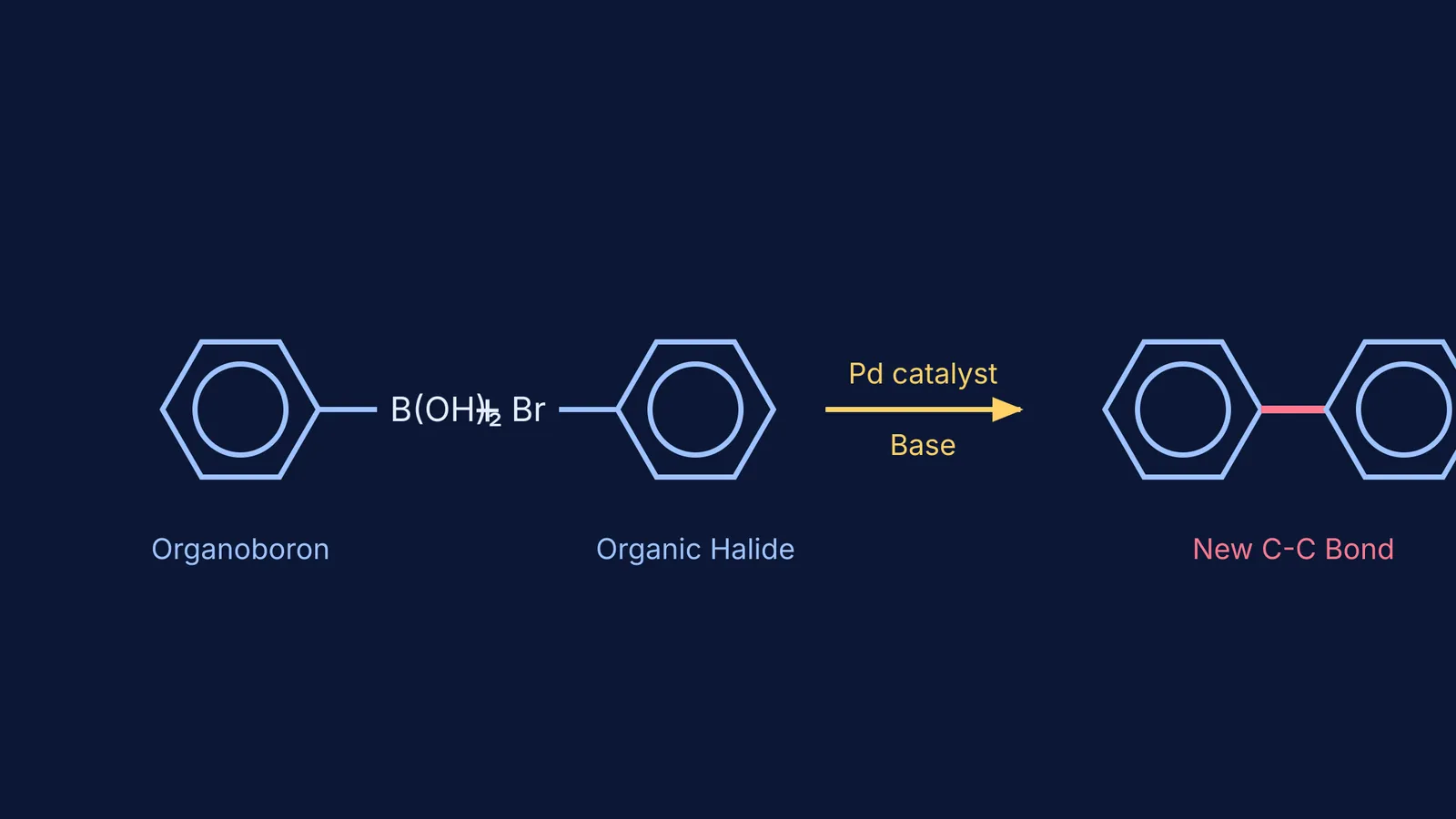
The Suzuki reaction (or Suzuki-Miyaura coupling) joins an organoboron compound with an organic halide. Today, this precise carbon-carbon bond formation is how we build the world around us, from the high-tech screens we look at to the life-saving medicines we take.
Why is the Suzuki reaction used in medicine?
The pharmaceutical industry relies on the Suzuki reaction to produce Active Pharmaceutical Ingredients (APIs) on a massive scale. It is particularly good at forming "biaryl" structures—two aromatic rings linked together—which are common in blood pressure medications and cancer treatments. Because drug molecules are often large and fragile, assembling them requires a gentle approach.
According to an analysis of the medicinal chemistry toolbox published in the *Journal of Medicinal Chemistry*, the Suzuki reaction is the most frequent carbon-carbon bond-forming reaction, appearing in over 20% of medicinal chemistry manuscripts in 2014. It dominates because it is highly "functional group tolerant," meaning chemists can use it to join complex molecules without damaging other sensitive parts of the drug, such as alcohols or amines. Additionally, the boron reagents it uses are stable to air and moisture, and relatively non-toxic compared to older methods that relied on highly reactive or toxic metals.
How does the Suzuki reaction make OLED screens?
The same chemical tool used in medicine is the primary method for manufacturing Organic Light-Emitting Diodes (OLEDs) found in smartphones and high-end televisions.
OLED displays require large, flat, "conjugated" molecules to conduct electricity and emit light efficiently. The Suzuki reaction is the preferred way to link these aromatic rings together because it forms bonds reliably without destroying the delicate extended pi-electron systems needed for luminescence. In commercial production, Suzuki coupling achieves high yields, allowing manufacturers to precisely tune the structure of the molecule to control the display's color purity and brightness. By connecting specific chemical groups, engineers can design materials that emit perfect reds, greens, and blues for vibrant screens.
How can you remember coupling reactions for exams?
While the Suzuki reaction is an advanced topic often seen in competitive exams like JEE, the core idea of cross-coupling builds directly on what you learn in Class 12 chemistry. It is a more precise, modern alternative to the Wurtz-Fittig and Ullmann reactions.
When studying organic synthesis, group reactions by what they achieve rather than just memorising names. For example, if you need to attach a halogen, you might look at the Finkelstein and Swarts reactions. If you are starting from a diazonium salt, the Sandmeyer and Gattermann reactions are your tools.
If you find yourself mixing up reagents, Fermi's AI tutor can work out what you already know and build a plan for the session, so you sit down to a clear next step. You can also explore the mechanisms of these named reactions in the Fermi Concept Library to see exactly how the electrons move in each step.


