On this page
Everyone learns that you cannot divide by zero; few are told why. The reason is short, it covers two different failures, and it sets up the limit, a core idea in Class 11 and JEE maths.
What does division actually mean?
Division is defined as the inverse of multiplication. Saying 12 ÷ 3 = 4 means exactly one thing: 4 is the number that, multiplied by 3, gives 12. So every division question is really a multiplication question:
a ÷ b = c means c × b = a
and c must be the only number that does this
A division works only if its answer exists and is unique. Wolfram MathWorld puts it plainly: division by zero is undefined for real numbers, because 0 × y = 0 for every y, so there is no unique answer.
Why is 5 divided by 0 undefined?
Turn 5 ÷ 0 = ? into its multiplication question: what number, multiplied by 0, gives 5?
Try anything. 0 × 1 = 0. 0 × 1000 = 0. 0 × (−7.5) = 0. Every number times zero is zero, so no number ever gives 5. The question has no answer at all.
Why is 0 divided by 0 a different problem?
Now ask 0 ÷ 0 = ? as multiplication: what number, multiplied by 0, gives 0?
This time every number works: 0 × 1 = 0, 0 × 42 = 0, 0 × π = 0. The trouble is the opposite of before: not zero answers but infinitely many, none with a better claim than the rest.
5/0 (any non-zero number over zero): no answer exists.
0/0: every number is an answer, so no single answer exists.
This puzzled early mathematicians too. In his Brahmasphutasiddhanta of 628 CE, Brahmagupta wrote that "zero divided by zero is zero", a rule the MacTutor archive at the University of St Andrews calls wrong. Over 500 years later, Bhaskara II called a quantity divided by zero "an infinite quantity", which MacTutor's history of zero explains does not work either.
What happens to 1/x near zero?
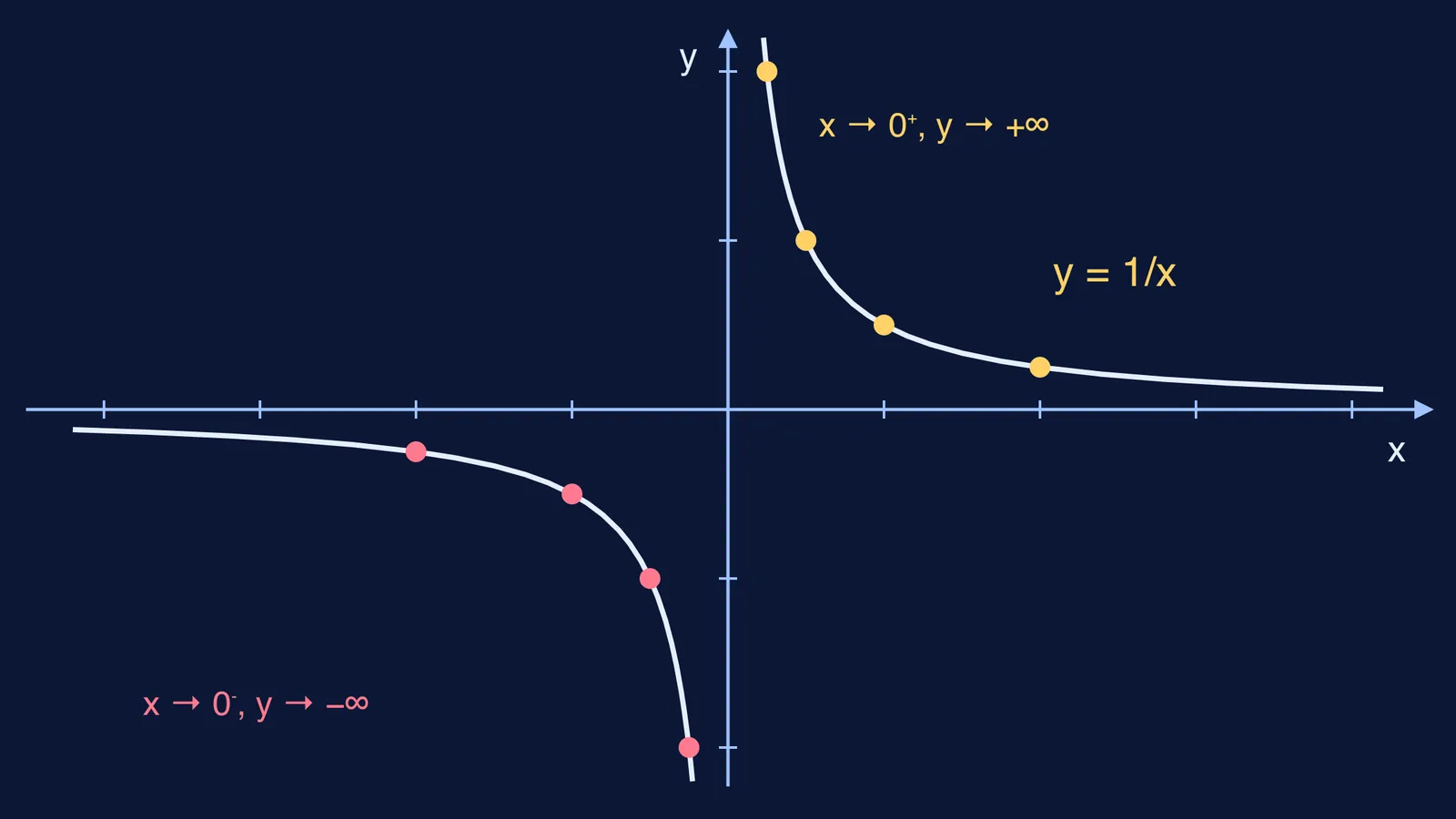
You cannot divide by zero, but a limit lets you divide by numbers close to zero and watch. Take 1/x, the graph at the top of this post: x = 0.01 gives 100, but x = −0.01 gives −100. MathWorld writes the right-hand behaviour as the limit of 1/x as x → 0⁺ being infinity. Because the two sides run off in opposite directions, no single value fits at x = 0. That is the 5/0 story drawn as a picture.
0/0 behaves differently, which is why it is called an indeterminate form. It is the first entry in Wikipedia's list of indeterminate forms. As x → 0:
x/x tends to 1
x²/x tends to 0
x/x³ grows without bound
All three look like 0/0 if you plug in x = 0, yet their limits are 1, 0 and infinity. Seeing 0/0 tells you that you need more information, not that the answer is a particular number.
How do you handle 0/0 in a limit question?
A typical Class 11 example: find the limit of (x² − 4)/(x − 2) as x → 2.
Substitute x = 2: you get (4 − 4)/(2 − 2) = 0/0. Stop. This is a signal to do more work, not an answer.
Factor the top: x² − 4 = (x − 2)(x + 2).
Cancel (x − 2). This is allowed only because x is near 2, never equal to it. You are left with x + 2.
Let x → 2: x + 2 → 4. The limit is 4.
By contrast, 1/(x − 2) as x → 2 gives 1/0 with nothing to cancel; it shoots to +∞ from one side and −∞ from the other, so the limit does not exist.
Two common slips come straight from this: writing 0/0 = 1 because "anything over itself is 1", and writing ∞ for a non-zero-over-zero limit without checking both sides. If you keep making them, the Fermi Problem Library has worked problems with a step-by-step solver that explains the reasoning rather than printing an answer. If the idea of a limit still feels shaky, the Fermi Concept Library gives each mathematics concept its own lesson and its place in the map.
How do you explain it to a younger sibling?
"Share 12 sweets among 3 friends and each gets 4. Share 12 sweets among 0 friends and the question makes no sense, because there is nobody to give them to."
"Share 0 sweets among 0 friends and any answer fits, so maths refuses to pick one."
When a calculator shows an error for 5 ÷ 0, now you know why: there is no answer to give.