On this page
Diesel does not freeze like water. It is a blend of many hydrocarbons with no single freezing point, and the first part to turn solid is a small fraction of waxy, long-chain alkanes. That wax is what stalls vehicles in a Ladakh winter, and the chemistry is the freezing-point-of-mixtures idea from the Class 12 solutions chapter.
Why does diesel turn waxy in the cold?
Diesel's straight-chain alkanes have high melting points when pure. Hexadecane (C16H34), a typical diesel-range molecule, melts at 18.18 °C, the value listed on PubChem's hexadecane record. n-Eicosane (C20H42) melts at about 310 K, or roughly 37 °C, according to the NIST Chemistry WebBook.
In warm fuel these molecules stay dissolved. As the fuel cools, it can hold less of them, and they come out as crystals. Longer straight chains generally melt higher, as our post on the even-odd effect in alkane melting points shows.
What do cloud point, CFPP and pour point mean?
Three temperatures track the trouble as diesel cools:
Cloud point: the temperature at which paraffin wax in diesel first forms a cloudy haze (Wikipedia: Cloud point).
Cold filter plugging point (CFPP): the lowest temperature at which a set volume of diesel still passes through a standard filter in a set time when cooled under set conditions (Wikipedia: Cold filter plugging point).
Pour point: the temperature below which the fuel loses its ability to flow (Drishti IAS explainer on winter diesel in Ladakh).
The gap between them matters. Additives can let a diesel with a cloud point of −7 °C reach a CFPP of −20 °C, so the fuel keeps passing the filter well after the first crystals appear (Wikipedia: Cold filter plugging point).
How is this linked to freezing points of mixtures?
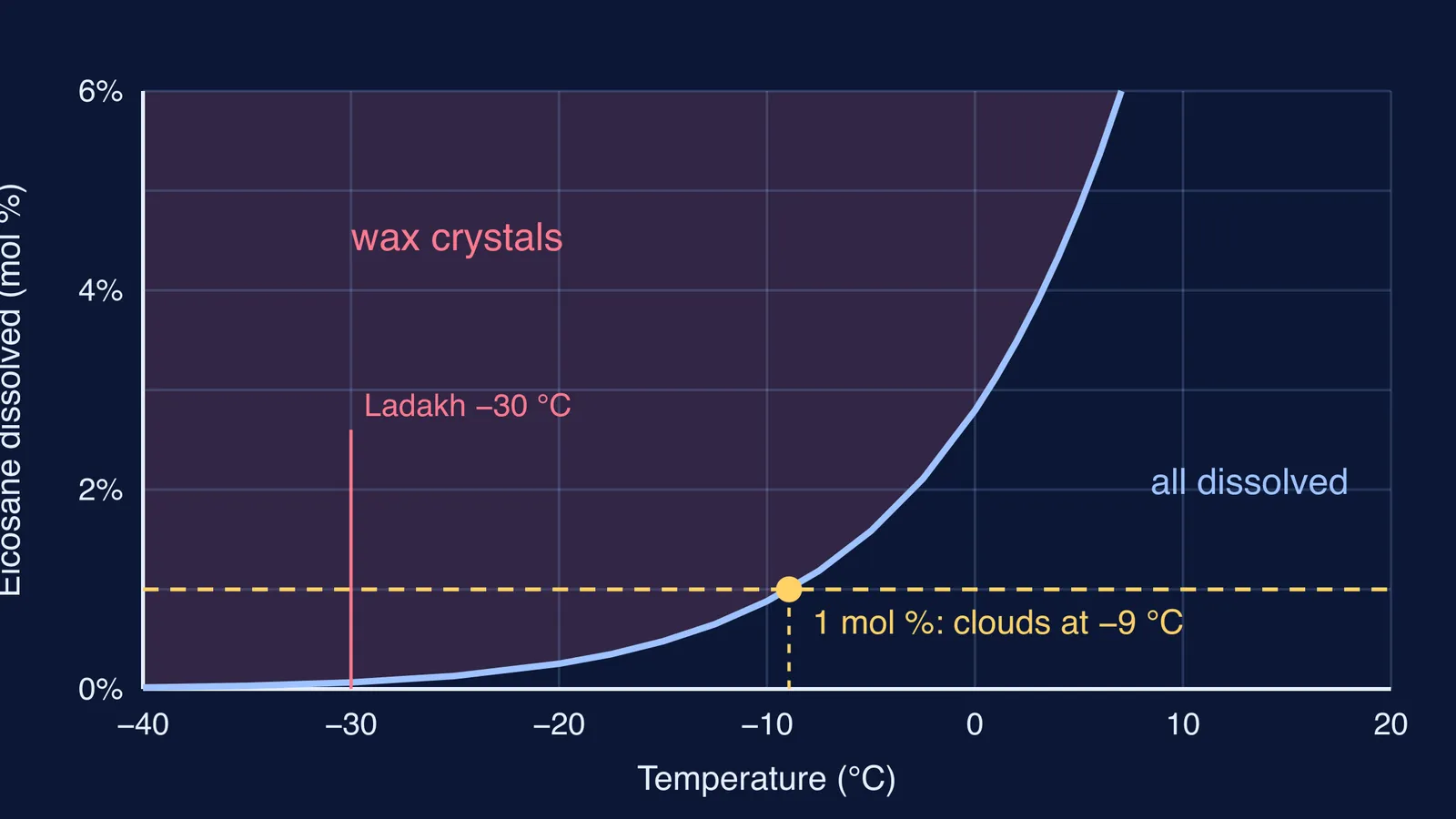
Think of the wax as a solid solute and the rest of the diesel as the solvent. For an ideal solution, the most solute that can stay dissolved at temperature T follows ln x = −(ΔfusH/R)(1/T − 1/Tm), where x is the solute's mole fraction, ΔfusH its enthalpy of fusion and Tm its melting point (LibreTexts, Ellgen, section 16.13). The same text notes that the argument mirrors the one for freezing-point depression.
In this ideal picture, the cloud point is the temperature at which the dissolved wax reaches its solubility limit, far below the pure wax's melting point because the wax is dilute. If you have practised finding molar mass from depression in freezing point, you know the idea.
Worked example: when does 1% wax start to cloud?
Take n-eicosane, with ΔfusH = 69.0 kJ/mol at 309.6 K (Barbillon and co-workers' 1991 value on the NIST Chemistry WebBook), dissolved at 1 mol% in an ideal solvent.
Write x = 0.01, so ln x = −4.605.
Rearrange: 1/T = 1/Tm − R ln x / ΔfusH.
Put in numbers: 1/309.6 = 0.003230 per K, and 8.314 × (−4.605) / 69 000 = −0.000555 per K.
So 1/T = 0.003230 + 0.000555 = 0.003785 per K, which gives T ≈ 264 K, about −9 °C.
At Ladakh's −30 °C (243.15 K) the same equation gives x ≈ 0.00066: the fuel can hold only about 0.07 mol% eicosane, roughly 40 times less than the 2.8 mol% it can hold at 0 °C. Real diesel is not an ideal solution and carries a spread of wax molecules, so treat these numbers as a picture of the trend, not a fuel specification.
If the solubility curve feels abstract, the Fermi Simulation Lab has interactive simulations for ideas that are easier to see than to read.
Why does Ladakh need winter-grade diesel?
IndianOil has said that winter temperatures in Ladakh fall to nearly −30 °C (IndianOil announcement, reproduced by Sarkaritel). Its Panipat refinery certified a winter-grade diesel on 8 November 2019 with a pour point of −33 °C, meeting the BIS specification for BS-VI diesel, for supply to its Leh and Kargil depots (same source).
The Army has gone further. In August 2026, Business Today reported an Xtreme Weather Grade diesel, developed by the Indian Army with domestic oil companies, with a pour point of −42 °C and meeting IS 1460:2025.
Refiners have two levers: the mix of hydrocarbons in the fuel, and cold-flow additives. A 2021 study of straight-run diesels found that choosing a cold-flow improver and its dose means accounting for the fuel's content of different hydrocarbon groups (Kirgina and colleagues, Oil & Gas Science and Technology). Cold matters for ignition too, as our post on why diesel engines need no spark plugs explains.
How can you check you have understood it?
Try these without notes:
Why does a mixture of alkanes have a cloud point instead of one sharp freezing point?
Using the equation above, does a heavier wax with a higher melting point make the cloud point higher or lower?
If the algebra trips you up, the Fermi Problem Library has worked problems with a step-by-step solver that explains the reasoning rather than printing an answer.