

On this page
When you look under the bonnet of a petrol car, you will find spark plugs screwed into the engine block. Their job is to fire a tiny electrical bolt to ignite the air-fuel mixture. But if you look at a diesel engine, those spark plugs are missing.
Instead, diesel engines rely entirely on the heat of compressed air. This design choice comes down to a few basic principles of thermodynamics and the chemical differences between fuels.
Why do diesel engines not need spark plugs?
The answer lies in a property called the autoignition temperature. This is the lowest temperature at which a substance will spontaneously catch fire in a normal atmosphere without any external flame or spark.
Diesel fuel has an autoignition temperature of roughly 210 °C (Wikipedia). If you can heat it past this point, it will burn all on its own. Instead of mixing the fuel and air beforehand and triggering it with a spark, a diesel engine first draws in pure air. The piston then squeezes this air into a tiny volume. The immense pressure raises the air's temperature well beyond 210 °C.
When the fuel injector finally sprays a fine mist of diesel into the cylinder, the droplets hit the scorching air and ignite immediately.
What happens during adiabatic compression?
To understand why simply squeezing air makes it so hot, we have to look at the work done by the piston.
When the piston moves up, it applies a force over a distance, doing mechanical work on the gas. This work transfers energy to the air molecules, making them move faster and raising the overall temperature. Because the compression stroke happens in a fraction of a second, there is almost no time for this new heat to escape through the metal cylinder walls.
In physics, a process where no heat is exchanged with the surroundings is called an adiabatic process. For an ideal gas undergoing adiabatic compression, the temperature and volume are linked by the relation:
T₁ × V₁^(γ−1) = T₂ × V₂^(γ−1)
Here, γ (gamma) is the heat capacity ratio. For dry air, which is mostly diatomic nitrogen and oxygen, γ is approximately 1.4 (if you are dealing with other gases, you might need to calculate the γ of a gas mixture).
How hot does the air get?
We can use the adiabatic formula to find out exactly what happens inside the cylinder.
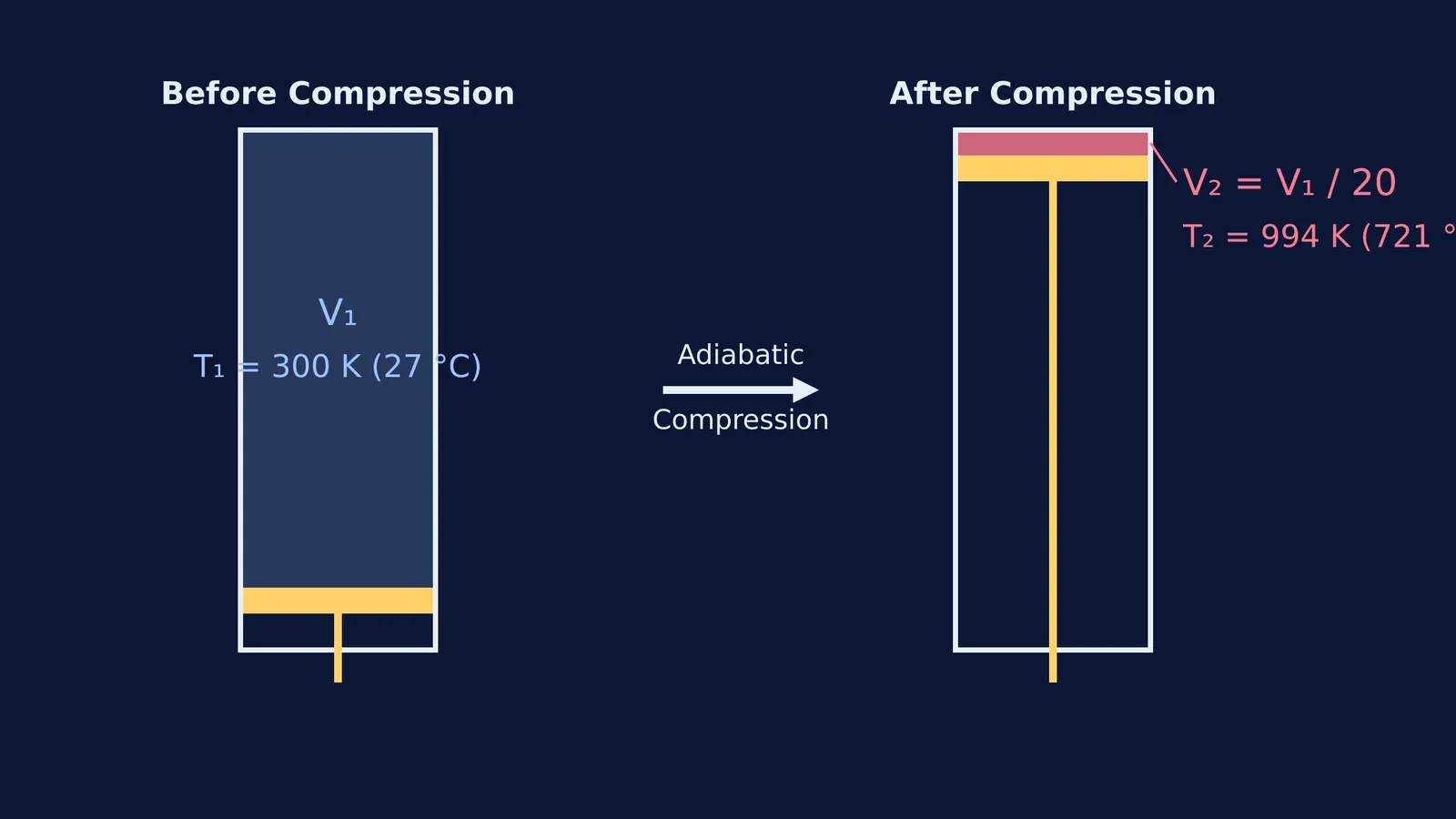
Diesel engines typically operate with a compression ratio between 15:1 and 23:1 (Wikipedia). Let us assume a compression ratio of 20:1, meaning the final volume (V₂) is one-twentieth of the initial volume (V₁).
Here is the step-by-step calculation:
Starting temperature: Assume the air enters the engine at a warm room temperature of 27 °C. In Kelvin, this is T₁ = 300 K.
Rearrange the formula: To find the final temperature, we isolate T₂ using T₂ = T₁ × (V₁ / V₂)^(γ−1).
Plug in the values: The ratio V₁ / V₂ is 20, and γ − 1 = 1.4 − 1 = 0.4, so T₂ = 300 × 20^0.4.
Calculate: 20^0.4 is roughly 3.314, giving T₂ = 300 × 3.314 = 994 K.
Convert back to Celsius: 994 K − 273 = 721 °C.
The air reaches a blistering 721 °C purely from being squeezed. This is more than three times the 210 °C required to ignite the diesel (Wikipedia).
To see this exponential temperature rise in action, you can change the compression ratio of a cylinder and watch the pressure and temperature spike in the Fermi Simulation Lab. Seeing the live readouts makes converting PV, PT and VT graphs much more intuitive.
Why not just use gasoline?
You might wonder why we don't just use this highly efficient compression method for petrol engines.
Counter-intuitively, gasoline (petrol) has a higher autoignition temperature than diesel, typically between 247 °C and 280 °C (Wikipedia). It is harder to ignite by heat alone. More importantly, petrol evaporates very quickly. In a petrol engine, the fuel and air are mixed together before they are compressed.
If you tried to compress a petrol-air mixture at a 20:1 ratio, the mixture would spontaneously ignite in unpredictable pockets before the piston reached the top of its stroke. This violent, mistimed explosion is called engine knock, and it can quickly destroy an engine. By keeping petrol compression ratios lower (around 8:1 to 12:1) (Wikipedia) and waiting for a precise spark, the engine dictates exactly when the burn begins.
A quick summary of ignition types
If you are studying for a physics or chemistry exam, keep this simple comparison in mind:
Spark-ignition (Petrol): Low compression ratio (8:1 to 12:1) (Wikipedia). Fuel and air are mixed early. The spark plug controls the timing. Limited by the risk of premature autoignition (engine knock).
Compression-ignition (Diesel): High compression ratio (15:1 to 23:1) (Wikipedia). Only air is compressed. The fuel injector controls the timing. Relies on the fuel having a low autoignition temperature (210 °C) (Wikipedia).
Understanding the relationship between volume, pressure, and temperature is not just an abstract thermodynamics problem—it is the very reason heavy-duty transport and modern infrastructure can function.


