On this page
If you have camped in the dunes near Jaisalmer, you know the surprise: a scorching afternoon, then a night when you need a blanket. Three pieces of physics explain it, and they are the same ideas that turn up in Class 11 thermal physics: radiation, specific heat and humidity.
Why are deserts hot by day and cold at night?
By day, the Sun heats the ground. After sunset the ground keeps radiating infrared, and the air above decides how much comes back.
Penn State's introductory meteorology course notes that the largest day-night temperature differences occur in desert regions such as the Sahara. The same source gives an example from El Paso, Texas, in dry desert air: daytime highs near 90°F (about 32°C) are sometimes followed by nights near 50°F (about 10°C), a drop of about 22°C by night.
Three things combine:
Radiation: every warm surface gives off infrared, day and night.
Humidity and clouds: water vapour and clouds absorb that infrared and send part of it back down. Desert air has very little of either.
Specific heat: dry sand needs little energy to change temperature, so it heats fast and cools fast.
Why does dry air let the heat escape?
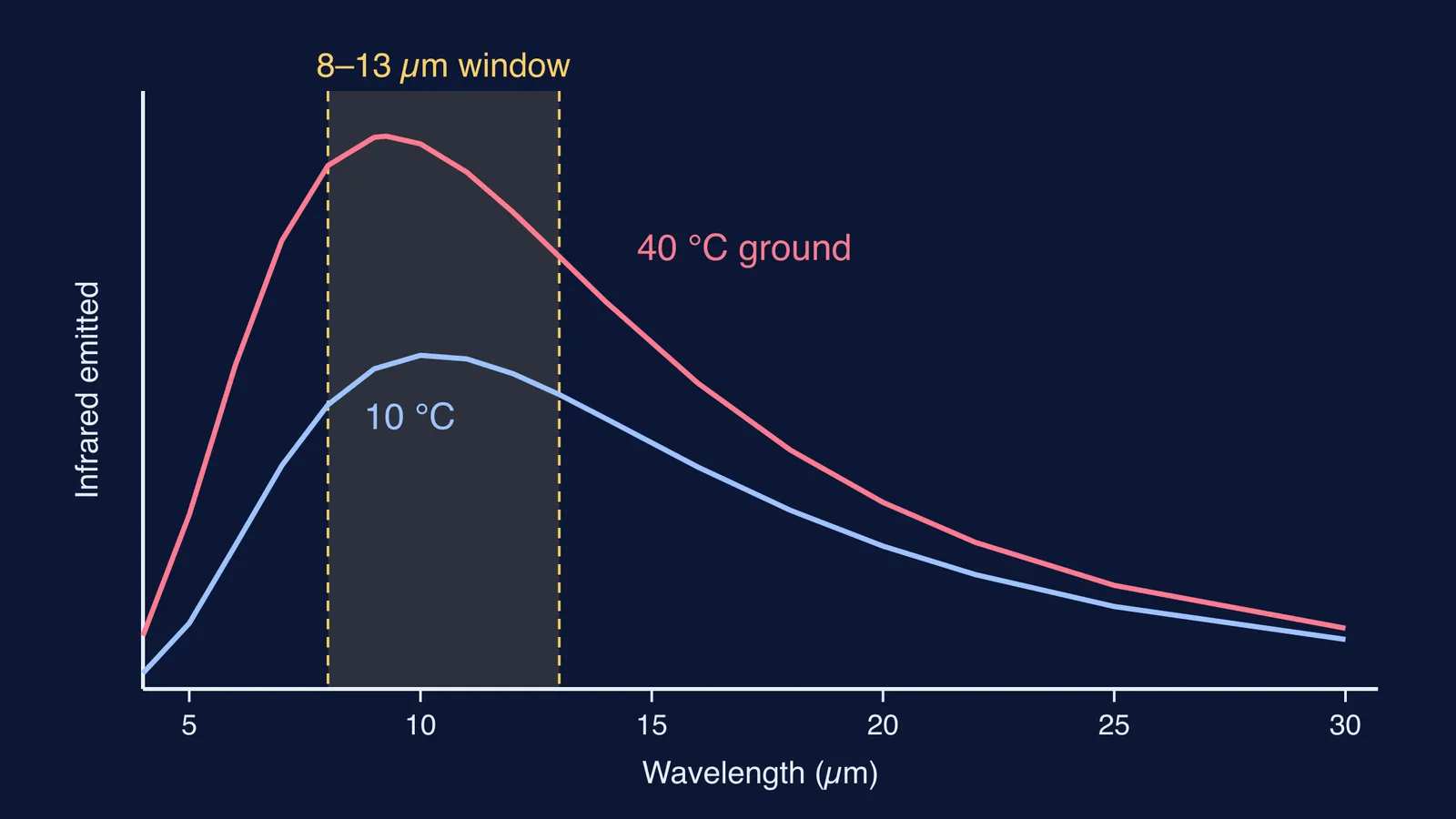
The ground at desert temperatures radiates mostly in the infrared. By Wien's law, the peak wavelength is the Wien constant, 2.898 × 10⁻³ m K (NIST), divided by the temperature. For sand at 40°C (313 K) the peak is about 9.3 micrometres; at 10°C (283 K) it is about 10.2 micrometres.
The atmosphere has a gap there. EUMETSAT describes an atmospheric window, where minimal absorption occurs, between 8 and 13 micrometres. Much of the surface's radiation in that band passes through to space.
Outside the window, water vapour is the main absorber. NASA calls water vapour Earth's most abundant greenhouse gas, responsible for about half of Earth's greenhouse effect. Humid air absorbs the ground's infrared and radiates part of it back down, so the ground cools slowly.
Penn State's course puts it simply: on humid nights water vapour emits infrared to the ground and slows its cooling, and clouds act like space heaters. Desert skies are usually clear and dry, so little comes back.
The US National Weather Service adds that clear skies allow for the maximum release of longwave radiation to space. This is also why dew and frost form on clear nights; our post on why dew forms on grass on clear nights follows the same chain of cause and effect.
Why does sand heat up and cool down so fast?
Specific heat is the energy needed to raise 1 kg of a material by 1°C. The Engineering ToolBox table lists quartz sand at 830 J/kg°C and liquid water at 4182 J/kg°C, so water needs about five times as much energy per kilogram for the same temperature change.
So the same sunshine warms sand much more than a lake, and sand has less heat to give up at night. Near the sea, water smooths out the swing, the same contrast behind why sea breeze blows towards land during the day. If you mix up "specific heat" and "heat capacity", read specific heat vs heat capacity first.
How much heat does desert ground lose after sunset?
Here is a worked example you can do in your notebook.
Step 1: how much the ground radiates. The Stefan-Boltzmann law says a black surface radiates σT⁴ per square metre, where σ = 5.670 × 10⁻⁸ W m⁻² K⁻⁴ (NIST). Treating sand as close to a black body in the infrared:
At 40°C (313 K): σ × 313⁴ ≈ 544 W per square metre.
At 10°C (283 K): σ × 283⁴ ≈ 364 W per square metre.
Whether the ground cools depends on how much of this the sky sends back.
Step 2: why sand responds so strongly. Take 1 kg of each and let it lose 8,300 J, using the specific heats above:
Sand: 8,300 ÷ 830 = 10°C drop.
Water: 8,300 ÷ 4182 ≈ 2°C drop.
Step 3: put it together. Same heat loss, five times the temperature change, and dry air returns little energy. That is a cold desert night.
How do you explain it in a board or JEE answer?
Use this checklist:
The Sun warms the ground by day.
The ground radiates infrared at night.
Water vapour and clouds absorb and re-emit infrared; desert air has little of both.
Sand's low specific heat makes its temperature swing widely.
Contrast with a coastal city, where water moderates temperature.
Radiation and heat flow are easier to see than to read, which is what the interactive simulations in the Fermi Simulation Lab are for. If Wien's law or the Stefan-Boltzmann law is still shaky, the Fermi Concept Library gives each concept its own lesson.
Next time someone asks why the desert gets cold, start with the ground's infrared, then add dry air and sand.