

On this page
Why does sea breeze blow towards land during the day?
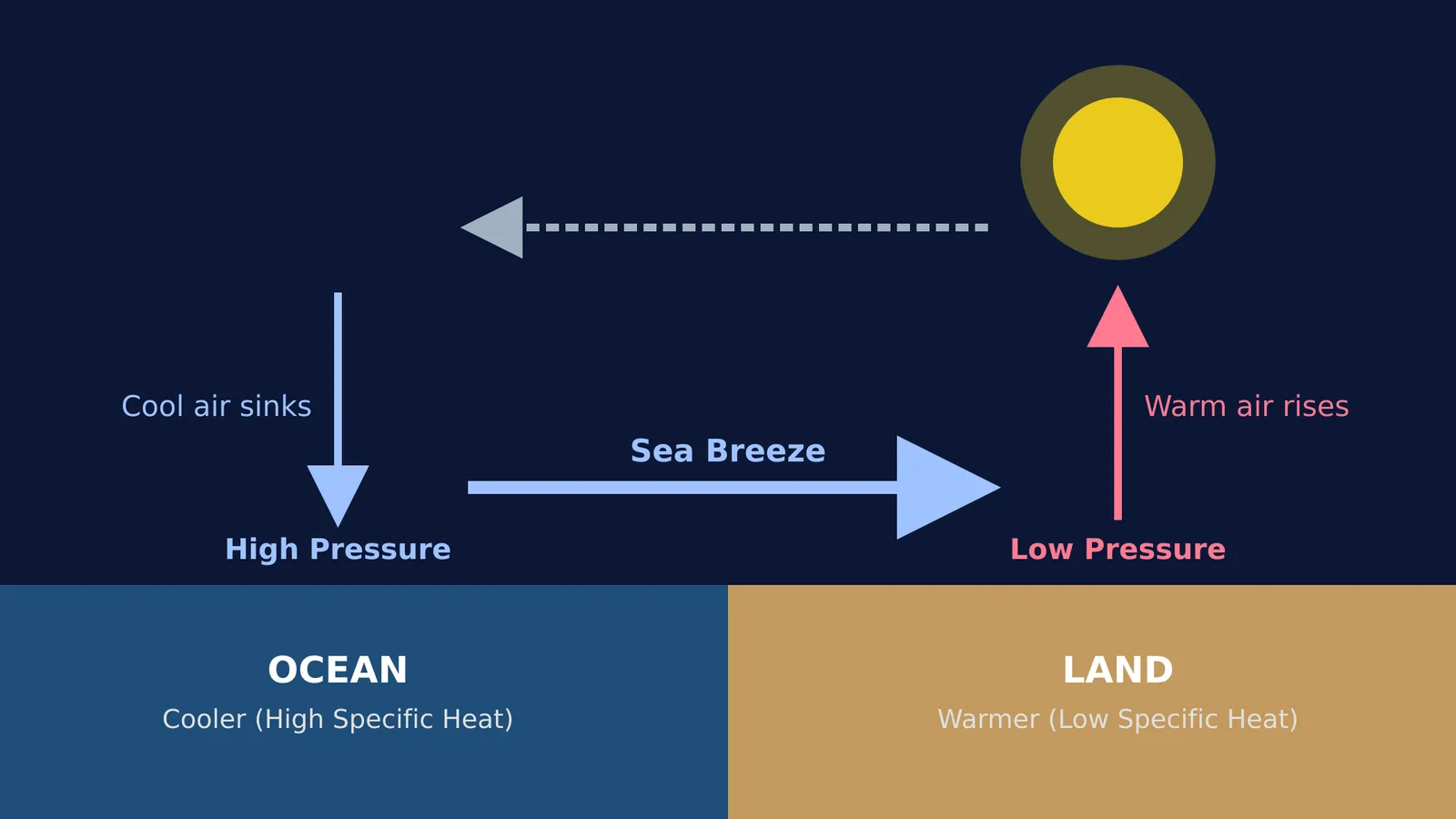
If you have ever visited a beach on a sunny afternoon, you know that a cool breeze almost always blows in from the water. This daytime wind is called a sea breeze. It happens because the sun's radiation heats the land much faster than it heats the ocean water.
As the land gets hot, it warms the air directly above it. Warmer air expands, becomes less dense, and rises. This upward movement creates an area of lower air pressure over the land. Meanwhile, the air over the cooler ocean remains denser and creates an area of higher pressure. Because air naturally moves from high pressure to low pressure, the cooler air from the sea flows inland to replace the rising warm air.
This continuous loop of rising warm air and sinking cool air is a form of atmospheric convection. Atmospheric convection is the vertical transport of heat in the atmosphere, occurring when warmer, less dense air rises while cooler, denser air sinks.
How does specific heat capacity cause a sea breeze?
The fundamental reason the land heats up faster than the water lies in a property called specific heat capacity. The specific heat capacity of a substance is the amount of heat energy required to raise the temperature of one kilogram of that substance by one Kelvin (or one degree Celsius).
Water has one of the highest specific heat capacities of any common substance at 4184 J/(kg·K). In contrast, the specific heat capacity of granite (a common rock in the Earth's crust) is only about 790 J/(kg·K). This means it takes more than five times as much heat energy to warm up a kilogram of water by one degree as it does a kilogram of rock or soil.
Because the ocean absorbs the sun's energy slowly and distributes it deep into the water, its surface temperature barely changes during the day. The land, however, absorbs the heat quickly at its surface, causing its temperature to spike. If you want to understand this difference better, read Why Sand Heats Faster Than Water: Specific Heat Explained and explore Why coastal areas have moderate climates: water's specific heat.
What is the role of convection in a sea breeze?
Convection is the mechanism that turns the temperature difference between land and water into a noticeable wind. When the sun heats the land, the air in contact with the ground warms up through conduction. This heated air becomes buoyant and rises, leaving a gap of low pressure below.
Higher up in the atmosphere, this warm air eventually cools, becomes denser, and moves outward over the ocean where it sinks back down, adding to the high pressure at the sea surface. The surface wind—the sea breeze—is the bottom leg of this large convection cell. To visualise how these currents loop, check out How convection currents form: heat a tank from one corner.
For students trying to picture this invisible process, the Fermi Simulation Lab provides interactive simulations for the ideas that are easier to see than to read. You can watch how temperature changes drive the air, while the AI tutor teaches and explains the reasoning.
What happens to the sea breeze at night?
Once the sun sets, the process reverses. The land loses its heat rapidly because of its low specific heat capacity, while the ocean holds onto the massive amount of thermal energy it absorbed during the day. This leads to a new sequence of events:
The land cools down much faster than the ocean.
The water becomes warmer than the adjacent land.
The air above the ocean becomes less dense and rises, creating low pressure.
The cooler, denser air over the land flows out towards the ocean, creating a land breeze.


