

On this page
Why do coastal areas have moderate climates compared to inland cities?
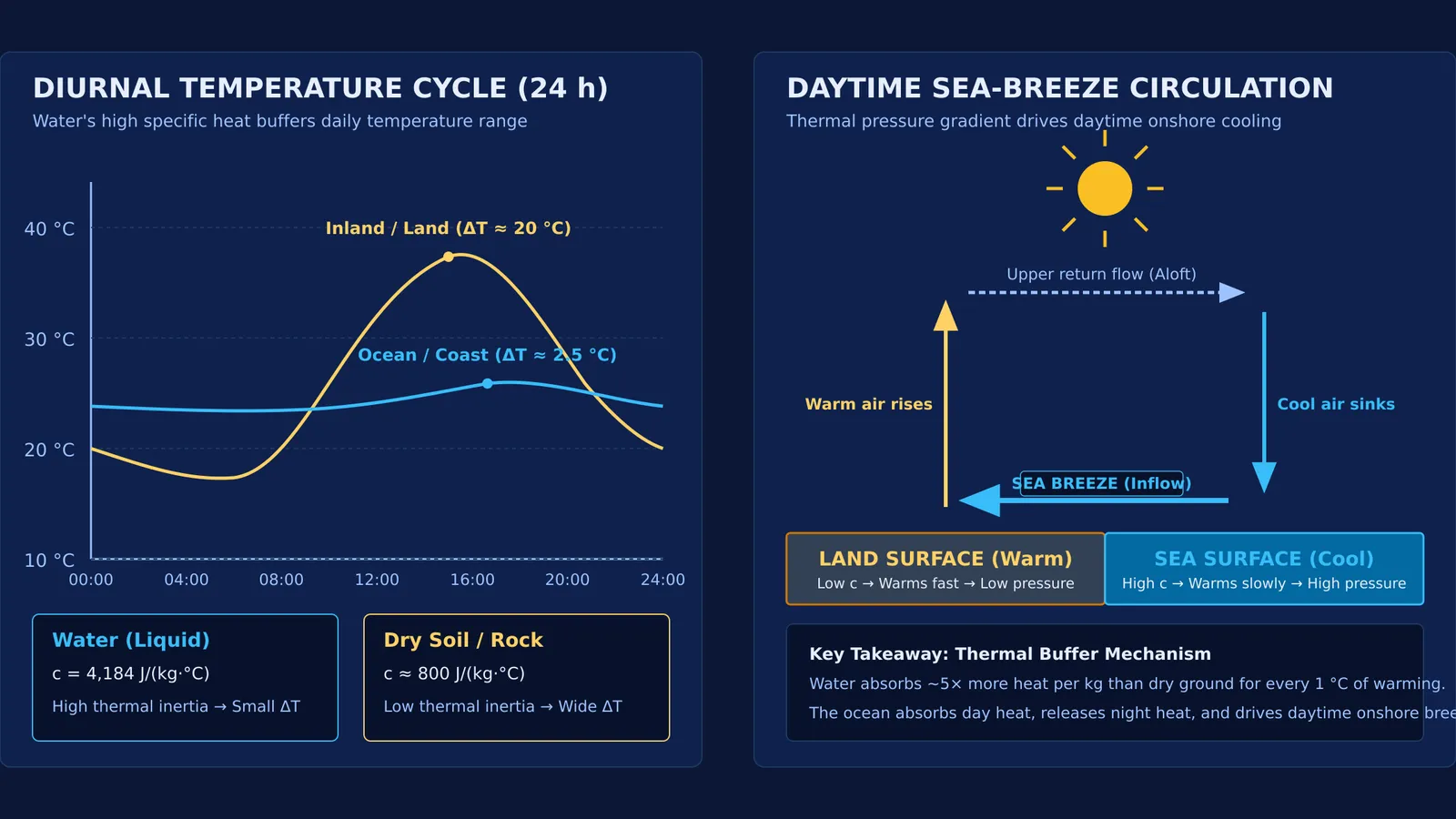
The world's oceans cover 71 percent of Earth's surface, according to the NOAA National Ocean Service, acting as an immense thermal buffer that regulates regional climate. This planetary buffer creates a striking contrast between coastal and inland cities, such as Mumbai on the western coast of India and Delhi in the northern interior. Coastal cities enjoy an equable maritime climate where the diurnal temperature range—the swing between afternoon peak heat and pre-dawn chill—rarely exceeds 5 °C to 8 °C. By contrast, landlocked continental cities experience harsh seasonal swings, where daily temperatures routinely fluctuate by 15 °C to 20 °C across a single 24-hour cycle.
This thermal stability is a direct consequence of thermal physics. Liquid water absorbs massive amounts of incoming solar radiation with only minimal changes in its own temperature. To understand why shorelines stay temperate, we look to the physical property governing thermal storage: specific heat capacity. For students learning thermal physics, this is the macroscopic manifestation of convection currents and heat transfer mechanisms.
How does water's high specific heat capacity buffer temperature?
According to data compiled by the U.S. Geological Survey, specific heat capacity measures the heat energy required to raise the temperature of one kilogram of a substance by one degree Celsius (or one Kelvin). The governing heat equation is:
Q = m · c · ΔT
Rearranging for temperature change yields ΔT = Q / (m · c). This inverse relationship means that for a given amount of absorbed heat Q, a substance with a high specific heat capacity experiences a far smaller temperature rise.
Liquid water is an exceptional thermal reservoir. Data published by the USGS establishes that water has a specific heat capacity of 4,184 J/(kg·°C). In contrast, dry soil, sand, and silicate rocks have specific heat capacities near 800 J/(kg·°C), while copper requires just 385 J/(kg·°C). Liquid water requires over five times as much thermal energy as dry earth to achieve the same temperature rise.
The molecular cause lies in hydrogen bonding. When heat enters liquid water, much of that energy is consumed in breaking and flexing intermolecular hydrogen bonds before increasing molecular kinetic energy. In dry minerals, heat immediately accelerates lattice vibrations, causing surface temperatures to spike. The distinction between temperature and internal thermal storage dates back to Joseph Black's pioneering work on specific and latent heat.
If you are exploring how heat capacity connects with other thermodynamic properties, the Fermi Concept Library covers every concept in physics, chemistry, biology, mathematics and computing, each with its own lesson and its place in the map.
How do land and sea breezes regulate coastal daily temperatures?
The difference in specific heat capacity between land and sea creates a natural convective engine that drives coastal wind patterns across the diurnal cycle. Observational research published in *Atmospheric and Oceanic Science Letters* on land-sea breeze circulation demonstrates how this mesoscale circulation is driven by the daily thermal contrast between land and sea surfaces:
Daytime sea breeze: As the Sun heats a coastline, dry ground warms rapidly due to its low specific heat capacity. The air over the land expands, becomes less dense, and rises, creating a localized drop in surface pressure. The ocean warms sluggishly, keeping marine air cooler, denser, and at higher pressure. This pressure gradient pushes a cool wind inland—the sea breeze—capping afternoon coastal temperatures.
Nighttime land breeze: After sunset, the land radiates heat into space rapidly because its low heat capacity holds relatively little thermal energy. The ocean cools far more slowly and remains warmer than the adjacent land. Warm air rises over the water, drawing a gentle offshore flow from land to sea that prevents coastal nights from dropping to freezing lows.
How do you calculate the temperature change from heat capacity?
To see the physics quantitatively, we apply the calorimetric relation ΔT = Q / (m · c). While climate modeling published in the *Journal of Climate* on the land-ocean warming contrast by Byrne and O'Gorman demonstrates that long-term equilibrium warming is constrained by atmospheric lapse rates and moisture availability, the short-term diurnal damping along coasts is governed by this direct heat capacity disparity. Consider equal 1,000 kg masses of coastal water and dry granite rock, each receiving a net solar heat flux of 1.0 × 10⁷ J (10 megajoules) on a sunny morning:
Water: ΔT_water = (1.0 × 10⁷ J) / (1,000 kg × 4,184 J/(kg·°C)) = 10,000,000 / 4,184,000 ≈ 2.39 °C
Granite rock: Using c_granite = 790 J/(kg·°C), ΔT_granite = (1.0 × 10⁷ J) / (1,000 kg × 790 J/(kg·°C)) = 10,000,000 / 790,000 ≈ 12.66 °C
The identical energy input causes dry rock to warm by over 12.6 °C, while water warms by less than 2.4 °C—a more than fivefold difference. Sunlight also penetrates several metres into translucent water with fluid mixing, whereas on land it is trapped in the top few millimetres of opaque soil.
When tackling calorimetry numericals, verify your units (1 cal/(g·°C) = 4,184 J/(kg·K)), distinguish intensive specific heat c from extensive heat capacity C = m · c, and note that a temperature change of 1 °C equals 1 K. For practice with thermal equilibrium, work through our guide to calorimetry and heat transfer. When working through problems where students get tangled in sign conventions, the Fermi Problem Library provides worked problems with a step-by-step solver that explains the reasoning rather than printing an answer.


