

On this page
Have you ever walked across a lawn early in the morning and found your shoes soaked, even though it hasn't rained for days? The drops on the grass are dew, and they are the result of a physical process called radiative cooling.
Understanding why dew forms — and why it prefers clear, still nights over cloudy ones — is an excellent way to see thermodynamics in action outside the classroom.
Why does dew form on clear nights?
Everything around us absorbs and emits heat. During the day, the ground and the grass absorb solar radiation, warming up. But at night, they radiate that energy back as infrared light.
This process is called radiative cooling. The heat escapes directly into outer space, which acts as a massive thermal sink sitting at approximately −270.15 °C. Because grass has a high surface area and is largely insulated from the warmer soil below, it loses heat much faster than the air above it.
What is the dew point?
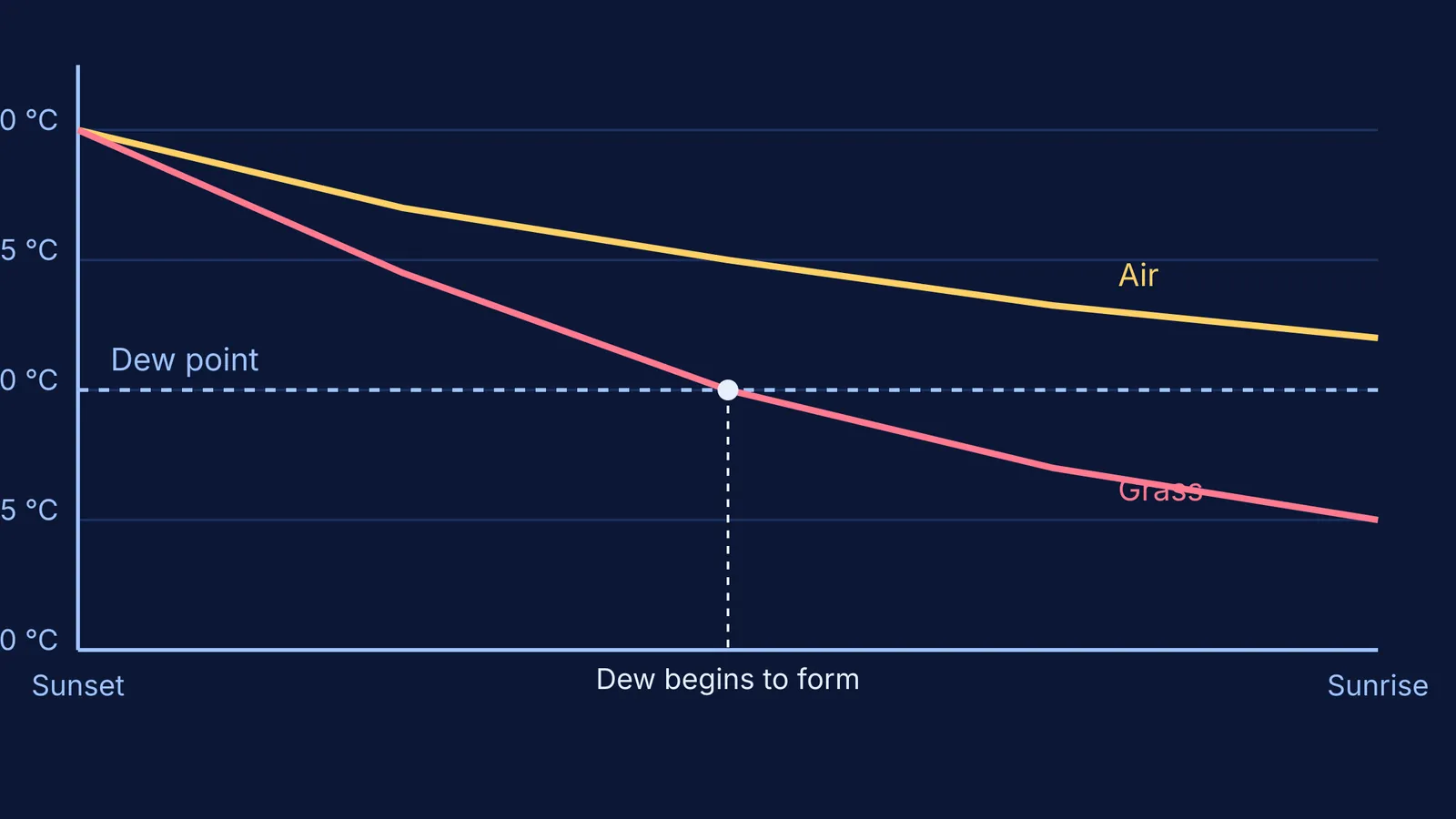
As the grass cools, it also cools the thin layer of air immediately touching its surface. Cold air cannot hold as much water vapour as warm air.
The dew point is the temperature at which water vapour condenses into liquid at the exact same rate it evaporates. When the air temperature matches the dew point, relative humidity reaches 100%. A helpful rule is that for every 1 °C difference between the air temperature and the dew point, relative humidity drops by about 5%.
Because the grass cools faster than the bulk of the air, the grass blade reaches the dew point first. The water vapour in the saturated air right next to the blade condenses into liquid droplets. This can deposit a surprising amount of water; on an optimal night, dew amounts can reach a theoretical maximum of 0.8 mm.
If you find it hard to picture heat transfer and phase changes, the Fermi Simulation Lab has interactive simulations for the ideas that are easier to see than to read.
Why do cloudy nights prevent dew?
For the grass to reach the dew point, the heat must be able to escape. The Earth's atmosphere has an "infrared window" between 8 and 13 μm that lets thermal radiation pass straight through to space.
However, water droplets in clouds are opaque to this infrared radiation. If the night is cloudy, the clouds absorb the heat radiating from the ground and emit it back downwards. This creates a blanket effect that prevents the grass from cooling down to the dew point. As a result, the grass stays dry.
Similarly, a strong wind will mix the cold air near the ground with the warmer air above it. For a heavy dew, you need still air to let the thermal gradient set in.
If you are calculating the variables of heat loss for JEE Main or NEET-UG, you might need to relate temperature changes to the properties of the air. You can explore worked examples on heat in isobaric and isochoric processes and the free expansion of an ideal gas in the Fermi News library.
A checklist for predicting morning dew
If you want to know whether to expect wet grass tomorrow morning, look for these three signs before you go to sleep:
Clear skies: No clouds to trap the outgoing infrared radiation.
High humidity: A higher starting humidity means the dew point is closer to the current temperature.
Still air: A lack of wind ensures the cold air remains undisturbed at the surface.
When you run into questions on thermodynamics, Fermi's AI tutor works out what you already know and builds a plan for the session, teaching through it by writing on a board and drawing the figures as it goes.


