On this page
On a dry May afternoon, a desert cooler can make a room feel properly fresh. Run the same cooler in July, when the monsoon air is sticky, and it mostly pushes warm, damp air around. The machine hasn't broken; the air going into it has changed.
How does a desert cooler cool the air?
A cooler uses a fan to pull outside air through wet pads. Some of the water evaporates, and evaporation needs energy. The molecules that escape from the liquid take heat from the air around them. The US Geological Survey puts it this way: because energy is needed to break the bonds holding water molecules together, evaporation "removes heat from the environment, leading to a net cooling".
That energy is called the latent heat of vaporisation. Evaporating water at 20 °C takes about 2.45 kJ for every gram. So a cooler that evaporates 1 kg of water in an hour removes roughly 2,450 kJ ÷ 3,600 s ≈ 680 W of heat from the air passing through it.
A review of evaporative cooling technologies by Amer, Boukhanouf and Ibrahim (2015) describes a direct cooler as turning sensible heat into latent heat: the air's temperature falls while its humidity rises. A USGS figure caption says that where humidity is low and temperatures are hot, such a cooler can lower air temperature by 20 °F (about 11 °C), "while it increases humidity". A clay matka keeps drinking water cool the same way.
Why do air coolers not work well in humid weather?
Evaporation slows down when the air already holds a lot of water vapour. Relative humidity tells you how close the air is to holding as much vapour as it can at its temperature (here's what the humidity figure on a weather app really means). Once the air is saturated, net evaporation stops.
For a cooler, the number that matters is the wet-bulb temperature. That's the temperature a thermometer wrapped in a wet cloth settles at when air blows over it. According to Amer et al. (2015), a direct evaporative cooler cannot cool incoming air below its wet-bulb temperature, and most commercial coolers get 70-95% of the way from the air temperature down to it. The same review calls the gap between dry-bulb and wet-bulb temperatures the driving force of evaporative cooling, and notes that in humid climates this gap is small.
How much cooling do you lose on a humid day?
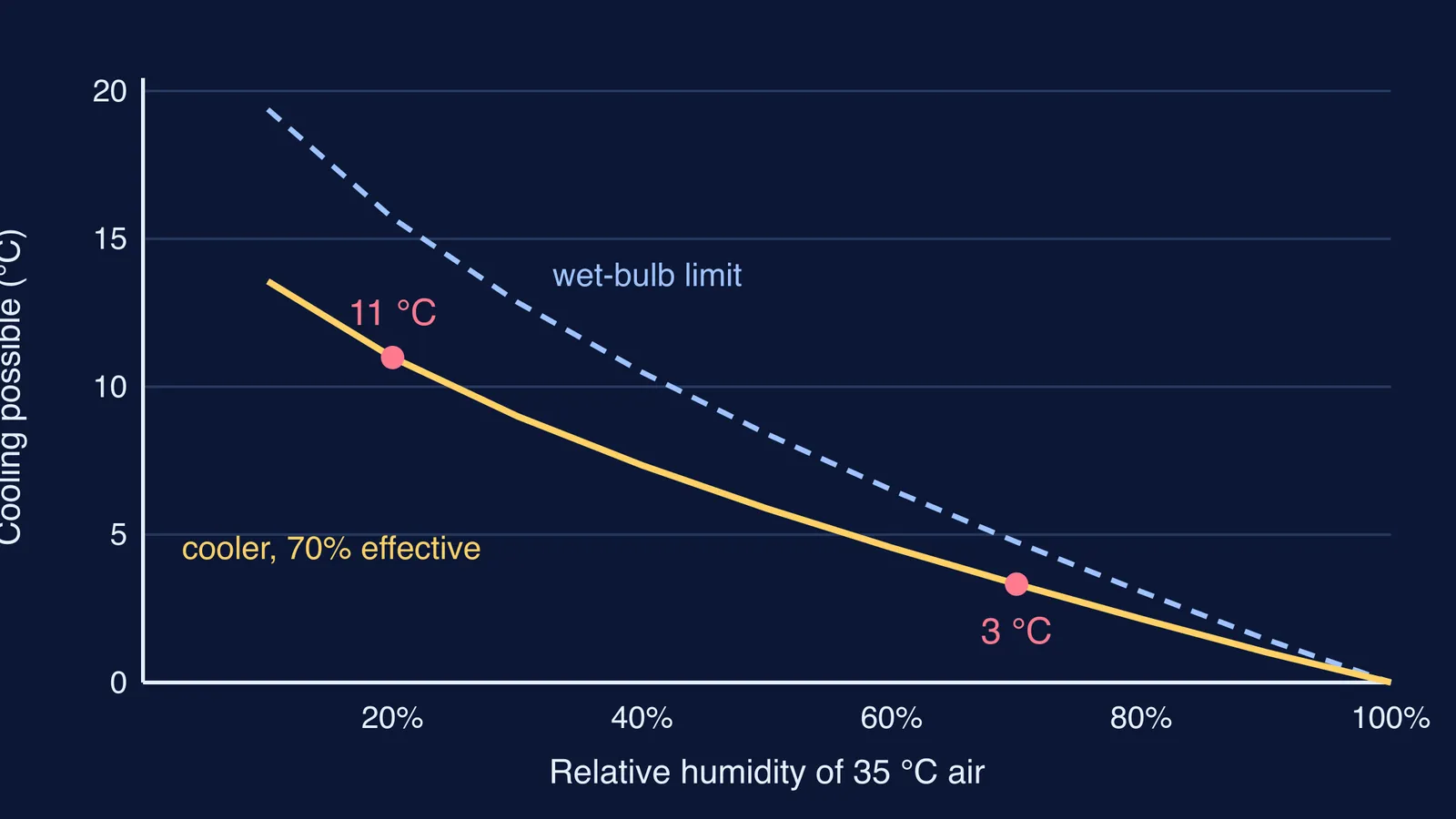
We used Roland Stull's formula for wet-bulb temperature from air temperature and relative humidity, which has a mean absolute error of less than 0.3 °C over its valid range. We assumed the cooler is 70% effective, the low end of the range in Amer et al.'s review.
Dry pre-monsoon afternoon: 35 °C air at 20% humidity. The wet-bulb temperature is about 19.3 °C, so the gap is 15.7 °C. A cooler that is 70% effective removes 0.7 × 15.7 ≈ 11 °C, and air leaves the pads at about 24 °C.
Humid monsoon afternoon: 35 °C air at 70% humidity. The wet-bulb temperature is about 30.3 °C, so the gap is only 4.7 °C. The same cooler removes about 3.3 °C, and air leaves at about 31.7 °C, damper than before.
Same machine, same air temperature, less than a third of the cooling. On the humid day the air coming out is also nearly saturated, so sweat evaporates slowly and the room feels clammy.
What should you do with a cooler on a humid day?
A quick checklist, based on the worked example and Stull's formula:
Check the humidity on your weather app. At 35 °C and 70% humidity, expect only about 3 °C of cooling from a typical cooler.
Keep a door or window open. The cooler adds water vapour to the room; if it can't escape, room humidity climbs and the gap shrinks further.
When it's muggy, try the fan with the water pump off. Moving air still helps sweat evaporate without adding more vapour.
Keep the pads clean and evenly wet in the hot, dry months, when the cooler has the biggest gap to use.
How can you measure the wet-bulb gap at home?
Make a wet-and-dry-bulb thermometer from two cheap thermometers. Wrap one bulb in cotton soaked in room-temperature water, then fan both for a few minutes. The dry one shows the air temperature; the wet one drops towards the wet-bulb temperature. Try it on a dry afternoon and again on a sticky one. The difference between the readings is roughly the most cooling any desert cooler could give you that day.
To see why escaping molecules take heat with them, our post on watching evaporative cooling in a simulation walks through it. The Fermi Simulation Lab has interactive simulations for ideas that are easier to see than to read. For humidity, vapour pressure and latent heat, the Fermi Concept Library gives each concept in physics and chemistry its own lesson.
Next time your cooler seems weak, check the humidity before you check the pump.