

On this page
During the peak of the Indian summer, many households rely on an earthen clay pot—a matka or surahi—to keep their drinking water refreshingly cold without electricity. While this might look like a rustic tradition, the mechanism behind it relies on the exact same physical principles that govern industrial cooling towers and the human body's ability to sweat.
How does a clay pot matka keep water cool?
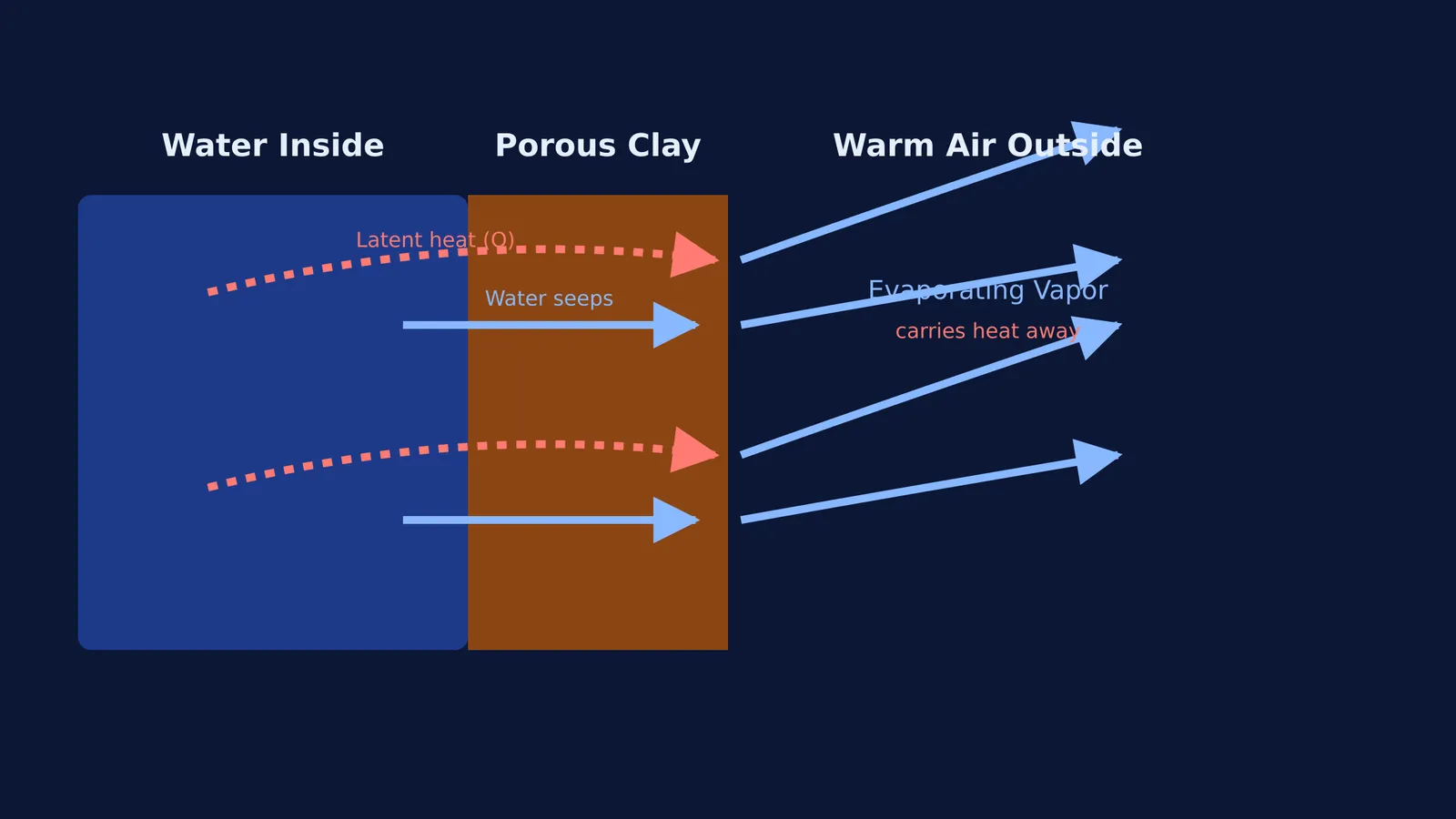
The cooling effect of a matka is driven entirely by evaporation. Unlike metal or plastic containers, earthen pots are naturally porous. At a microscopic level, the fired clay contains thousands of tiny interconnected capillary channels.
Water stored inside the pot slowly seeps through these microscopic pores to the outer surface. Once this water reaches the outside, it is exposed to the surrounding warm and dry air, causing it to evaporate. To change from a liquid to a gas, the water molecules must absorb a significant amount of thermal energy. Because the water on the outer surface is in direct contact with the clay pot, it draws this required heat energy directly from the pot walls and the remaining water inside. As the heat is carried away by the vapour, the temperature of the stored water steadily drops.
Why is latent heat important for cooling?
The energy required to turn liquid water into a gas without changing its temperature is known as the latent heat of vaporisation. This value is exceptionally high because strong hydrogen bonds hold liquid water molecules together.
According to OpenStax *University Physics Volume 2*, evaporating one kilogram of water at its boiling point requires 2256 kJ of energy. At room temperature, this requirement is even higher. Every drop of water that evaporates from the matka carries away a massive amount of thermal energy. This continuous extraction of latent heat is what makes earthen pots so effective. Research confirms this efficiency: a 2016 study on indirect evaporative cooling using clay pots found that the process can achieve a cooling effectiveness of up to 57% at low air velocities.
To visualise how energy flows during these phase changes—ideas that are easier to see than to read—you can explore the interactive simulations in the Fermi Simulation Lab. You can also review how these state changes are taught in schools in our guide on Matter in our surroundings: states, evaporation and latent heat.
Does the surrounding air affect how cold the water gets?
While the matka's porosity provides the mechanism, the external environment controls the rate of cooling. Two major factors decide how cold the water will get: temperature and humidity.
Humidity: Evaporation is fastest when the surrounding air is dry. If the air is already saturated with water vapour—such as during the monsoon season—evaporation slows down significantly, and the matka cannot cool the water as effectively.
Airflow: A constant breeze sweeps away the water vapour that forms around the pot, maintaining a concentration gradient that encourages further evaporation.
The fundamental math behind this heat transfer is the same whether you are cooling water in a clay pot or mixing hot and cold liquids in a laboratory experiment. If you are preparing for physics exams, mastering these energy exchange calculations is essential. You can practice solving these energy balance problems in our detailed breakdown of Calorimetry and heat transfer: mixing, melting and conduction.
Checklist for maximum cooling
If you want to get the coldest water possible out of your earthen pot, follow these practical steps:
Wash before first use: Soak the new matka in water for a few hours and scrub it gently to clear the clay pores of fired dust.
Choose a breezy spot: Place the pot near a window or under a fan. Moving air sweeps away the evaporated water, maintaining a high evaporation rate.
Keep it in the shade: Direct sunlight will add more thermal energy to the water than evaporation can take away.
Use a damp cloth: Wrapping the matka in a wet cloth increases the surface area available for evaporation, boosting the cooling power.
By understanding how latent heat works, you can see how a simple clay pot engineers a continuous heat extraction system out of nothing but mud, water, and dry air.


