

On this page
When you check your weather app before heading out, a reading of 80% humidity can sound like you are walking into a swamp. Yet on a cold winter morning, that same 80% reading might feel perfectly dry, as explained by the US National Weather Service.
To understand why the same number creates two entirely different experiences, we have to look at the physics of gases and what the percentage actually measures.
What does 80 percent humidity mean on a weather app?
Most weather apps display relative humidity rather than absolute humidity. According to the US National Weather Service, relative humidity is a percentage that compares the water vapour currently in the air to the maximum amount the air could hold at that specific temperature.
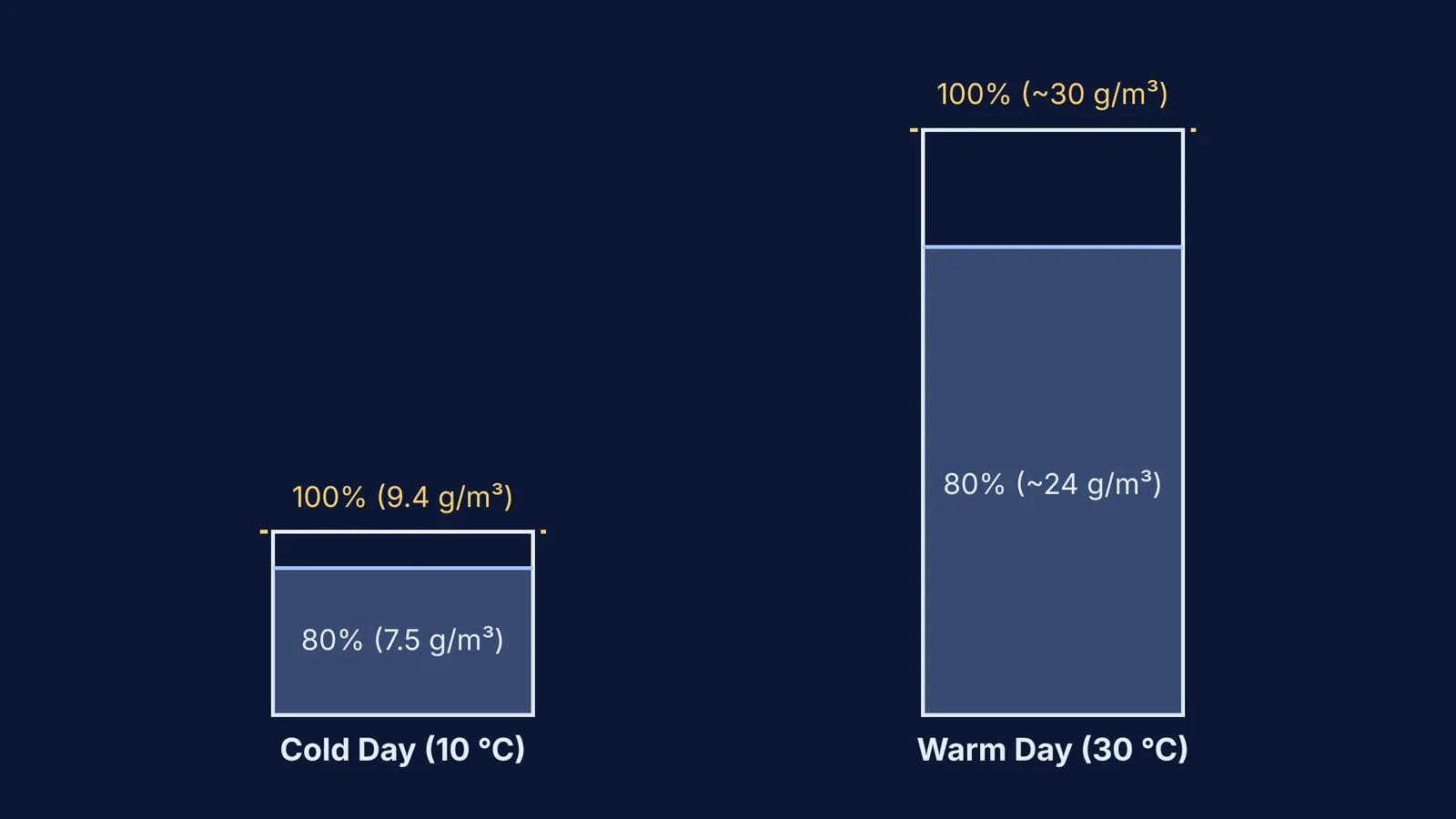
An 80 percent reading means the air is holding 80% of its total capacity for moisture. The confusion arises because this capacity is not a fixed number. Think of the air as a bucket that expands as it warms up and shrinks as it cools down. If the temperature rises during the day, the relative humidity percentage will drop because the "bucket" got bigger, even though the actual amount of water in the air did not change.
Why does 80 percent humidity feel different on different days?
Because warm air has a significantly higher capacity for water vapour, an 80% full bucket at 30 °C contains vastly more water than an 80% full bucket at 10 °C, according to the US National Weather Service.
To put numbers to it, the National Weather Service notes that a cubic metre of air in the middle 80s Fahrenheit (around 30 °C) can hold about 30 grams of water vapour. This means that 80% relative humidity on a hot summer day puts about 24 grams of water into every cubic metre of air around you. The same 80% reading on a cold day means there is significantly less water present, because the overall capacity of the cooler air is a fraction of what it would be in summer.
When preparing for physics exams, understanding the average molar mass of a gas mixture when water vapour is added helps explain why moist air behaves differently than dry air. Similarly, exploring heat in isobaric and isochoric processes builds a solid foundation for mastering these thermodynamic concepts.
How does humidity affect evaporation and sweat?
Your body cools itself down by sweating and allowing that moisture to evaporate into the surrounding air. The US National Weather Service explains that when humidity is high, this evaporation process slows down because the air is already close to being saturated.
At 80% relative humidity on a hot day, the air has very little room left to absorb your sweat. Your body's natural cooling system becomes inefficient, which is why 30 °C with high humidity feels much hotter and more oppressive than 30 °C in a dry climate. If you find it hard to picture how temperature, capacity and evaporation rates interact, the Fermi Simulation Lab provides interactive simulations for the ideas that are easier to see than to read.
What does 100 percent humidity mean?
When the relative humidity reaches 100%, the air has reached its maximum capacity and becomes completely saturated, per the US National Weather Service. At this point, the bucket is entirely full. Any additional moisture, or any drop in temperature, will force water vapour to condense back into liquid water.
In the real world, this is when you see dew forming on the grass in the early morning, or fog settling into a valley as the night air cools down. A reading of 100% relative humidity does not automatically mean it is raining—rain requires complex cloud physics and rising air currents higher in the atmosphere to pull that moisture upward—but it does mean that water will condense onto cooler surfaces. This continuous condensation is exactly why the outside of a cold drink sweats heavily on a humid summer afternoon.
How should you use this to read your weather app?
Instead of taking the humidity percentage at face value, you can build a clearer picture of the day ahead by checking three numbers in order:
Check the temperature first: This sets the size of the "bucket". High temperatures mean the air can hold a massive amount of water.
Check the relative humidity: This tells you how close the air is to its limit. High humidity at a high temperature means the air is packed with water and your sweat will not evaporate easily.
Check the dew point: This is the temperature at which the air would become 100% saturated. As a rule of thumb, a dew point below 12 °C (55 °F) feels dry and comfortable, while anything above 18 °C (65 °F) will feel sticky and oppressive, according to the US National Weather Service.
If you are studying these principles for a test and struggling to apply them to numericals, the Fermi Problem Library has worked problems with a step-by-step solver that explains the reasoning rather than printing an answer.


